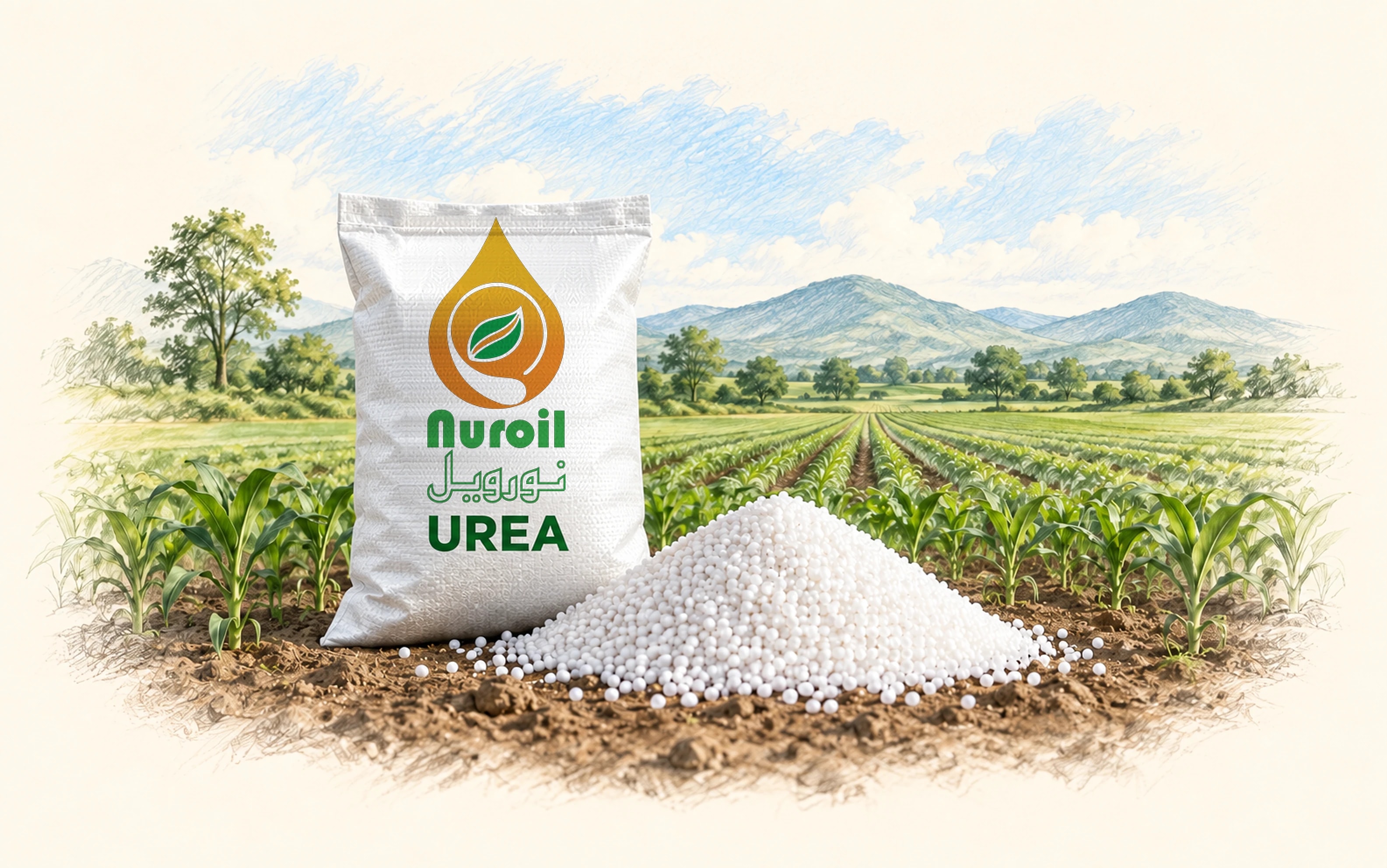
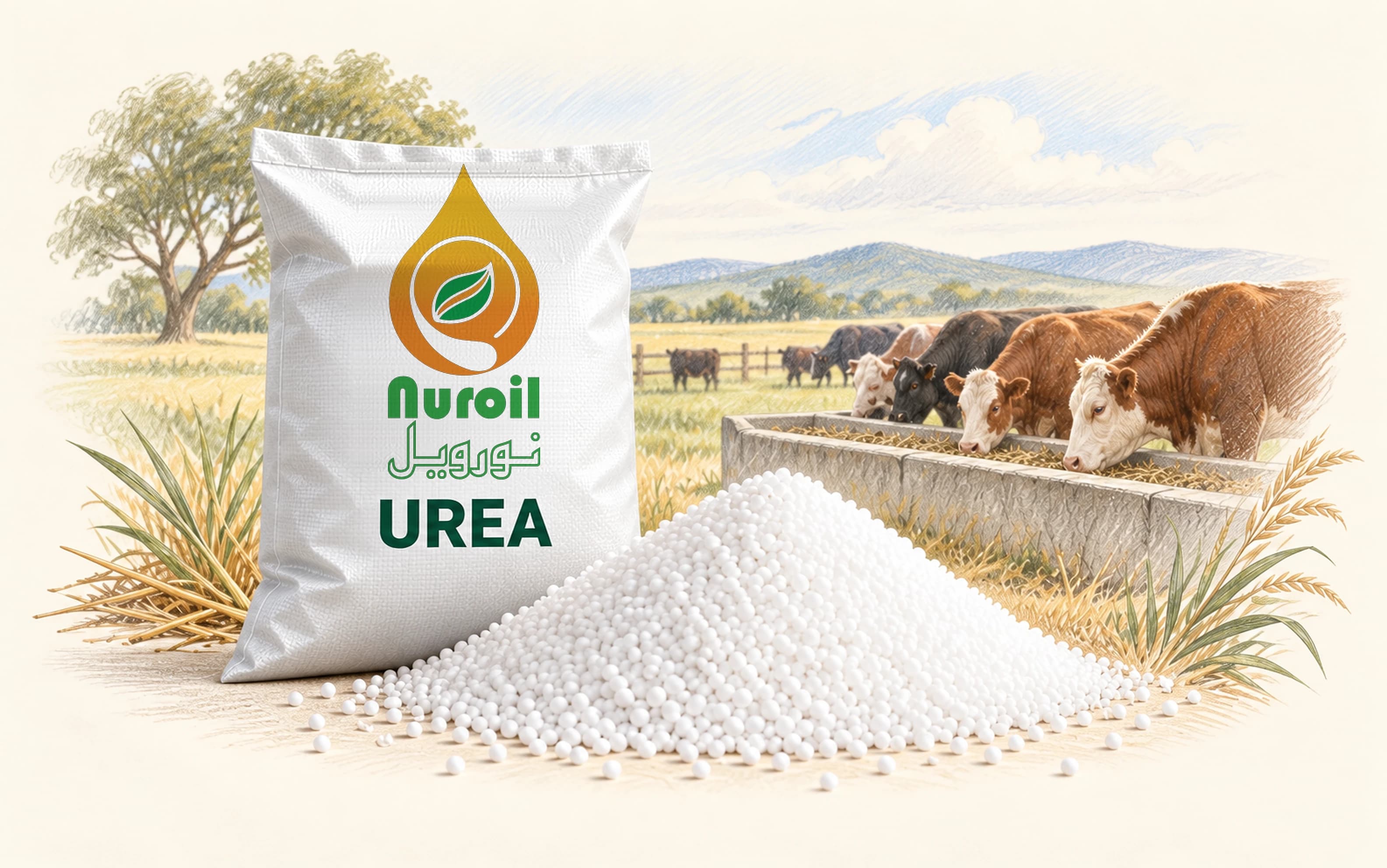
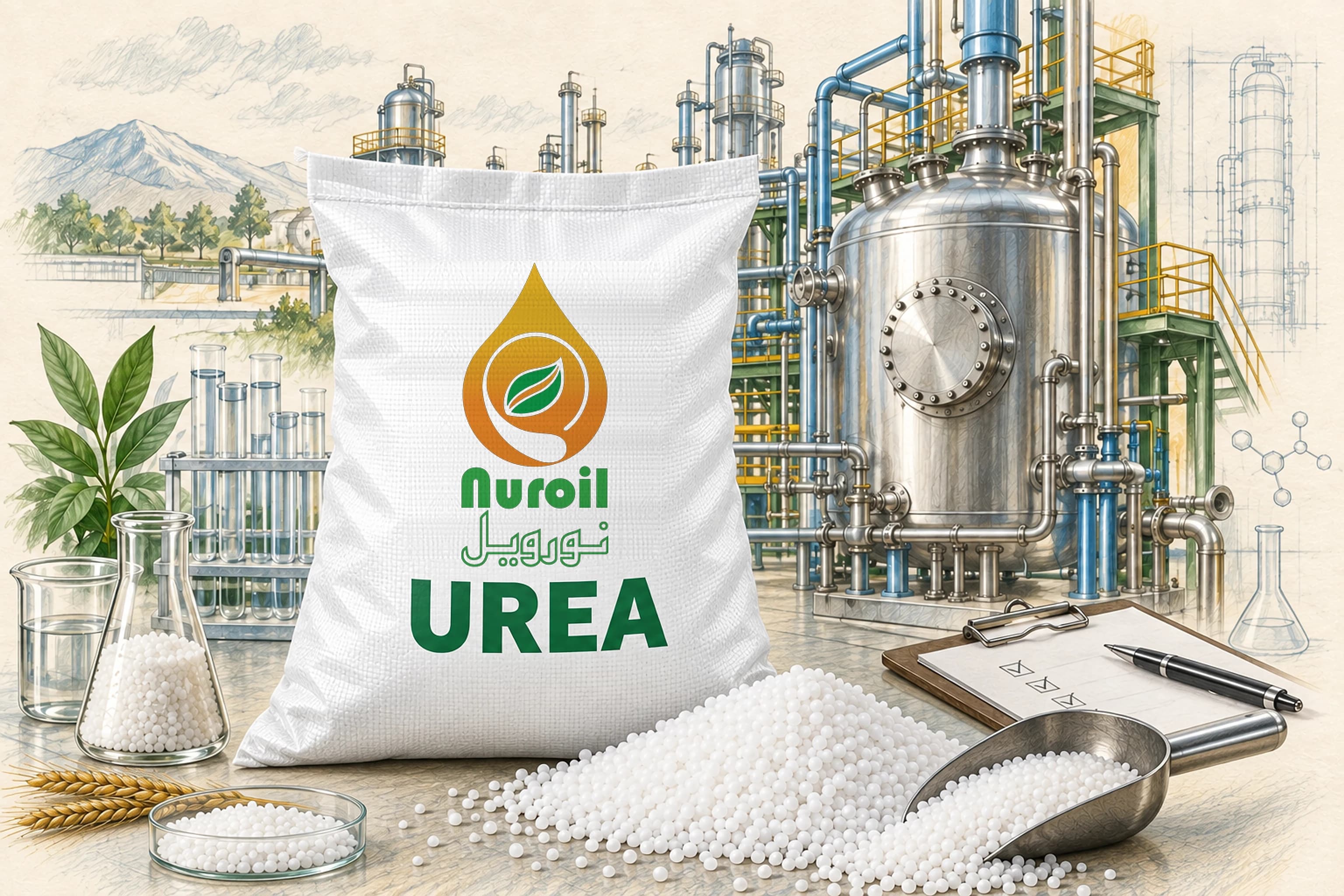
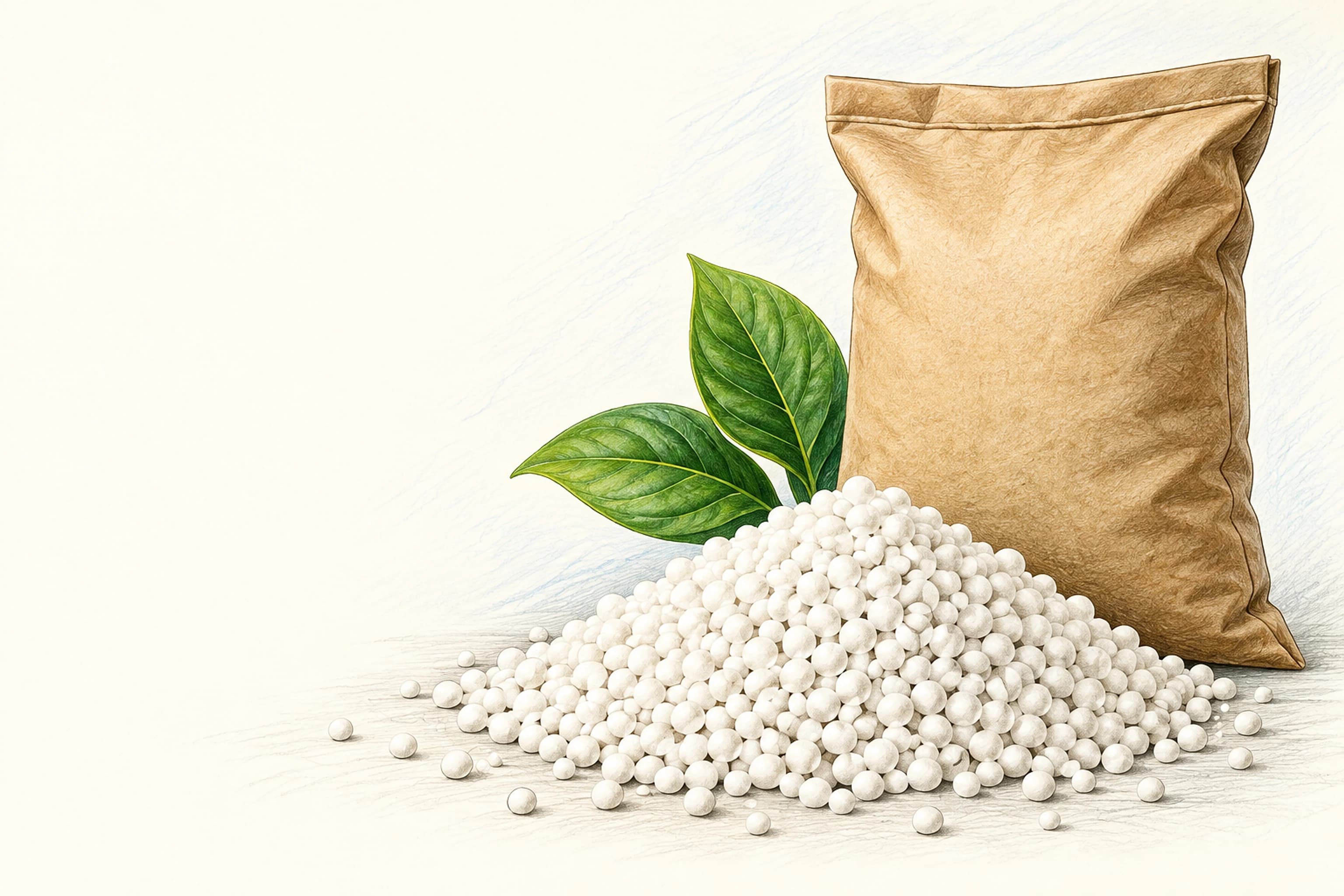
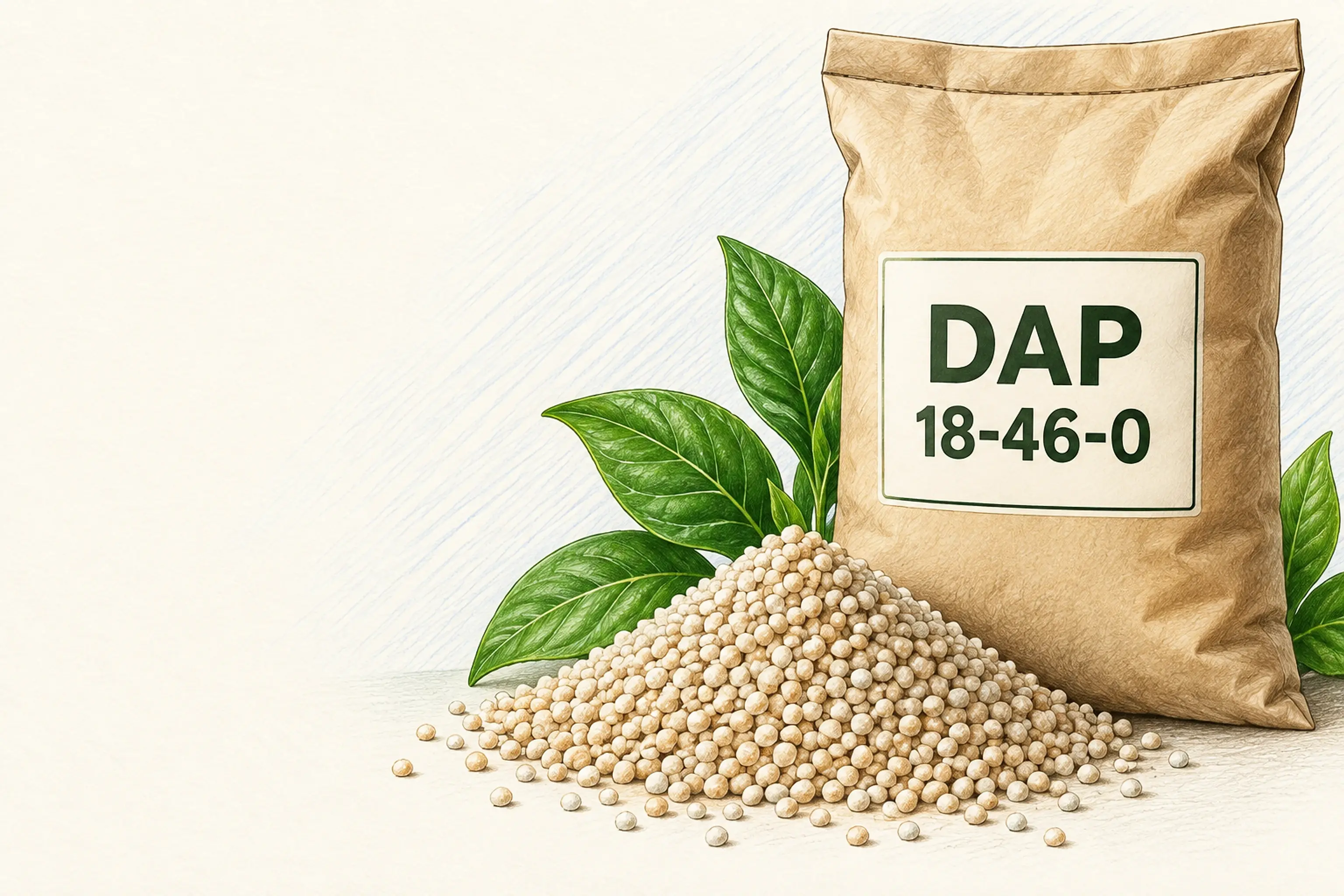
The most widely used dry nitrogen fertilizer in the world: 46-0-0, with the lowest cost per unit of nitrogen among common solid fertilizers, for field crops, pasture and turf.
Urea is a white crystalline solid made from anhydrous ammonia (NH₃), carrying 46% nitrogen: the highest analysis of any common solid nitrogen fertilizer. Agriculture grade is made and certified for soil and foliar application, with biuret held to a level that is safe for crops.
Against ammonium nitrate at 34% or ammonium sulphate at 21%, less product has to be freighted, stored and handled for the same nitrogen, a saving that grows with volume.
In the soil, urease turns urea into ammonia and carbon dioxide; the ammonia becomes ammonium, which roots take up or bacteria turn into nitrate. Left on a warm, humid surface, urea can lose more than 30% of its nitrogen as ammonia within a day, so work it in by tillage, rain or irrigation within a day or two.
Identity
Formula
CO(NH₂)₂
Molar mass
60.06 g/mol
CAS
57-13-6
Urea · CO(NH₂)₂Why Agriculture grade urea
Lowest cost per unit of nitrogenHigh analysis cuts freight, storage and handling.
Flexible applicationApplied as a solid, a solution or a crop-specific foliar spray.
Low handling riskLittle to no fire or explosion hazard compared with oxidising nitrogen sources.
Clean manufactureRelatively few pollutants from the production route.
Proven yieldsApplied correctly, it performs as well as other nitrogen forms.
What Nuroil does on every order
Why choose agriculture grade urea from Nuroil?
Checked against the batch CoA
Nitrogen, biuret and moisture, with heavy metals for feed grade, are reviewed on the batch certificate before loading.
Grade matched to the use
Agriculture, feed or technical grade, prilled, granular, coated or solution, confirmed against your crop, ration or process.
From bulk to field-ready bags
Bulk, 1 MT big bags or 50 kg bags, planned around your receiving facilities and order volume.
One desk, firm offers
FOB, CFR or CIF from our Sharjah trade desk, usually within 24 hours.
02 TECHNICAL DATA
Technical specification.
Nitrogen (N) content
46% minASTM E1518 / ISO 18227
Form
Prilled or granularVisual / sieve inspection
Appearance
White, free-flowing solidVisual
Biuret content
1.0% maxISO 17318
Moisture content
0.5% maxISO 760 / Karl Fischer
Granule / prill size
2–4 mmISO 8397 / sieve analysis
Bulk density
Approx. 0.74 g/cm³ASTM D1895
Crushing strength
2–3 kg/granule, typicalSingle-granule crush test
Anti-caking treatment
Available on request
Solubility
Fully soluble in water
Shelf life
12 months from production, stored dry and covered
Country of origin
Confirmed at enquiry stage
01PRILLED · 90% WITHIN 1–4 MM
Direct field application
Small, smooth particles from a prilling tower. Softer, so more prone to breakage and fines in repeated bulk handling.
02GRANULAR · 95% WITHIN 2–5 MM
Blends and long freight
Larger, harder granules with a static strength of 2.5 kg per granule, sized to match DAP and potash in NPK blends.
03UREASE-INHIBITOR TREATED
Less ammonia loss
NBPT-type treatment slows conversion to ammonia and cuts volatilisation where urea stays on the surface.
04SULPHUR- OR POLYMER-COATED
Slow or controlled release
SCU also supplies sulphur; PCU extends nitrogen supply over the season. Both cost more per tonne but can cut total nitrogen loss in warm, wet conditions.
Selection guidance Both forms carry the same nitrogen. Specify granular for blending into NPK; for direct field application either form performs equally well.
The same 46% nitrogen in three grades. Each is made and certified for one use, so the grades are not interchangeable.
Property
AgricultureThis page
Feed
Technical
Nitrogen
46% min
46% min
46% min
Biuret
1.0% max
0.3% max
Process-specific
Heavy metals tested
Not specified
Arsenic and lead
Iron, trace metals as agreed
Forms
Prilled or granular
Prilled, granular or coated
Prilled, granular or solution
Size
2–4 mm
1–3 mm
To the process
Governing specification
Fertilizer standard
Feed-additive standard
Buyer process spec or ISO 22241-1
Best suited to
Field crops, pasture, turf, NPK blends
Ruminant rations, feed blocks, roughage
Resins, melamine, DEF, de-icing
03 HOW IT IS MADE
From ammonia to prills and granules.
Ammonia and carbon dioxide react under pressure to form a urea solution, which is concentrated to a melt and then prilled in a tower or granulated, cooled and screened to size.
01
Ammonia and CO₂
Anhydrous ammonia and carbon dioxide feed the reactor
02
Synthesis
They react under pressure to form urea solution
03
Prilling or granulation
The melt is formed into prills or granules
04
Testing and packing
Screened, tested for nitrogen and biuret, then bagged or loaded
04 APPLICATIONS
Match the rate to the crop.
01
Wheat and rice
Typically 100–150 kg/ha for wheat over 2–3 splits; 100–130 kg/ha for rice at transplanting, tillering and panicle.
02
Maize and sugarcane
150–200 kg/ha for maize at planting and knee-high; 200–250 kg/ha for sugarcane across the season.
03
Vegetables
Around 80–120 kg/ha, adjusted to each crop’s nutrient demand.
04
Pasture and turf
40–80 kg/ha per application, repeated through the growing season.
05
Solution and fertigation
Dissolved in water and applied through suitable irrigation systems for even spread.
06
Foliar spray
For selected crops needing a fast correction; follow crop-specific rates to avoid leaf scorch.
05 SAFETY & HANDLING
Low hazard. Handle it with care.
This summary does not replace the Safety Data Sheet. Review the SDS and site procedure before first handling.
Not classified
GHS Not classified as hazardous by most producers. Keep dust from the eyes; store apart from strong oxidisers and hypochlorites.
UN
Not regulated
Transport
Not dangerous goods
01
Work it into the soil
Incorporate surface-applied urea within a day or two to limit ammonia loss.
02
Keep it off the seed
Concentrated nitrogen in direct seed contact can damage germination.
03
No lime in the blend
Do not mix directly with pelletised limestone or strongly alkaline materials; they speed up nitrogen loss.
04
Blend with P and K
Urea blends well with phosphate and potash fertilizers for mixed NPK application.
05
Follow the SDS
Avoid dust in the eyes and keep it from strong oxidisers and hypochlorites.
Keep it dry, keep it covered.
Shelf lifeAbout 12 months
From production, stored dry and covered. Urea draws moisture from humid air and cakes when left uncovered.
Keep bags closedReseal opened bags at once; humid air causes caking.
Dry, covered storeCool and ventilated, on pallets and off direct ground contact.
Away from alkaline materialsLime and strongly alkaline products speed up nitrogen loss as ammonia.
Each grade on its ownStore and label agriculture, feed and technical grades apart; they are not interchangeable.
Confirm the destination standard.
HS code3102.10
CAS number57-13-6
EC number200-315-5
TransportNot regulated
ISO 18227
International reference for urea fertilizer nitrogen content
EU Fertilising Products Regulation (2019/1009)
Required for import or sale within the EU
Indian Fertilizer Control Order (FCO)
Required for import or sale within India
GOST 2081
Common reference standard across CIS markets
Turkish Standard TS 3861
Referenced for Turkish market import
Bag marking
Product name, grade, net weight, batch or lot number, production date and manufacturer; confirm destination language and registration marks before the production run
National regulations
Fertilizer registration, import permit and labelling rules of the destination
06 PACKING OPTIONS
Choose your packing format.
Figures are indicative. Confirm exact loading against the container type and destination-port handling requirements.
Large volumes
Bulk supply
The most cost-efficient large-volume format; vessel and hold requirements confirmed at booking.
Typical loads used for planning. Your offer confirms the exact packing and load for the product and source.
420 ft containers
bags
2,000
Last 20 ft container
100% full
Minimum orderOne 20 ft containerAbout 24–25 t in 50 kg bags or big bags
Shelf lifeAbout 12 monthsFrom production, stored dry and covered
DocumentsCoA with every batchSDS and Certificate of Origin on request
07 BEFORE YOU ORDER
Frequently asked questions.
01What does 46-0-0 mean?
The numbers state nitrogen, phosphate and potash by mass. Urea 46-0-0 is 46% nitrogen with no phosphorus or potassium.
02Is prilled or granular urea better?
Both deliver the same nitrogen. Granular urea is preferred for blending and long freight because it is larger and harder; prilled urea suits direct field application.
03Why does urea sometimes underperform in the field?
Surface-applied urea can lose nitrogen as ammonia unless it is worked in by tillage, rain or irrigation, particularly in warm, humid conditions. Urease-inhibitor treated urea reduces that loss.
04Can urea be used as a foliar spray?
Yes, for certain crops. Follow crop-specific rates because a concentrated solution can scorch leaves.
05How much urea should I apply per hectare?
It depends on the crop, soil test and yield target. Typical planning ranges are 100–150 kg/ha for wheat, 100–130 kg/ha for rice, 150–200 kg/ha for maize, 200–250 kg/ha for sugarcane, 80–120 kg/ha for vegetables and 40–80 kg/ha per application for pasture and turf. Confirm the programme with a local agronomist.
06How does urea compare with other nitrogen fertilizers?
Urea carries 46% nitrogen against 34% for ammonium nitrate, 21% for ammonium sulphate and 28–32% for UAN solution, so it has the lowest cost per unit of nitrogen. Its volatilisation risk is higher if it is left on the surface.
07What documents come with each shipment?
Every shipment has a Certificate of Analysis. Certificate of Origin, SDS and destination import documents, including phytosanitary papers where required, are available on request.
08What is the minimum order quantity?
It depends on packing. Share the bulk, big-bag or 50 kg bag quantity you need and we will confirm feasibility.
09What Incoterms do you offer?
FOB is standard; CFR and CIF offers to your destination port are available on request.
10How should urea be stored?
Dry, covered and off direct ground contact. Urea absorbs moisture and cakes in humid, uncovered conditions; stored correctly it keeps for about 12 months from production.
Include the quantity, destination, prilled or granular preference, crop or application and packing format for a tailored offer. We reply with a firm FOB, CFR or CIF offer, usually within 24 hours.