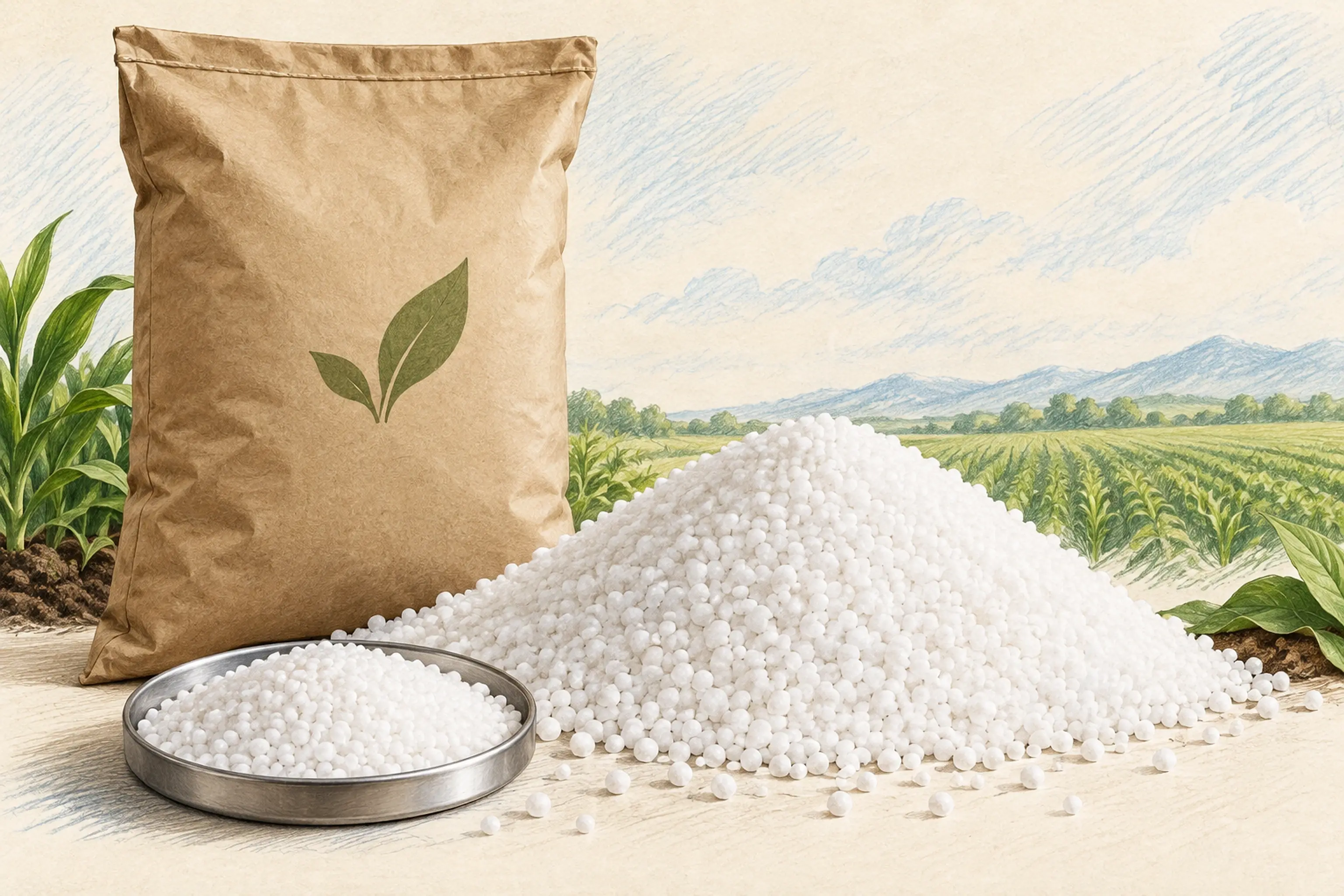
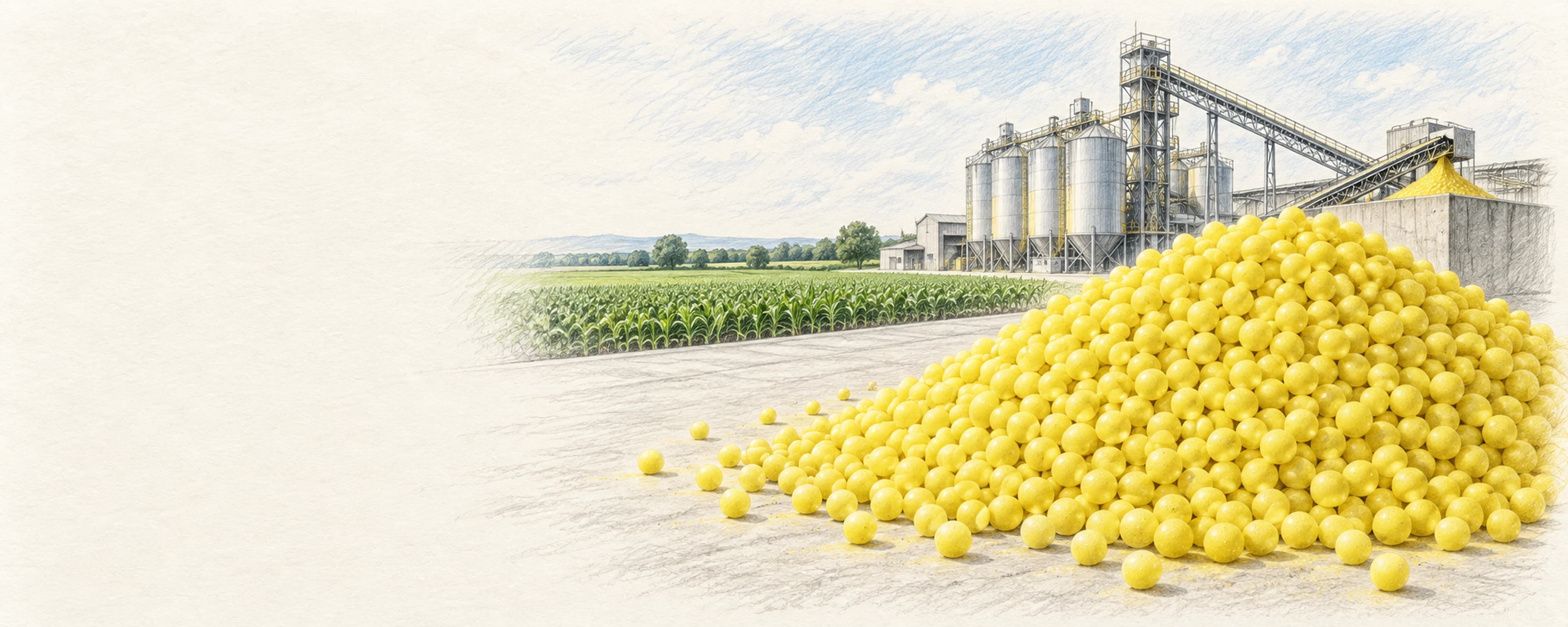
A granular 34-0-0 fertilizer that supplies half its nitrogen as nitrate and half as ammonium. It loses less ammonia from the surface than untreated urea, which makes it a popular choice for pasture, hay and crops.
Ammonium nitrate, NH₄NO₃, is made from ammonia and nitric acid. At room temperature it is a white crystalline solid that dissolves readily in water, melting at about 170 °C.
As a fertilizer it comes as granules with about 34% nitrogen. The nitrate half moves with soil water to the roots and is available at once; the ammonium half is held by the soil and turned into nitrate over time, extending supply.
It is a regulated oxidiser, controlled in many countries. Confirm the storage, import and labelling rules for your destination early.
Identity
Formula
NH₄NO₃
Molar mass
80.04 g/mol
CAS
6484-52-2
Ammonium nitrate · NH₄NO₃Why Ammonium nitrate
Immediate and sustained supplyNitrate acts at once while ammonium extends availability.
Lower surface lossLess ammonia volatilisation than untreated urea when top-dressed.
Flexible timingSuits split applications and top-dressing through the season.
Even spreadingHard, uniform granules spread consistently.
Batch-verified qualityNitrogen, moisture and granulometry confirmed on every batch.
What Nuroil does on every order
Why choose ammonium nitrate from Nuroil?
Checked against the batch CoA
Nitrogen, moisture, granulometry and granule strength are reviewed on the batch certificate before loading.
Dangerous-goods paperwork handled
Shipped as a class 5.1 oxidiser with the correct UN entry, labels and declarations.
Destination rules checked
Import licences, end-user declarations and marking confirmed for your market before booking.
One desk, firm offers
FOB, CFR or CIF from our Sharjah trade desk, usually within 24 hours.
02 TECHNICAL DATA
Technical specification.
Total nitrogen (N), min
34.4%Supplier specification
Nitrate nitrogen
17.2%Supplier specification
Ammonium nitrogen
17.2%Supplier specification
Moisture (Fischer method), max
0.6%Karl Fischer
pH of 10% aqueous solution, min
5.0pH meter
Granulometry 1 to 4 mm, min
95%Sieve analysis
Granulometry below 1 mm, max
5%Sieve analysis
Static strength of granules, min
8.0 N/granule (0.8 kg/granule)Single-granule crush test
03 HOW IT IS MADE
From ammonia and nitric acid to granules.
Ammonia neutralises nitric acid to give an ammonium nitrate solution, which is concentrated and granulated, then cooled, screened and coated against caking.
01
Ammonia and nitric acid
The two raw materials feed the neutraliser
02
Neutralisation
They react to form ammonium nitrate solution
03
Granulation
The concentrated melt is formed into hard granules
04
Testing and packing
Cooled, screened, tested and bagged or loaded
04 APPLICATIONS
Built for how you grow.
01
Pasture and hay
A common choice for pasture and hay top-dressing, where lower surface loss matters.
02
Cereals and field crops
Nitrogen for wheat, barley, maize and other row crops, split across the season.
03
Top-dressing
Nitrate available straight away, with ammonium that lasts longer.
04
Blending and distribution
Bulk and bagged supply for blenders and distributors, subject to local handling rules.
05 SAFETY & HANDLING
An oxidiser. Keep it apart.
General guidance only; it does not replace the Safety Data Sheet. Follow the SDS and local regulations.
Warning
H272 May intensify fire; oxidiser.
H319 Causes serious eye irritation.
UN
2067 AN-based fertilizer
Class
5.1, oxidiser · PG III
01
Away from fuels and organics
Keep it from fuels, oils, combustible materials, acids, powdered metals and organic matter: as an oxidiser it can intensify a fire.
02
No heat or ignition
No smoking, welding or open flames in or near storage.
03
Prevent contamination
Use clean equipment; contamination can increase the hazard.
04
Limit stack height
Follow the stacking height and spacing set by the supplier and regulations.
05
Secure the stock
Where the law requires it, keep ammonium nitrate secure and record its movements.
Dry, clean and on its own.
StoreDry, clean, apart
Moisture makes it cake; contamination and heat raise the hazard. Store it covered, ventilated and on its own.
Keep it dryCovered, on a clean, dry, ventilated floor; moisture causes caking.
SegregateApart from fuels, oils, combustibles, acids, powdered metals and organic matter.
Stack safelyTo the height and spacing recommended by the supplier and regulations.
Secure and recordedLocked storage and movement records where the law requires them.
Plan documentation early.
HS code3102.30
CAS number6484-52-2
EC number229-347-8
UN numberUN 2067
Import licence / permit
Often required; confirm with the destination authority before ordering
End-user declaration
May be required to show the fertilizer end use
Packing and labelling
Product name, grade (34-0-0), net weight, batch or lot number, production date and oxidiser marking where required
National regulations
Rules differ widely between countries and may require licences
06 PACKING OPTIONS
Choose your packing format.
Figures are indicative. Confirm exact loading against the container type and destination-port handling requirements.
Large volumes
Bulk supply
For large distributors and blenders with dedicated intake, storage and approved handling systems.
Typical loads used for planning. Your offer confirms the exact packing and load for the product and source.
420 ft containers
bags
2,000
Last 20 ft container
100% full
Minimum orderOne 20 ft containerAbout 24–25 t in 50 kg bags or big bags
BulkBy vesselPer vessel hold capacity, confirmed at booking
DocumentsCoA with every batchSDS and Certificate of Origin on request
07 BEFORE YOU ORDER
Frequently asked questions.
01What is the difference between ammonium nitrate and urea?
Ammonium nitrate is about 34% nitrogen, half nitrate and half ammonium; urea is about 46% nitrogen. Ammonium nitrate loses less ammonia when left on the surface, so it is often preferred for pasture and hay. Urea costs less per unit of nitrogen.
02How does it compare with DAP?
DAP is 18-46-0, supplying ammonium nitrogen with phosphate at planting. Ammonium nitrate supplies nitrogen only, for top-dressing through the season, and is handled as a regulated oxidiser.
03What does 34-0-0 mean?
The numbers state nitrogen, available phosphate (P₂O₅) and soluble potash (K₂O) as percentages by mass: about 34% nitrogen and no phosphate or potash.
04Is ammonium nitrate regulated?
Yes. It is an oxidiser and is controlled in many countries because it can be misused. Import licences, end-user declarations, storage rules and packing or labelling requirements vary by destination, so confirm them before ordering.
05How should ammonium nitrate be stored?
Dry and covered on a clean, well-ventilated floor, away from combustibles, fuels, acids, powdered metals and heat or ignition sources, stacked to the recommended height. Follow the SDS and local regulations.
06What documents come with each shipment?
Every shipment includes a Certificate of Analysis. Certificate of Origin and SDS are available on request, and destination import and dangerous-goods documents are confirmed where they apply.
07What packing formats are available?
Bulk, big bags and 50 kg bags. Bag material, lining and availability depend on quantity, transport rules and receiving facilities.
08What is the minimum order quantity?
It depends on the packing and destination. Share your requirement and we will confirm feasibility with your quote.
09What Incoterms do you offer?
FOB is standard; CFR and CIF offers to your destination port are available on request.
Include the quantity, destination, packing format and any import licence requirements for a tailored offer. We reply with a firm FOB, CFR or CIF offer, usually within 24 hours.