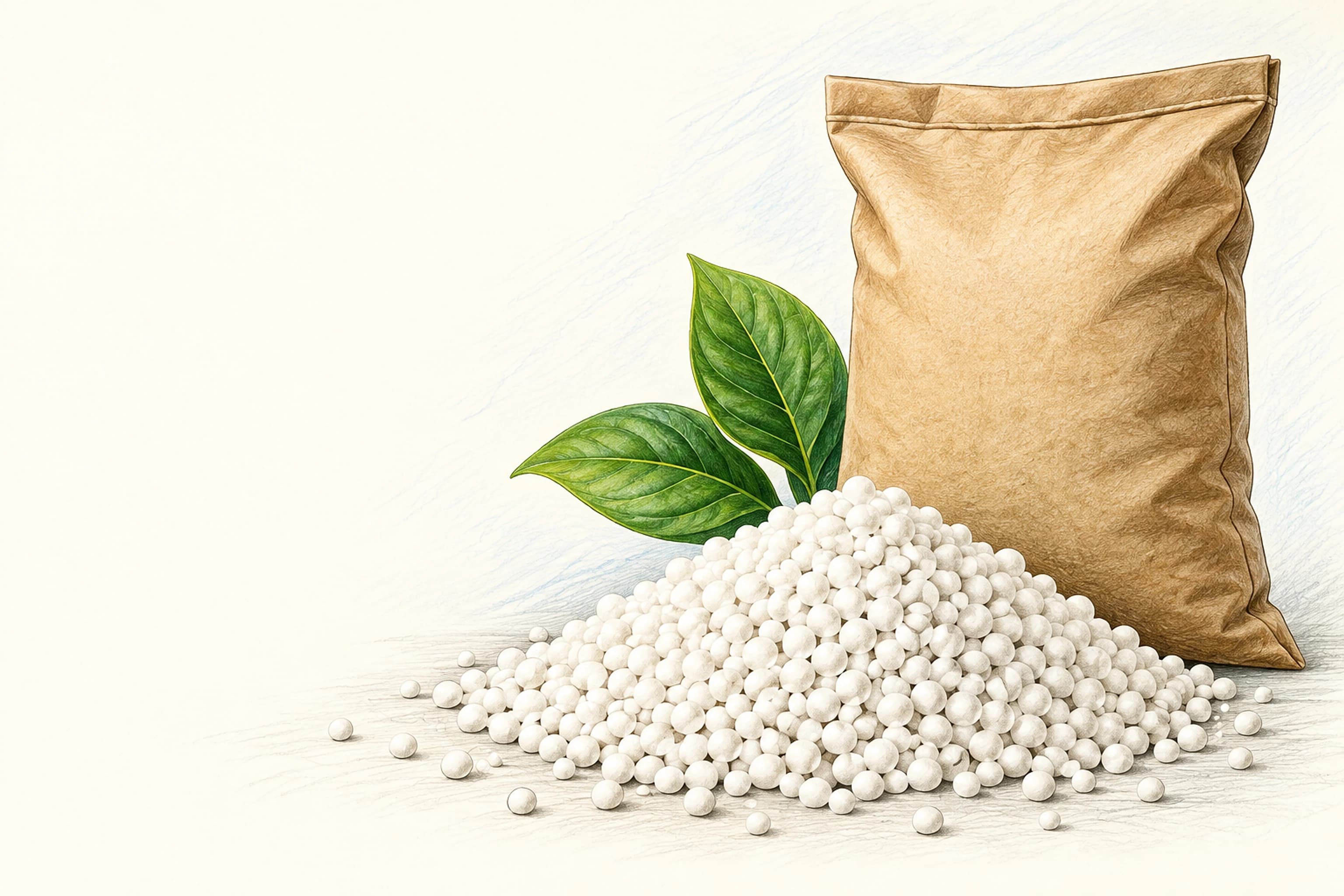
Straight ammonium nitrate (AN) and calcium ammonium nitrate (CAN) are close relatives. Both supply nitrogen as a mix of ammonium and nitrate, both act quickly in the crop and both are widely used for top-dressing cereals, grassland and horticultural crops. They differ in concentration, effect on soil and how they are regulated. This article helps buyers and agronomists decide between them.
What each product is
Straight fertilizer-grade ammonium nitrate contains about 34% nitrogen. Half of that nitrogen is in nitrate form, which crops take up immediately, and half is ammonium, which is absorbed directly or converted to nitrate in the soil over the following days and weeks.
CAN is ammonium nitrate blended with a calcium source, usually ground limestone or dolomite, before granulation. The most common grade carries 27% nitrogen, again split evenly between nitrate and ammonium, plus calcium and, with dolomite, some magnesium. The calcium content varies between producers, so it should be read from the product label.
Side-by-side comparison
| Factor | Ammonium nitrate (about 34% N) | Calcium ammonium nitrate (27% N) |
|---|---|---|
| Nitrogen forms | Half nitrate, half ammonium | Half nitrate, half ammonium |
| Nutrients beyond N | None | Calcium, sometimes magnesium |
| Effect on soil pH | Acidifying over time | Less acidifying, due to the carbonate content |
| Product per kg of N | Less material to buy, ship and spread | About a quarter more material |
| Moisture sensitivity | Very hygroscopic | Hygroscopic; also deteriorates in damp storage |
| Regulatory position | Tightly controlled in many countries | Often allowed where straight AN is restricted |
Agronomy: where they differ
On crop response per unit of nitrogen, the two behave similarly because the nitrogen forms are the same. The main agronomic difference is soil acidity. Ammonium in both products releases acidity as it converts to nitrate. In CAN, the carbonate partly neutralises that acidity, so CAN is commonly preferred on acid soils and where liming is expensive or irregular. The calcium also benefits crops and soils short of it, although the quantity supplied is modest compared with a liming programme.
Where soils are neutral or alkaline, the extra calcium and buffering in CAN add little value, and the higher nitrogen concentration of straight AN becomes the stronger argument.
Logistics and cost per unit of nitrogen
Because straight AN is more concentrated, a tonne carries more nitrogen. That reduces freight, storage space and the number of passes or refills during spreading. When comparing offers, always convert to cost per kilogram of nitrogen delivered to the farm, not cost per tonne of product. Then add any value you place on calcium or reduced liming.
Handling and regulation
Both products need dry, covered storage and careful separation from combustible materials. Straight AN of high nitrogen content is subject to stricter rules in many jurisdictions: licensing, record keeping, security of storage, notification thresholds and, in some places, a ban on sale to the general public. Some countries permit CAN where straight AN is not allowed. Buyers should check national fertilizer and dangerous-goods regulations before choosing a product.
Choose on soil pH, delivered cost per kilogram of nitrogen and what your national rules allow. The crop itself responds much the same to both.
Quick decision guide
- Acid soils, limited liming: CAN usually makes more sense.
- Neutral or alkaline soils, long freight distances: straight AN usually gives cheaper nitrogen.
- Regulations restrict high-nitrogen AN: CAN or another nitrogen source.
- Crops responsive to calcium: CAN offers a small bonus.
Preparing an enquiry
State the product and nitrogen grade, the particle form (prilled or granular), packing, destination and any import permits your country requires. Ask for a certificate of analysis covering nitrogen content, moisture and particle size. Nuroil supplies ammonium nitrate fertilizer and other nitrogen fertilizers; use the quote form to send details.