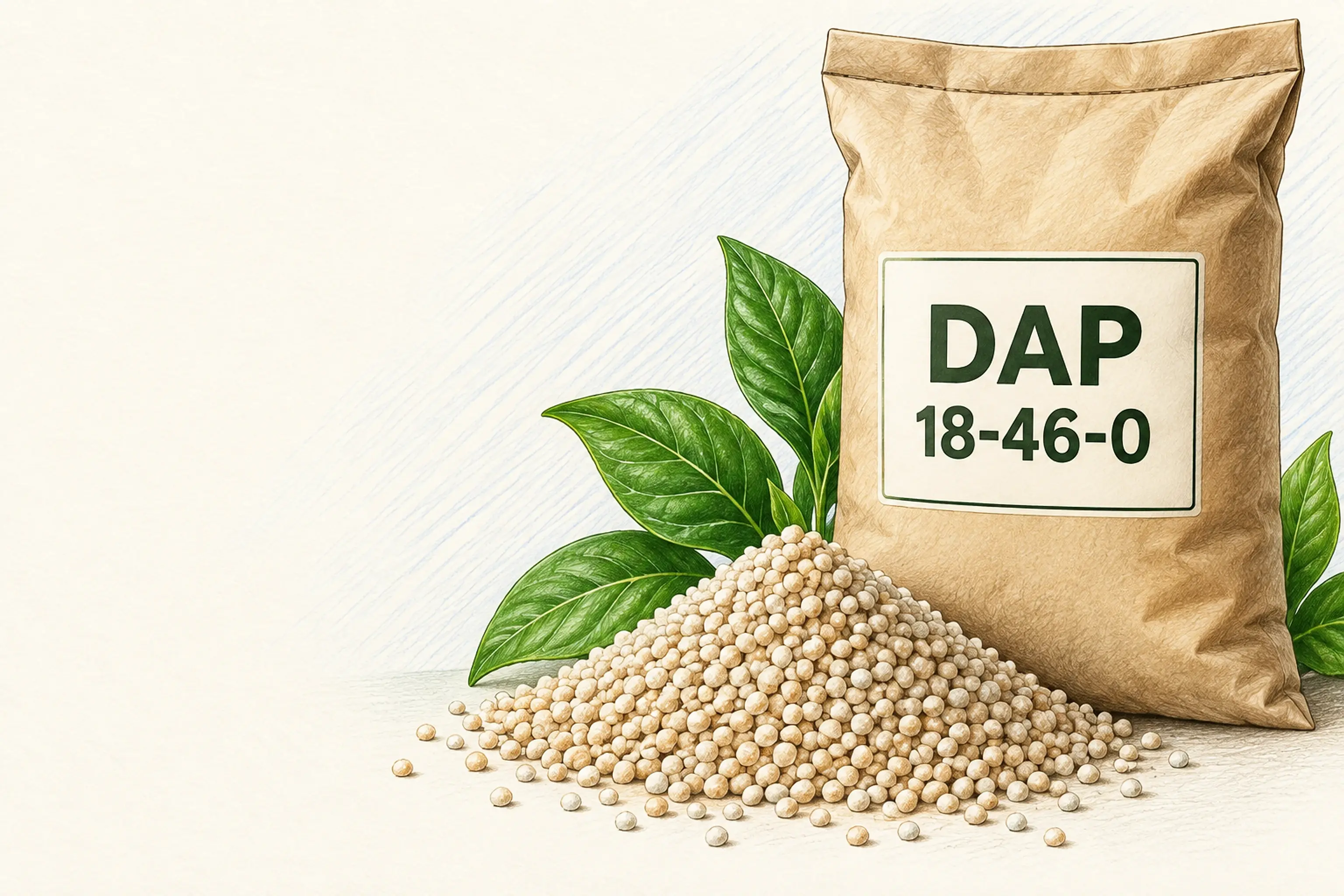
Two lots of fertilizer with the same chemical analysis can behave very differently in a spreader. The nitrogen or phosphate content tells you what goes on the field; the physical properties of the granules decide where it actually lands. For distributors and blenders, these properties are as important to check as the guaranteed analysis.
Granule size and size range
Particle size is the single biggest influence on how a granular fertilizer spreads. A spinning-disc spreader throws larger, heavier granules further than small ones, so the usable spread width depends on granule size. One often-quoted study found urea of about 4.7 mm could be spread across roughly 20 m, while urea of about 1.7 mm reached only about 10 m.
Size is usually reported in two ways:
- Size guide number (SGN): the average granule diameter in millimetres multiplied by 100. An SGN of 300 means an average size of about 3 mm.
- Uniformity index (UI): the ratio of the small end of the size range to the large end, multiplied by 100. Values of about 40 to 60 indicate a reasonably uniform product; higher values within that range mean a tighter spread of sizes.
A wide size range causes two problems. Fines and dust drop close behind the spreader instead of travelling to the edge of the bout, and in a blend, small and large granules separate during handling. Where a product has a lot of fines, operators are advised to narrow the bout width.
Matching sizes in a blend
Bulk blends segregate when their components differ in size. A commonly used rule is that the SGNs of the blend components should be within about 10 of each other, which keeps the mix together through loading, transport and spreading. A difference of 11 to 20 is workable with careful handling, and more than 20 is likely to segregate. Shape and density matter too, but size difference has the largest effect.
| Product | Typical median size (mm) | Typical crushing strength (kg/granule) | Typical loose bulk density (kg/m³) |
|---|---|---|---|
| Granular urea | About 2.2 | 1.5 to 3.5 | 720 to 820 |
| Prilled ammonium nitrate | About 2.2 | 1.2 to 1.7 | 850 to 975 |
| DAP | About 3.0 to 3.2 | 3.0 to 5.0 | 880 to 1,050 |
| Granular MAP | About 2.4 | 2.0 to 3.0 | 900 to 1,050 |
The figures above are typical published values and will differ by producer and by how the product has been handled; always check the actual lot.
Particle density and bulk density
Particle density is the weight of the granule itself, excluding the air between granules. Denser granules travel further and tolerate higher disc speeds, while light granules fall short and may break up. Mixing products of very different particle density increases segregation even when sizes match.
Bulk density, the weight of a loose-poured volume, matters for metering. Spreader rate controllers convert volume to application rate using the bulk density entered by the operator, so a wrong figure means a wrong rate. It also drives truck, bag and warehouse capacity calculations.
Hardness and crushing strength
Crushing strength is the force a single granule withstands before it fractures. Soft granules break in conveyors, during long-distance transport and on the spinner vanes, creating dust that changes both the size distribution and the spread pattern. Harder products can be spread with higher disc speeds and wider bouts; softer products need slower discs. A simple field check is to press a granule between finger and thumb: if it crushes easily, treat it as soft.
A product that leaves the plant at a good size range can arrive as a dusty one. Handling, storage pressure and humidity all erode granule quality along the supply chain.
What to ask for in an enquiry
For granular fertilizers destined for blending or mechanical spreading, ask the supplier to state the size range with the minimum percentage inside it, the maximum fines below 1 mm, and where available the SGN, UI and crushing strength. Specify the packing that best protects granules on your route. Nuroil can provide a certificate of analysis for each delivery and arrange third-party inspection of size distribution at loading on request. See our fertilizers range or contact us to discuss specifications.