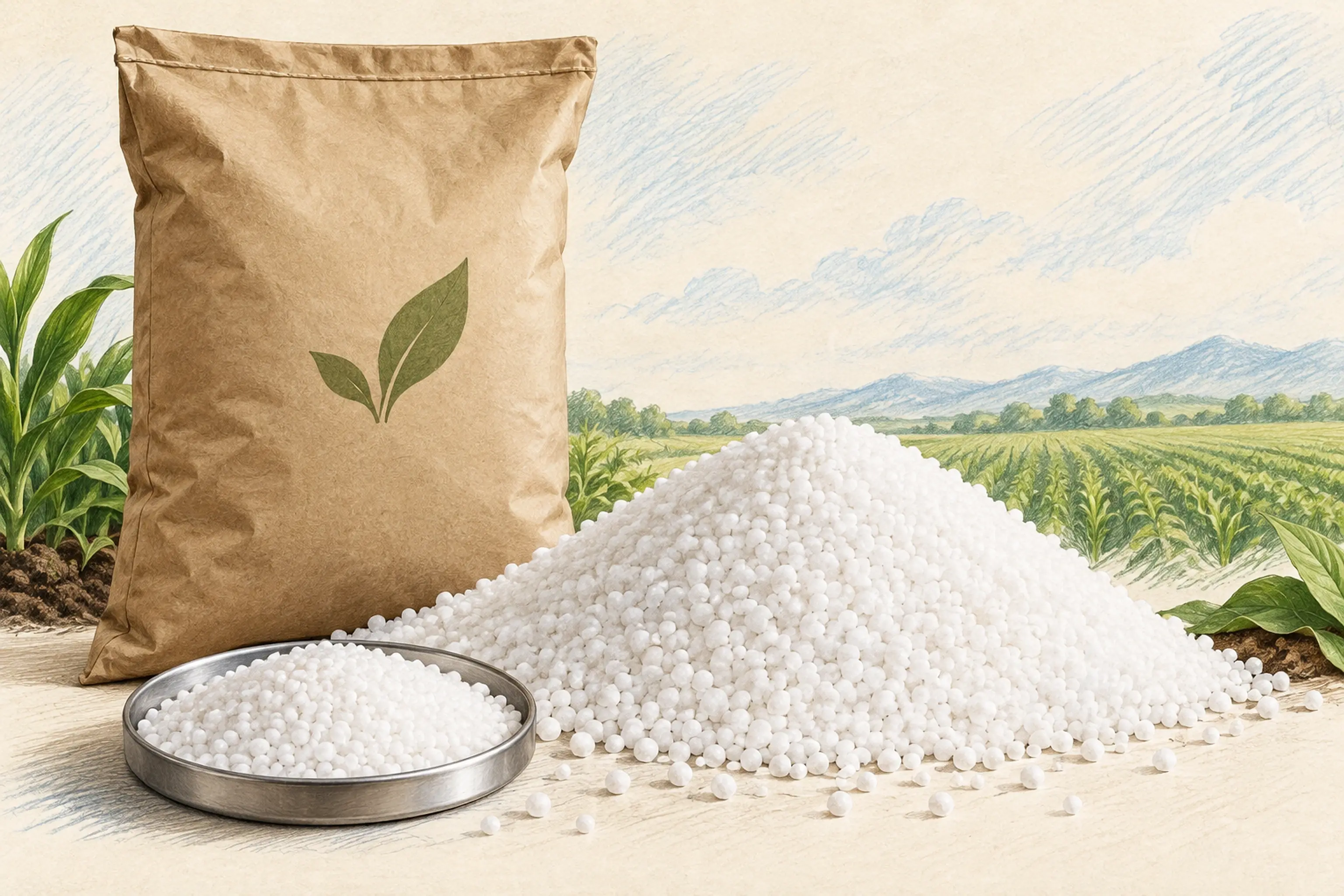
Most quality complaints about fertilizers start after the product leaves the plant. Granules absorb moisture, cake under pressure, break into dust in handling or get contaminated in a shared warehouse. Good storage keeps the product as specified and, for nitrate-based fertilizers, is also a safety requirement. This guide covers the general principles for bagged and bulk storage.
Why fertilizers deteriorate
Many fertilizers are hygroscopic. Above their critical relative humidity, they draw water from the air; when the air dries again, dissolved salts recrystallise and bridge granules together. The result is caking on pile surfaces and hard lumps in bags. Higher temperatures lower the critical humidity, so hot, humid coastal warehouses are particularly demanding. Ammonium nitrate and nitrate-containing blends are among the most sensitive; urea is less sensitive, and DAP generally stores well.
Pressure adds to the problem. Granules at the bottom of tall stacks or deep bulk piles are pressed together, and soft granules crush into fines that cake more readily.
The storage building
- Use a dry, weathertight, well-ventilated building with a sound floor. A moisture barrier on concrete floors helps for bulk piles.
- Keep doors closed when not loading, and avoid loading or unloading in rain.
- Keep the store clean before new product arrives, and keep heaters, light fittings and electrical equipment away from product and dust.
- For nitrate fertilizers, use non-combustible construction and avoid drains or pits where product could collect.
Bagged and jumbo-bag storage
- Store bags on clean, undamaged pallets, never directly on the floor.
- Build stable, interlocked stacks and limit their height; tall stacks crush lower bags and can collapse.
- Leave clear aisles between stacks and space between stacks and walls for inspection and access.
- Rotate stock on a first-in, first-out basis so older lots are not left to cake.
- Repack damaged bags promptly into sound overpacks and sweep up spillage.
- If bags must be kept outdoors briefly, use a level, secure area, keep them on pallets and fully sheeted against sun and rain.
Bulk storage
- Divide the store into clearly labelled bays with solid walls, one product per bay.
- Inspect and clean bays before adding a new batch, and clean loaders and conveyors between products.
- Cover piles with sheeting in unheated buildings to reduce moisture pick-up.
- Distribute product evenly when filling, as fines tend to concentrate where a pile is fed from one point.
- Keep vehicles in the store free of oil and fuel leaks.
Keeping incompatible products apart
| Product | Main storage concern | Keep away from |
|---|---|---|
| Ammonium nitrate and high-nitrogen AN products | Oxidiser; hygroscopic; toxic fumes if heated | Urea, combustibles (hay, straw, grain, wood, oils), acids, alkalis, sulphur, metal powders, heat sources |
| Urea | Moisture pick-up and caking | Ammonium nitrate and nitrate blends; superphosphates |
| DAP and MAP | Dust from soft or damaged granules | Wet areas; product with free acid if urea is stored nearby |
| Blends | Lower critical humidity than components | Long-term storage; humid conditions |
Where urea and ammonium nitrate must be in the same building, keep them in separate walled bays so they cannot mix in an accident. On farms, separate ammonium nitrate from hay, straw, grain and feed by a fire break of several metres or an inert barrier. Storage of ammonium nitrate above certain quantities may need to be notified to local authorities; rules differ between countries.
Dry, clean, separated and rotated: most storage problems come from neglecting one of these four.
Safety and personal protection
Fertilizer dust can irritate eyes, skin and airways, so use the protective equipment set out in the product SDS when handling loose product. Prohibit smoking and naked flames in stores holding nitrate fertilizers, and plan fire response with the local fire service where such products are kept.
Agreeing storage and packing with your supplier
Packing choice is the first line of defence. Specify lined, water-resistant bags for hygroscopic products, state the stack or pallet configuration you need, and agree marking with lot numbers for traceability. Request the SDS before arrival so the store can be prepared. Nuroil can supply fertilizers in bags, jumbo bags or bulk, provides a CoA with every delivery and shares SDS on request. See our fertilizers page or contact us to discuss packing for your route.