A fertilizer specification sheet is the reference point for a purchase contract. It sets the minimum nutrient content the buyer pays for and the physical limits that decide whether the product stores, blends and spreads properly. This guide explains the lines you will usually see for straight and compound granular fertilizers.
The grade: N-P-K
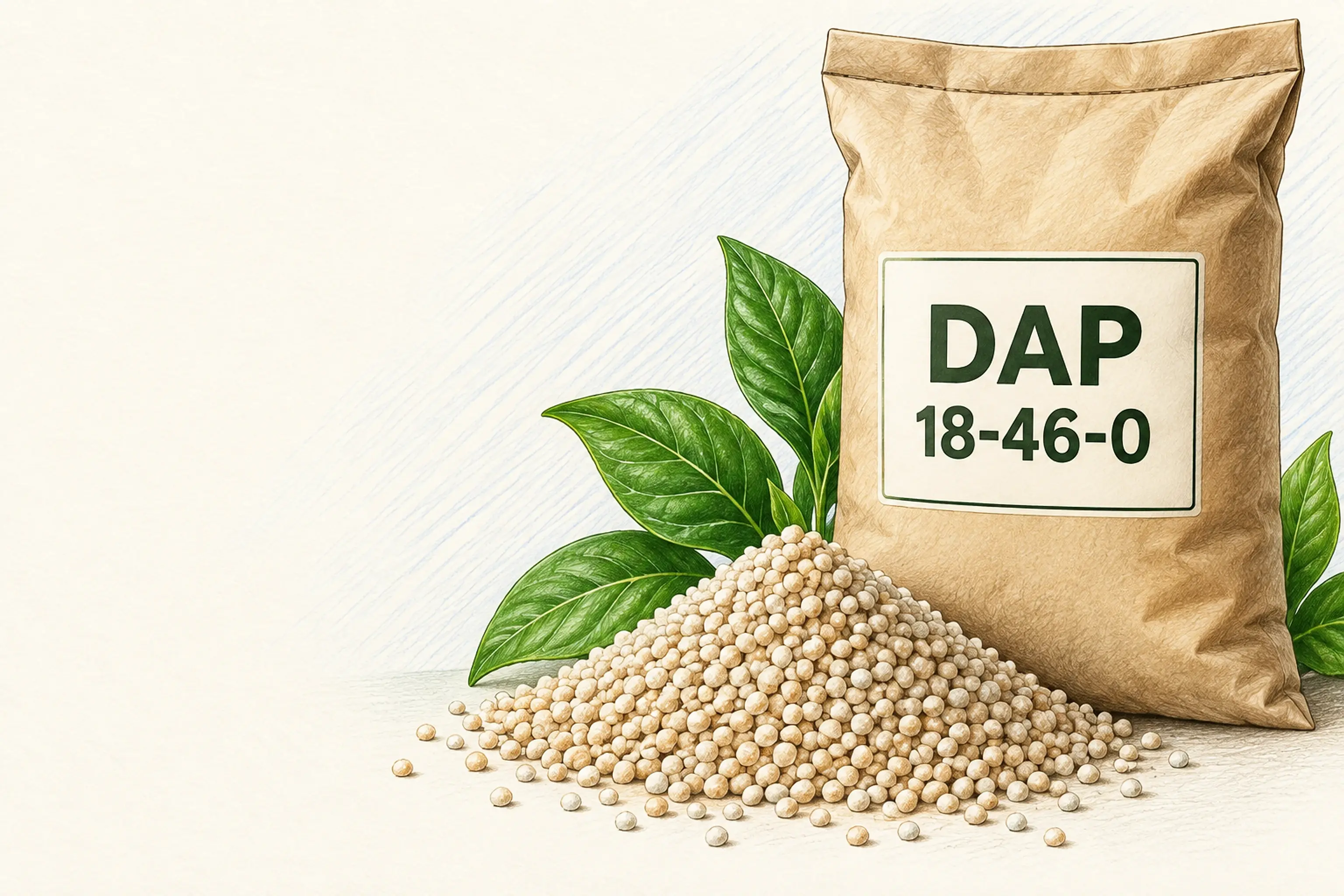
The grade is three numbers giving the guaranteed percentage by weight of nitrogen (N), phosphate expressed as P₂O₅, and potash expressed as K₂O, always in that order. Urea is 46-0-0, DAP 18-46-0 and a balanced compound might be 15-15-15. A straight fertilizer supplies one major nutrient; a compound or complex fertilizer supplies two or more. The numbers are minimums, so a lot that analyses below them is off-specification.
Nutrient lines in detail
- Total nitrogen, sometimes split into ammoniacal, nitrate and urea forms. For ammonium nitrate and CAN, the split is roughly half ammonium and half nitrate.
- Available P₂O₅, commonly measured as neutral ammonium citrate soluble, and water-soluble P₂O₅. Water solubility matters for fast crop response and for use in solutions. For NPK grades, one procurement standard asks that at least 85% of the citrate-soluble phosphate be water soluble.
- Water-soluble K₂O for potash-containing products.
- Secondary nutrients, such as sulphur, calcium or magnesium, where they are part of the guarantee.
Impurity and quality limits
- Moisture (maximum). Excess moisture causes caking and granule breakdown. Limits are typically around 0.5 to 1% for urea and 1.5 to 2.5% for DAP, depending on the standard.
- Biuret (maximum), for urea. Biuret forms during urea manufacture and can harm sensitive crops, particularly in foliar sprays; limits of 1 to 1.5% are common for soil-applied grades.
- Free acid, for some phosphate products. Free acid can react with urea or carbonates in blends.
- Anti-caking coating, sometimes stated as a range.
Physical properties
The size line normally reads as a minimum percentage between two sieve sizes, for example "90% minimum between 2 and 4 mm", often with a maximum for fines below 1 mm. Blenders also look for the size guide number (average size × 100) and uniformity index, because components with mismatched sizes separate. Crushing strength and bulk density may also be quoted.
| Specification line | Granular urea | DAP | CAN |
|---|---|---|---|
| Nitrogen (min) | 46% | 18% | 26% (half ammoniacal, half nitrate) |
| Phosphate (min) | None | 46% citrate-soluble P₂O₅; 41% water-soluble | None |
| Moisture (max) | 1% | 1.5% | 1% |
| Biuret (max) | 1.5% | Not applicable | Not applicable |
| Size | 90% min between 2 and 4 mm; max 5% below 1 mm | 90% min between 1 and 4 mm; max 5% below 1 mm | 90% min between 1 and 4 mm; max 5% below 1 mm |
These figures follow a published international procurement specification and are a useful baseline. Producers and national standards often set tighter limits, such as 0.5% moisture or 1% biuret for urea, so compare offers line by line rather than by grade alone.
Packing and marking
Specifications often include the packing: for example 50 kg woven polypropylene bags with a polyethylene liner, jumbo bags or bulk. Bags should be marked with product name, grade, net weight and lot number at a minimum. Agree whether net weight is guaranteed per bag or per lot.
The grade tells you what you are buying; the moisture, size and impurity limits tell you whether it will still be usable when it reaches the field.
Using the sheet in an enquiry
When you send an enquiry, attach or quote the full specification you need, name the test methods if your market requires them, and state the packing and destination. Ask how the lot will be sampled and who will analyse it. Nuroil provides a certificate of analysis with every delivery and can arrange independent inspection at loading, plus certificate of origin and SDS on request. Browse our fertilizer range or request a quote with your specification.