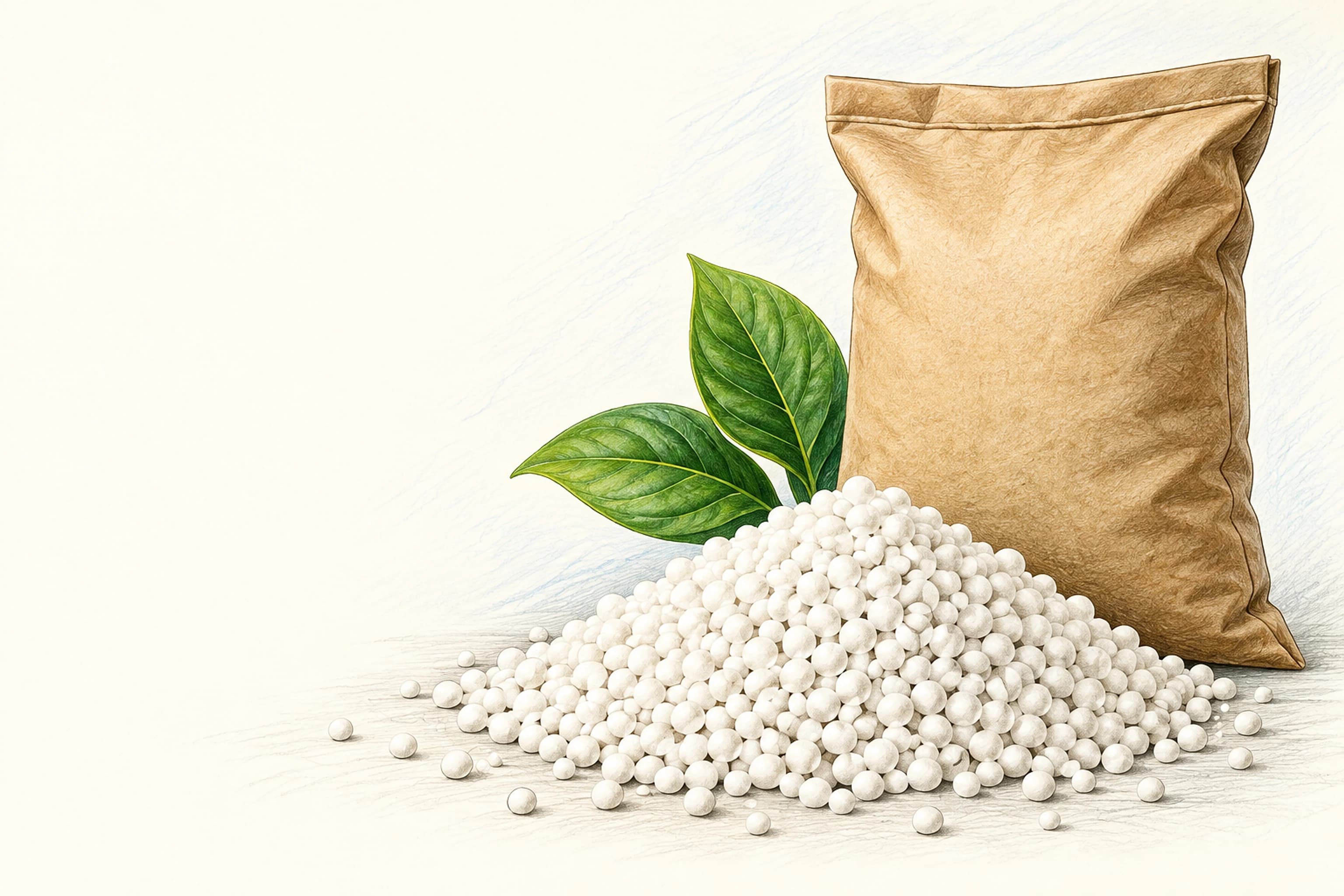
Ammonium nitrate is often discussed as a field-spread fertilizer, but its high solubility also makes it a common nitrogen source for fertigation, where nutrients are dissolved and delivered through irrigation water. Whether it is broadcast or injected, it has a gradual effect on soil pH that growers should plan for. This article looks at both points.
Why ammonium nitrate acidifies soil
Half of the nitrogen in ammonium nitrate is ammonium. Soil bacteria convert ammonium to nitrate in a process called nitrification, and that conversion releases hydrogen ions. Over repeated applications, those hydrogen ions lower soil pH. The nitrate half does not acidify the soil in the same way, which is why ammonium nitrate is less acidifying per unit of nitrogen than fertilizers whose nitrogen is entirely ammonium.
Extension tables that rank nitrogen sources by equivalent acidity put ammonium nitrate well below ammonium sulphate and well above potassium or calcium nitrate, which have no acidifying effect. Urea sits close to ammonium nitrate because it converts to ammonium in the soil.
| Nitrogen source | Relative acidifying effect |
|---|---|
| Ammonium sulphate | High |
| Ammonium nitrate | Moderate |
| Urea | Moderate |
| Calcium ammonium nitrate | Lower, due to added carbonate |
| Calcium or potassium nitrate | Little or none; slightly basic |
Managing the pH effect in the field
- Test soil regularly. A pH test every few seasons shows whether liming is needed.
- Lime to target. On acid-prone soils, budget lime to offset the acidity from nitrogen applications.
- Match the source to the soil. Where liming is impractical, a less acidifying nitrogen source such as calcium ammonium nitrate may suit better.
- Remember the subsoil. Surface liming corrects the topsoil first; long-term acidification can reach deeper layers.
Ammonium nitrate in fertigation
Ammonium nitrate dissolves readily in water, leaves little insoluble residue when it is of good quality and supplies both a fast-acting nitrate and a slower ammonium portion. These features suit drip and micro-sprinkler systems in orchards, vegetables and protected cropping.
Some practical points for growers:
- Dissolving cools the water. Ammonium nitrate absorbs heat as it dissolves, so a concentrated stock tank becomes noticeably cold. Allow time and mixing for complete dissolution, especially in cool weather.
- Use a separate stock tank where needed. Keep calcium-containing fertilizers and sulphate or phosphate fertilizers in separate tanks to avoid precipitates that block emitters. Ammonium nitrate itself is compatible with most nitrogen and potassium products.
- Watch the root zone pH. In drip-irrigated beds, especially under plastic mulch, acidification concentrates in the wetted zone around each emitter. pH there can fall faster than in the field as a whole.
- Balance ammonium and nitrate in soilless media. In substrates, the ammonium share of total nitrogen strongly influences pH drift. Many growers combine ammonium nitrate with calcium or potassium nitrate to hit the ratio they want.
- Filter and flush. Even good-quality product carries traces of conditioning agent. Line filters and periodic flushing keep emitters clear.
Ammonium nitrate gives a useful balance of quick and steady nitrogen, but every application nudges soil pH down. Plan liming or source mixing alongside the nitrogen programme.
Product quality for fertigation
For dissolving, the most useful quality indicators are nitrogen content, insoluble matter and the type of coating or conditioning agent used. A product designed for field spreading may carry more anti-caking coating than a grower would like in a stock tank. Always follow the product safety data sheet when preparing solutions, and keep stock solutions away from combustible materials.
What to ask your supplier
Tell your supplier whether the product is for spreading, blending or fertigation, and ask for nitrogen content, moisture and insoluble matter on the certificate of analysis. Nuroil supplies ammonium nitrate fertilizer alongside other fertilizers; use the quote form to share your requirements.