A specification sheet for fertilizer-grade ammonium nitrate is short, but every line on it matters for crop performance, physical quality or safety. This guide explains the parameters that commonly appear, what they mean for the user and how they relate to regulatory requirements that apply in some markets.
Typical specification parameters
| Parameter | What it tells you | Typical or regulatory reference |
|---|---|---|
| Total nitrogen | Nutrient value; split equally between nitrate and ammonium | About 34% N for straight fertilizer grade |
| Moisture | Risk of caking and physical breakdown | Kept low; stated on CoA |
| Particle size | Spreading width, blending, dust | EU: max 5% through 1 mm, max 3% through 0.5 mm |
| pH of a 10% solution | Absence of free acid | EU: at least 4.5 |
| Combustible material (as carbon) | Purity and safety | EU: max 0.2% where N is 31.5% or more |
| Chlorine | Impurity affecting stability | EU: max 200 mg/kg |
| Copper | Impurity affecting stability | EU: max 10 mg/kg |
| Conditioning agent | Anti-caking treatment applied | Type stated by producer |
The limits marked EU come from the European fertilizing products regulation for ammonium nitrate fertilizers of high nitrogen content. Other markets have their own rules, but these figures are a widely recognised reference for good-quality material.
Nitrogen content
Straight ammonium nitrate fertilizer carries about 34% nitrogen, sometimes quoted as 33.5% to 34.5%. Half is nitrate nitrogen and half is ammonium nitrogen. Products with lower nitrogen content are usually blends with a filler such as limestone (calcium ammonium nitrate) or with other nutrients. Under EU rules, a lower combustible limit of 0.4% applies to products between 28% and 31.5% nitrogen.
Moisture
Ammonium nitrate is strongly hygroscopic, and moisture drives both caking and the breakdown of prills when temperatures cycle around 32 °C. A low moisture figure at loading is a good sign, but the product will only stay dry if the bags are sound and storage is dry.
Particle size and hardness
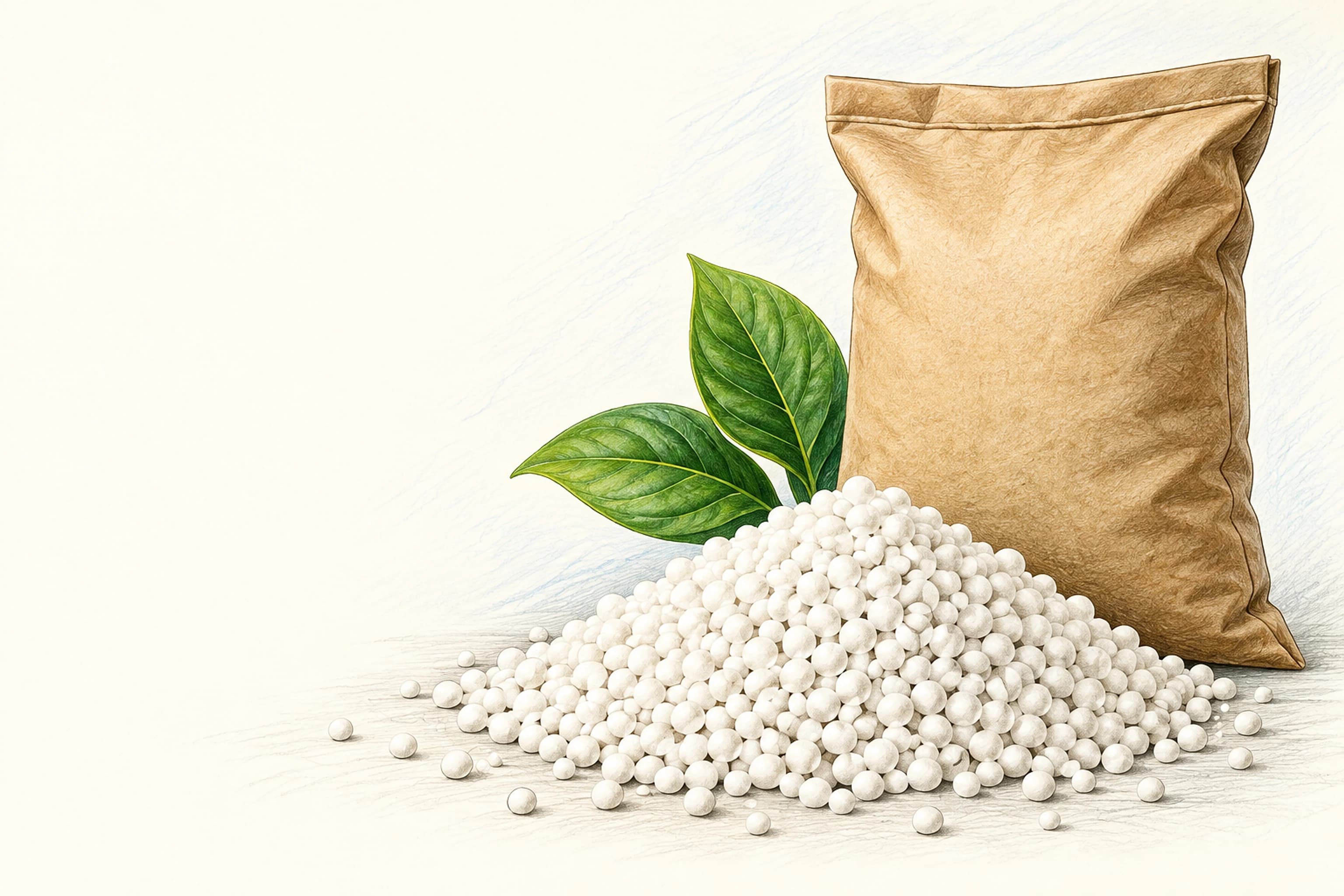
Size distribution determines how far and how evenly the product spreads and whether it blends without segregating. Fines raise dust levels and can cake more readily. Producers sometimes also report crushing strength, which indicates how well prills or granules survive handling. Prilled product tends to be smaller and softer; granular product is larger and harder.
pH, combustible material and impurities
These parameters are mainly about purity and stability rather than agronomy. A minimum solution pH shows the product does not carry free acid. Limits on combustible content and on certain impurities such as chloride and copper exist because these substances can reduce the thermal stability of ammonium nitrate. For buyers, they are a useful sign that the producer controls its process tightly.
Thermal stability and traceability
In some markets, high-nitrogen ammonium nitrate must also pass prescribed stability tests and carry traceability information linking each lot to its production. Buyers selling into such markets should confirm that the product and its documentation meet the destination's rules before ordering.
Nitrogen, moisture and particle size describe how the fertilizer will perform. pH, combustible content and impurity limits describe how well it has been made.
Reading a certificate of analysis
- Check that each result is given against a stated limit or method.
- Confirm the lot or batch number matches the bags or shipment.
- Look for both total nitrogen and, where shown, the nitrate and ammonium split.
- Note the date of analysis; product condition can change in storage.
Specifying ammonium nitrate in an enquiry
List the minimum nitrogen content, maximum moisture, particle size range and any regulatory limits your market applies. State packing, quantity and destination, and ask for the certificate of analysis, safety data sheet and certificate of origin you will need for import. Nuroil supplies ammonium nitrate fertilizer with a CoA for each delivery; send your specification via the quote form.