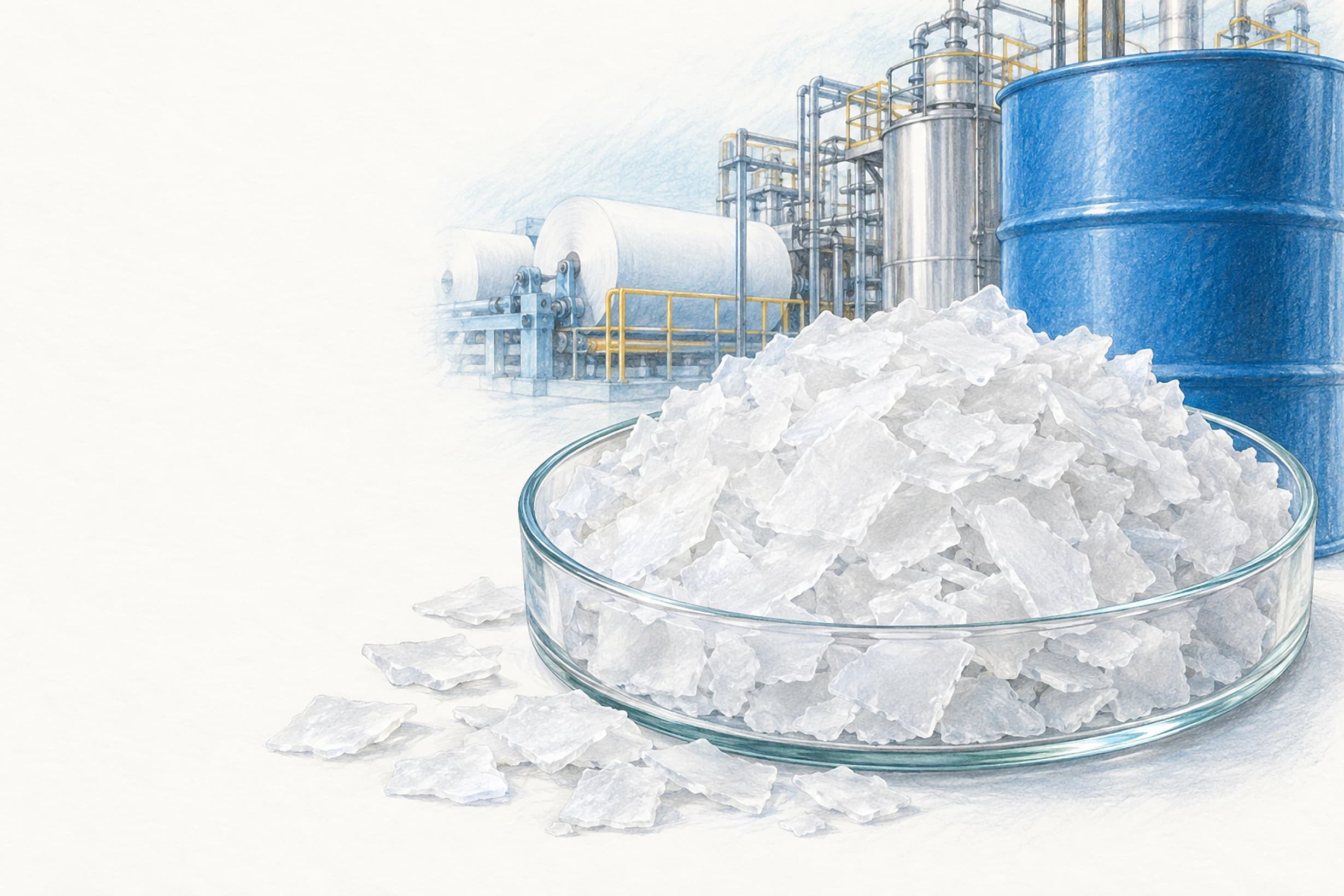
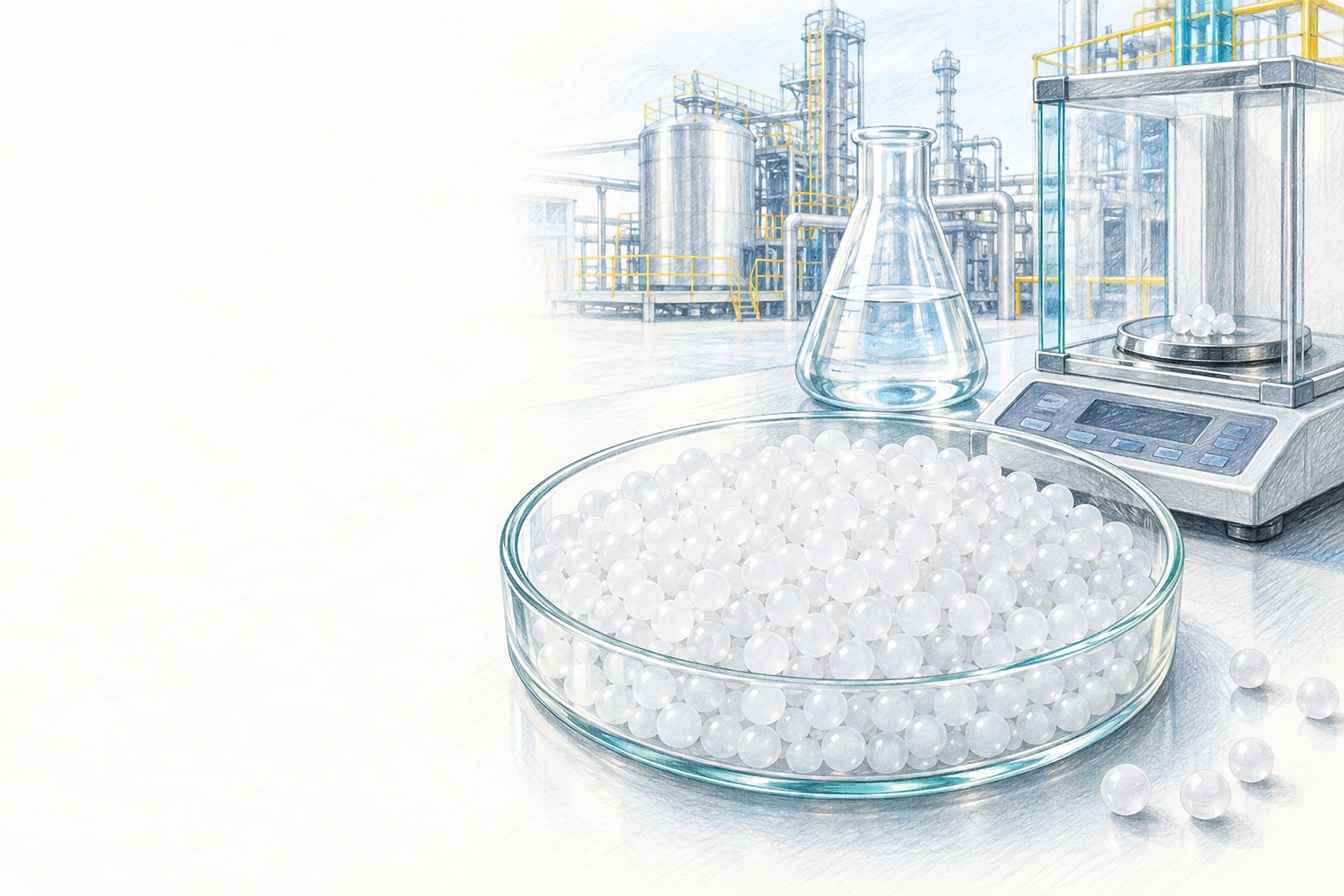
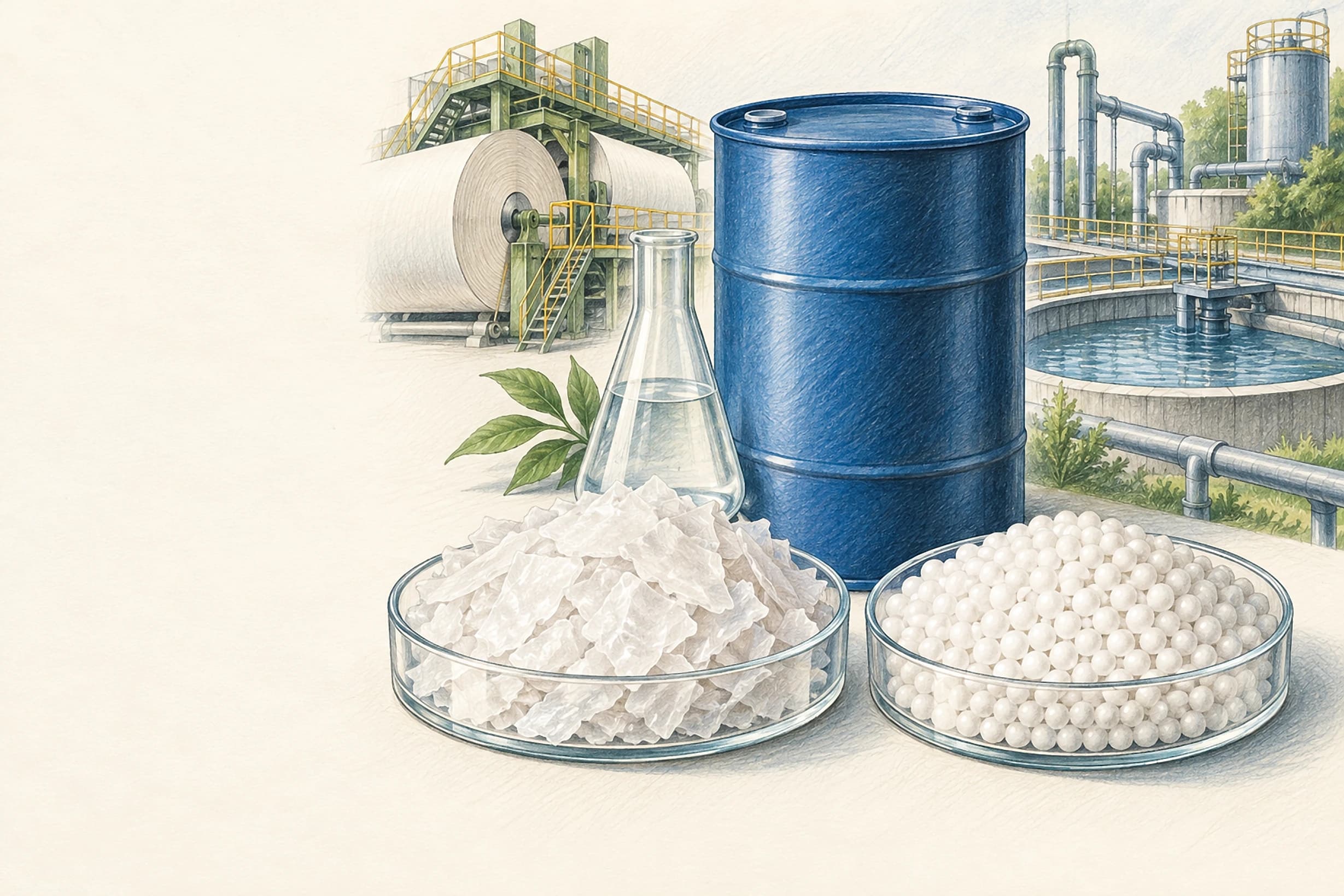
Liquid sodium hydroxide at 32 to 50% NaOH, ready to dose, for alumina, pulp and paper, soap, textiles and water treatment. Supplied by ISO tank, tanker, IBC or drum.
Caustic soda lye is sodium hydroxide (NaOH) as a water solution. It is the direct product of the chlor-alkali process, so it needs no dissolving step and can be pumped and metered straight into a process.
As a strong alkali it reacts readily with acids, fats, oils and proteins. That supports neutralisation, saponification and pulp processing, but it also means correct storage materials, PPE and dilution practice are essential.
Identity
Formula
NaOH
Molar mass
40.00 g/mol
CAS
1310-73-2
Sodium hydroxide · NaOHWhy Caustic soda lye
Ready to doseNo heat-releasing dissolution on site.
Lower freight per tonne at 50%More NaOH per load in concentrated grades.
Continuous dosingPumped and metered directly into the process.
Documented qualityBatch CoA supports shipment verification.
What Nuroil does on every order
Why choose lye from Nuroil?
Checked against the batch CoA
NaOH, carbonate, chloride and iron are reviewed on the batch certificate before loading.
Sourced from India, China and the UAE
The producer and origin are named in each offer, matched to your grade and destination.
Packing and loading planned
Bags, jumbo bags or bulk, with the load and corrosive-goods paperwork arranged for you.
One desk, firm offers
FOB, CFR or CIF from our Sharjah trade desk, usually within 24 hours.
02 TECHNICAL DATA
Technical specification.
NaOH content
32%, 48% or 50% w/w (agreed per order)Acid-base titration
Na₂CO₃
0.1% max, typicalTitration
NaCl
0.02% max, typicalTitration
Iron (as Fe)
Typically low ppm; agreed per orderAAS / ICP
Sulphate (as Na₂SO₄)
0.02% max, typicalGravimetric / titration
Appearance
Clear, colourless to slightly hazy liquidVisual
Density at 20°C
About 1.35 g/cm³ (32%) to 1.52 g/cm³ (50%)Hydrometer / densitometer
Crystallisation
Around 6°C (32%) to 12°C (50%); heated storage in cool weather
Solubility
Fully miscible with water; exothermic on dilution
Shelf life
Stable when sealed; absorbs CO₂ from air
0132% NaOH
Easy to handle and store
Lower crystallisation temperature, simpler storage and widely used for water treatment, neutralisation and general industrial dosing.
0248–50% NaOH
More caustic per tonne shipped
Cuts freight and storage per tonne of NaOH, but crystallises at higher temperatures and needs heated, insulated tanks and lines in cool weather.
Selection guidance Choose by your dosing concentration, storage heating and delivery distance. State the required concentration and impurity limits at enquiry.
The same chemical in three forms. The right one depends on how you store, handle and dose it.
Property
Flakes
Pearls
LyeThis page
NaOH
96–99%
99% min
32–50% in water
Dust
Some fines
Low
None
Flow
Can bridge in hoppers
Free-flowing
Pumped
Dissolving
Fast, gives off heat
Fast and even
None needed
Price
Lowest of the solids
Slightly higher
Low per tonne; freight on the water
Storage
Dry, sealed bags
Dry, sealed bags
Tanks, kept warm if 48–50%
Typical buyers
Soap, pulp and paper, alumina, textiles, water treatment
Purified sodium chloride solution is electrolysed in membrane cells. The caustic soda solution that forms is collected and, if required, concentrated by evaporation from about 32% to 50%.
01
Purified brine
Clean salt solution feed
02
Electrolysis
Membrane cells separate the brine
03
Caustic solution
About 32% NaOH is collected
04
Concentration
Evaporated to 48–50% if required
05
Delivery
Loaded to tank, IBC or drum
04 APPLICATIONS
Where lye performs.
01
Alumina production
Bayer-process digestion of bauxite ore.
02
Pulp, paper & textiles
Pulping, bleaching and textile mercerisation.
03
Soap & Detergents
Saponification of fats and oils.
04
Water Treatment
pH adjustment and acidic-stream neutralisation.
05
Chemicals & Metals
Neutralisation, ore processing and chemical synthesis.
06
Food Processing
Certified food-grade material only.
05 SAFETY & HANDLING
Corrosive. Handle deliberately.
This summary does not replace the Safety Data Sheet. Review the SDS and site procedure before first handling.
Danger
H290 May be corrosive to metals.
H314 Causes severe skin burns and eye damage.
UN
1823 solid · 1824 solution
Class
8, corrosive
01
Protect skin and eyes
Use chemical-resistant gloves, apron and eye/face protection.
02
Add lye to water, never the reverse
Dilution releases substantial heat and can cause violent spattering.
03
Avoid aluminium, zinc and tin
Reaction can release flammable hydrogen gas.
04
Prevent crystallisation
Heat and insulate 48–50% storage and lines in cool weather.
05
Exposure response
Rinse skin or eyes immediately with water for at least 15 minutes and seek medical attention; do not neutralise with acid.
Plan documentation early.
HS code2815.12
CAS number1310-73-2
EC number215-185-5
UN numberUN 1824
GHS
Skin Corrosion Category 1A (H314)
REACH
Registration/import obligations for the EU
National regulations
Destination-specific chemical import and tank-transport requirements
06 DELIVERY OPTIONS
Choose your delivery format.
Figures are indicative; confirm exact payload and corrosive-goods transport requirements before booking.
ISO tank / road tanker
For bulk delivery to receiving tanks with compatible unloading.
Origin is confirmed in each offer. Country markers indicate sourcing origins, not individual refineries or live stock availability.
India — Caustic soda
China — Caustic soda
United Arab Emirates — Caustic soda
08 BEFORE YOU ORDER
Frequently asked questions.
01What is caustic soda lye?
Caustic soda lye is liquid sodium hydroxide (NaOH) dissolved in water, commonly supplied as 32%, 48% or 50% solution. It is the same chemical as flakes and pearls, ready to dose without a dissolving step.
02Which concentration should I choose?
32% is easy to handle and widely used. 48 to 50% reduces freight per tonne of NaOH but crystallises at higher temperatures and needs heated storage and lines. Choose by your dosing system and climate.
03Is liquid caustic soda dangerous to handle?
Yes. It is corrosive to skin and eyes and reacts violently with acids. Use suitable PPE and compatible materials. When diluting, always add lye to water slowly with cooling, never water to lye.
04What storage is needed?
Use sealed tanks or IBCs made of carbon steel, stainless steel or suitable plastics, kept clear of aluminium, zinc and tin. Heat and insulate 48 to 50% material in cool weather to prevent crystallisation.
05How is caustic soda lye delivered?
By ISO tank container, road tanker, IBC or drum, and by bulk vessel for larger volumes, depending on concentration, quantity and destination.
06What purity and grade is available?
Membrane-cell grade is common for industrial use. Share your required NaOH, carbonate, chloride and iron limits at enquiry. The batch Certificate of Analysis is the controlling document.
07What documents come with a shipment?
A batch Certificate of Analysis. Safety Data Sheet and Certificate of Origin are supplied with the shipment documents. Dangerous-goods transport documents are provided as required.
08What Incoterms are available?
FOB, CFR and CIF offers can be prepared around the selected origin, destination and shipment size.
Include concentration, quantity, destination, delivery format and impurity limits for a tailored offer. We reply with a firm FOB, CFR or CIF offer, usually within 24 hours.