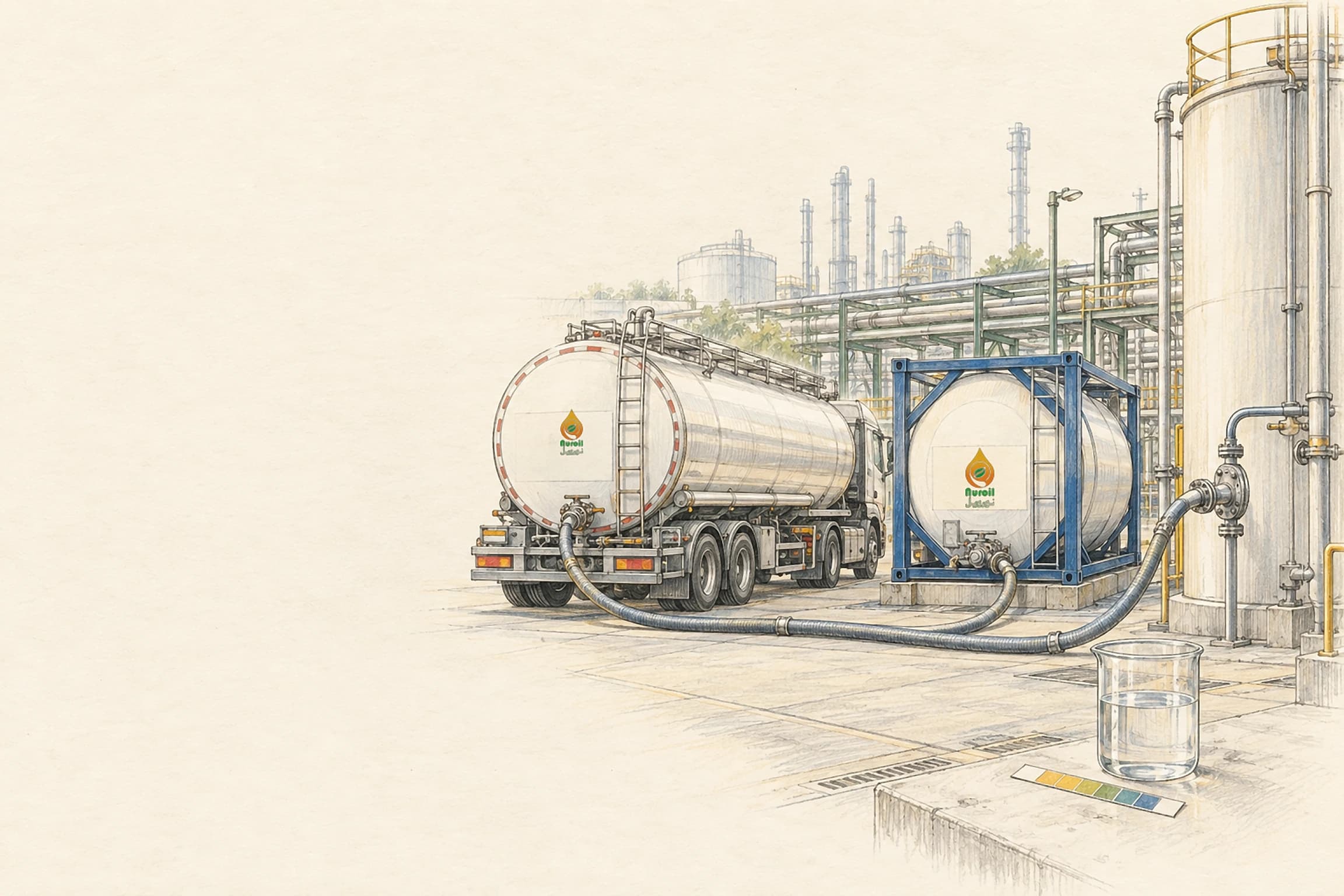
Buyers who switch from flakes or pearls to liquid caustic soda are often surprised that the product can freeze on a mild night. A 50% sodium hydroxide solution is not like water: it starts to crystallise at a temperature many sites see every winter, and once crystals form in a pipe or valve, the system stops. This article explains why it happens and how plants keep lye moving through the cold months.
Why strong lye freezes at a warm temperature
Sodium hydroxide and water form a series of solid hydrates, so the freezing point of the solution does not simply fall as you add more caustic. It falls at first, reaching a minimum in the high-teens percentage range, then climbs steeply as the solution gets stronger. Producers' handbooks state that 50% caustic soda begins to crystallise at about 54 °F, roughly 12 °C. Water-treatment guidance from Australia gives a similar picture: around 30% the solution stays liquid until below 0 °C, but a 40% solution can freeze at about 15 °C and a 46% solution at about 5 °C.
Two practical points follow. First, the exact freezing point depends on concentration, so a lye that is a few points stronger than ordered can freeze earlier. Second, even before crystals appear, cold 50% lye becomes thick and flows poorly, which upsets pumps and dosing.
For 50% lye, think of 12 °C as the danger line and about 21 °C as the comfortable minimum for unloading.
Where lye systems block first
- Unloading lines and hoses that sit empty and cold between deliveries.
- Bottom outlet valves on road tankers, ISO tanks and railcars, which are often less insulated than the shell.
- Small-bore dosing lines and instrument tappings with little thermal mass.
- Dead legs and low points where liquid stands still.
- Outdoor storage tanks without insulation, where a crystal layer can build on the walls and floor.
Keeping tanks and lines liquid
The usual design combines insulation with gentle heat. Producer guidance suggests about 50 mm of polyurethane foam or cellular glass is normally enough for a storage tank, with an external heat exchanger and circulation pump, or internal heating coils, where heat is needed. Unloading and transfer lines are best fitted with electric or steam tracing under the insulation. An alternative is to blow steam or hot water through the line just before use, but never into the delivery vessel itself.
Heat must be moderate. Carbon steel holding strong caustic corrodes quickly above about 49 °C (120 °F), and the iron it picks up discolours the product; stress-cracking can also start in steel that has not been stress relieved. Handbooks therefore recommend low-pressure or atmospheric steam rather than high-pressure steam, and warn against leaving heating coils on while a tank or tanker is being emptied.
Thawing frozen lye safely
- Vent the vessel before heating so expanding liquid and air have somewhere to go.
- Apply low-pressure steam to jackets, coils or the outlet valve area, never directly into the caustic.
- Measure the product temperature with a long probe; temperature is the best guide to whether it is ready.
- Expect slow progress: a fully frozen railcar can take days of steaming to liquefy.
- Wear full chemical protective equipment when opening any connection on frozen or thawing lines, because trapped pockets of hot caustic can spurt.
When dilution is the better answer
If a site has long cold spells and little steam, it may be simpler to buy or dilute to a lower strength. A solution around 30% stays liquid well below 0 °C, which is why drinking-water authorities note that climate matters for any lye stronger than about 30%. The trade-off is more water to transport and store per tonne of sodium hydroxide; the companion article on choosing between 32% and 50% lye covers that balance.
What to agree with your supplier
For winter deliveries, confirm the concentration and its tolerance, the loading temperature, whether the ISO tank or tanker has heating coils or a steam jacket, and the transit time to your site. Ask for the certificate of analysis and the SDS, and give the supplier your minimum unloading temperature. Nuroil can quote 32% or 50% caustic soda lye with these details on request through the quote form.