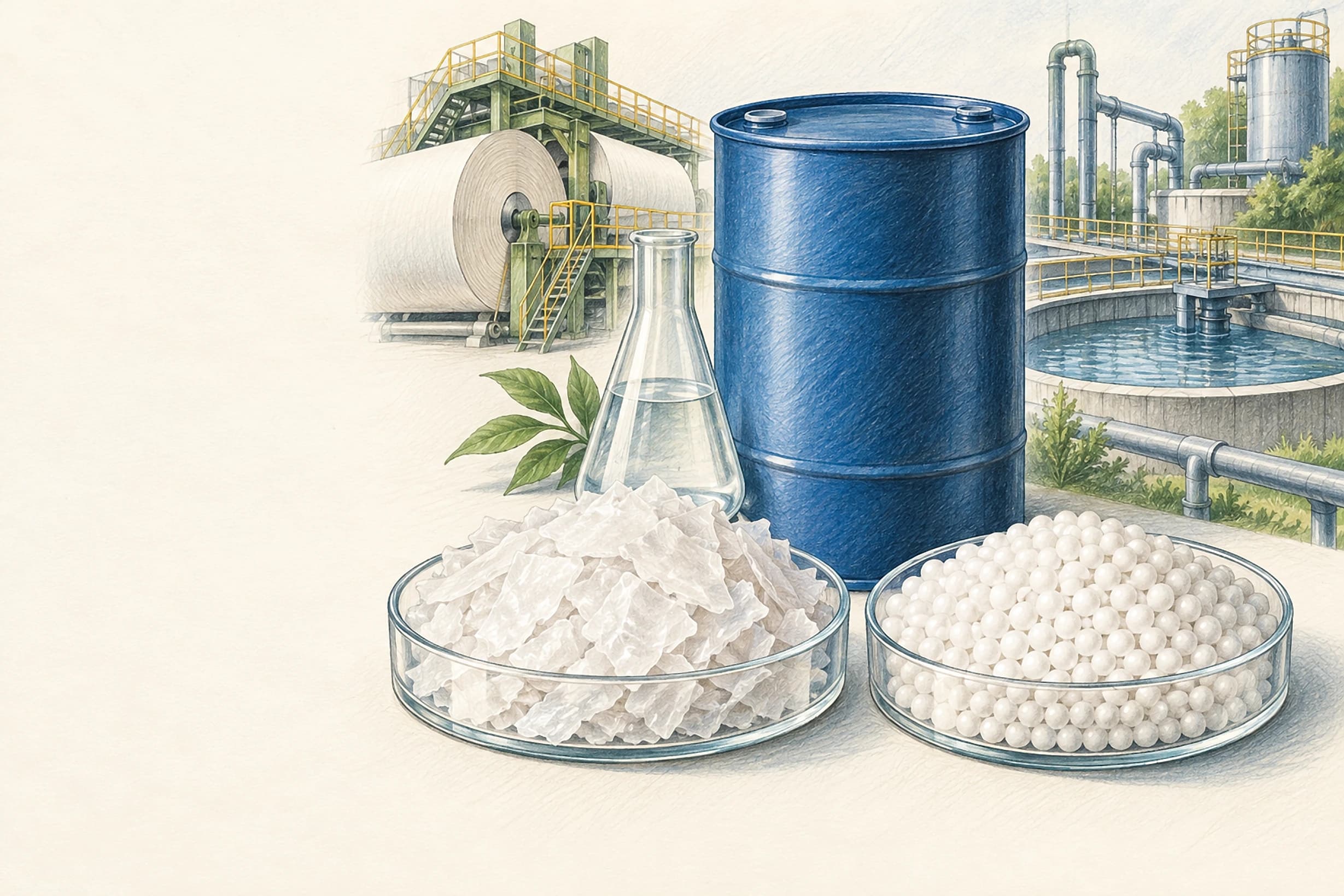
Caustic soda (sodium hydroxide, NaOH) reaches buyers in two broad families: solid, or "anhydrous", product and liquid solution, usually called lye. The solids are mainly sold as flakes and as pearls, also known as beads or prills. Chemically they are identical. What differs is shape, particle size, water content and therefore how the product travels, stores and goes into your process.
Choosing the wrong form rarely ruins a batch, but it can add avoidable freight cost, dissolving time and handling risk. This article sets out the practical differences.
How each form is made
Almost all caustic soda comes from electrolysis of salt brine, which produces chlorine and hydrogen alongside it. The cell produces a weak solution that is evaporated to the standard commercial strength of about 50% NaOH. That 50% liquor is the starting point for everything else.
- Lye is the 50% solution itself, sometimes diluted to lower strengths for convenience.
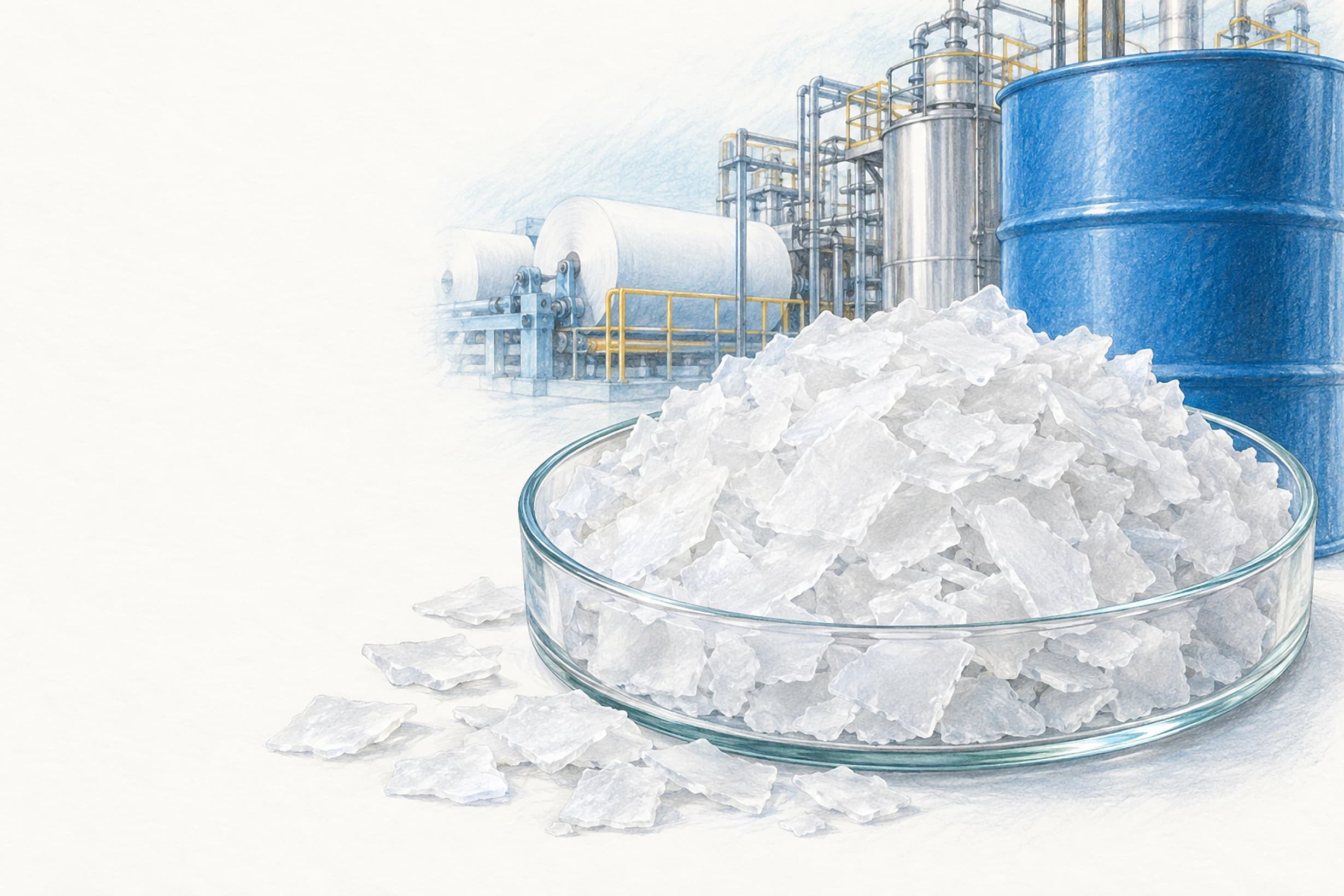
- Flakes are made by evaporating the remaining water to give molten caustic, then running it over cooled rolls that solidify it into thin flakes of even thickness.
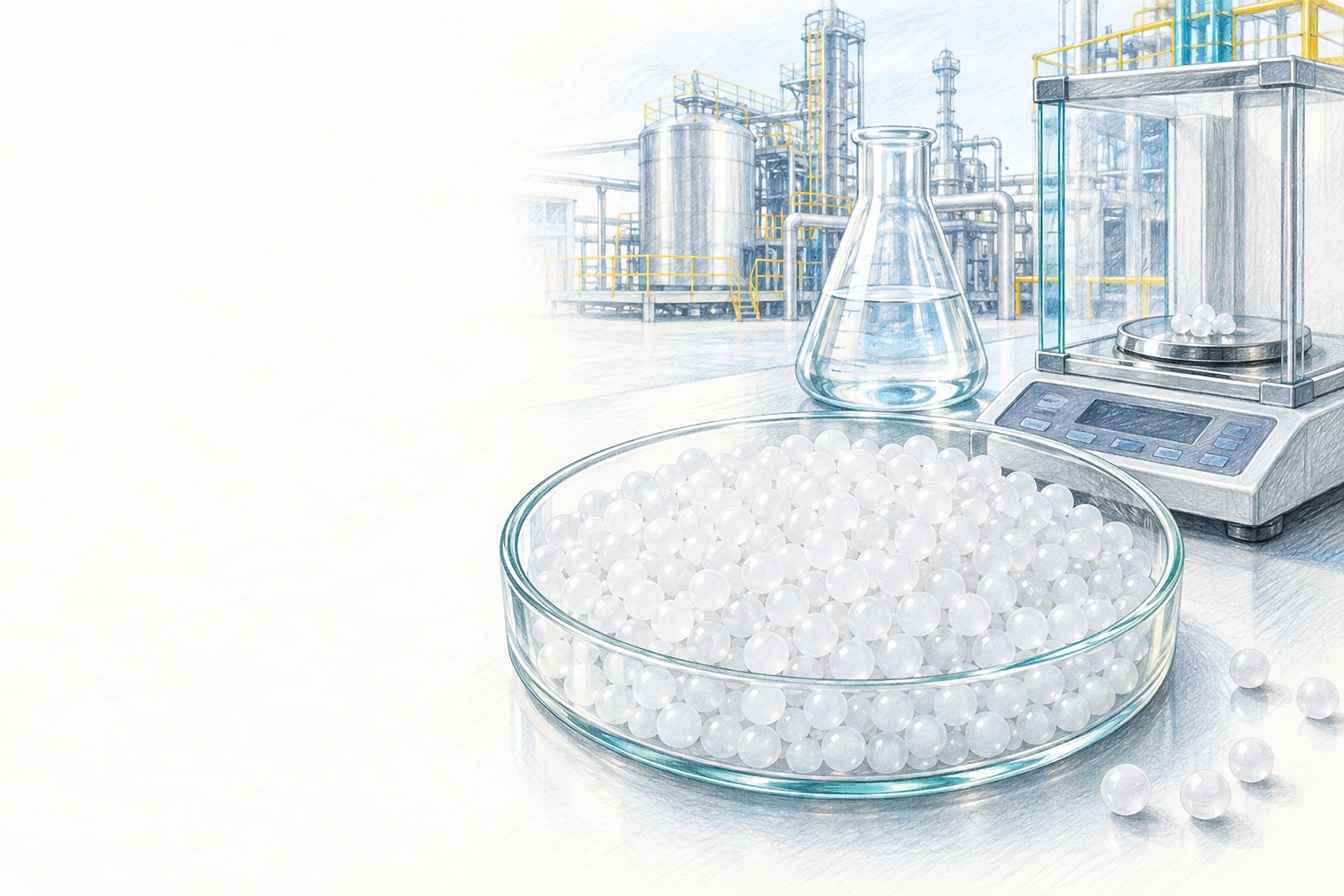
- Pearls are made by spraying molten caustic down a prilling tower, where droplets solidify into small spheres of controlled size.
Flakes and pearls typically assay at 98% NaOH or higher. Lye carries roughly half its weight as water.
Dissolving speed and dosing
Most users dissolve solid caustic before use, so dissolving behaviour matters. Producer test data show that beads dissolve markedly faster than flake under the same conditions: in one laboratory comparison, beads dissolved in about 15 seconds against around 41 to 44 seconds for two flake grades. The rounded, uniform pearls also flow freely, which suits screw feeders, hoppers and automatic dosing.
Flakes are irregular and tend to stick together as they pick up moisture, so they are generally dosed by the bag into a stirred dissolving tank. They are widely used where caustic is added by hand or in batches, such as soap making, textile processing and general cleaning.
Lye needs no dissolving at all. It can be pumped and metered directly, which makes it the usual choice for continuous dosing in water treatment, chemical plants and large cleaning-in-place systems.
Comparing the three forms
| Factor | Flakes | Pearls | Lye (about 50%) |
|---|---|---|---|
| Typical NaOH content | 98% or more | 98% or more | Around 49.5 to 51.5% |
| Dissolving | Slower; needs good agitation | Faster; free flowing | None needed; dilute only |
| Best suited to | Manual or batch addition | Automated feeders, quick make-up | Continuous pumped dosing |
| Freight efficiency | High (little water shipped) | High (little water shipped) | Lower (about half is water) |
| Main storage issue | Moisture and CO₂ pickup | Moisture and CO₂ pickup | Crystallises in cool weather |
Freight, storage and site conditions
Because solid caustic carries almost no water, it is the economical choice for long-distance shipments and for sites without bulk tanks. Packed in moisture-proof bags, it is easy to containerise and warehouse. Its weakness is that it readily absorbs water and carbon dioxide from air, so opened bags cake and slowly convert some NaOH to sodium carbonate.
Lye avoids dissolving, dust and the heat released when solids dissolve, but you pay to move the water. It also needs suitable tanks, pumps and in cooler places heat tracing, because 50% solution begins to crystallise at around 12 °C. In hot climates this is less of a concern, while elsewhere it can drive the decision towards solids or a lower-strength solution.
A simple way to decide
- Large, steady consumption with bulk storage and metering pumps: lye.
- Automated dry feeding, or quick batch make-up: pearls.
- Manual addition, smaller plants, long ocean freight or no tank capacity: flakes.
- Regulated end uses such as drinking water or food processing: whichever form is offered in the required certified grade.
The chemistry is the same in every form. Choose on how you dissolve and dose, how far the product travels and how you will store it.
What to specify when you enquire
State the form (flakes, pearls or lye), the minimum NaOH content and any limits on carbonate, chloride and iron, plus the intended use so the right grade can be offered. Give the packing you can handle and the destination port. Ask for a certificate of analysis for each lot and the safety data sheet. Nuroil supplies all three forms and can arrange certificates of origin or third-party inspection on request; see the caustic soda range or send details through request a quote.