Technical document

· PDF

Tell us who you are and the document downloads straight away. We use these details only to follow up on your requirement.

Samples & documents

What can we send you?

Tick what you need
Request a quote
NUROIL / CAUSTIC SODA

Caustic soda.Compare the range.

Caustic soda flakes, pearls and liquid lye (sodium hydroxide) for alumina, soap, textiles, water treatment and chemicals, supplied in bags, jumbo bags and bulk.

Caustic SodaFlakes · Pearls
Forms3Flakes · Pearls · Lye
NaOH content32 – 99%+liquid lye to pearls
Bead size (pearls)0.5 – 2 mmlow dust
PackingBags · jumbo bags · bulkFOB · CFR · CIF
01 / YOUR SUPPLY PARTNER

Why source
caustic soda from Nuroil.

Grade, specification and delivery confirmed for your requirement, from Nuroil Trading in Sharjah.

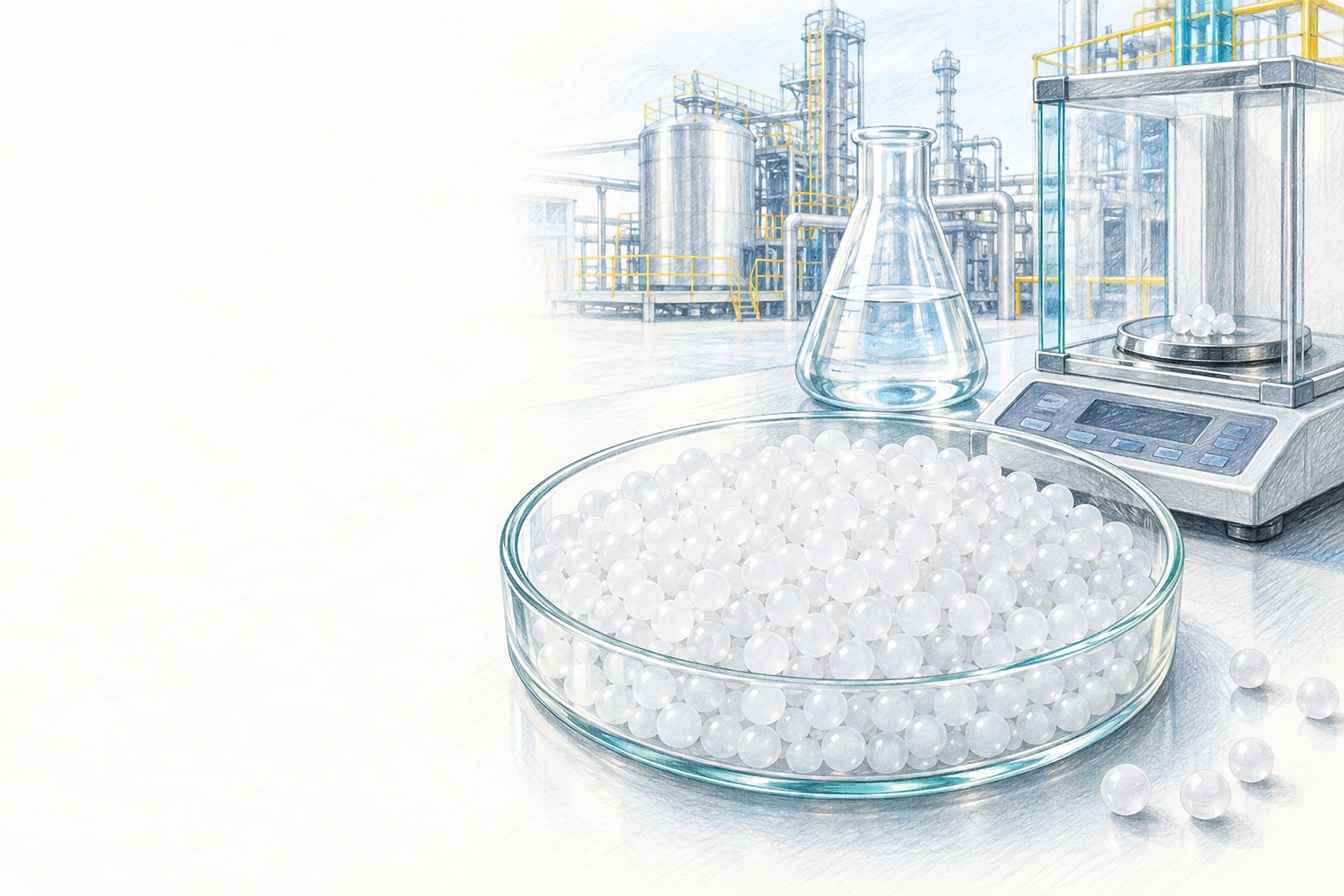
  • Pencil sketch comparing caustic soda flakes and pearls

    Three forms, one contact

    Flakes, pearls and liquid lye through one commercial relationship, matched to your feeding system.

  • Pencil sketch of a laboratory titration beside a sample jar of caustic soda flakes

    Every batch verified

    Review typical values against the batch Certificate of Analysis for NaOH, carbonate, chloride and iron.

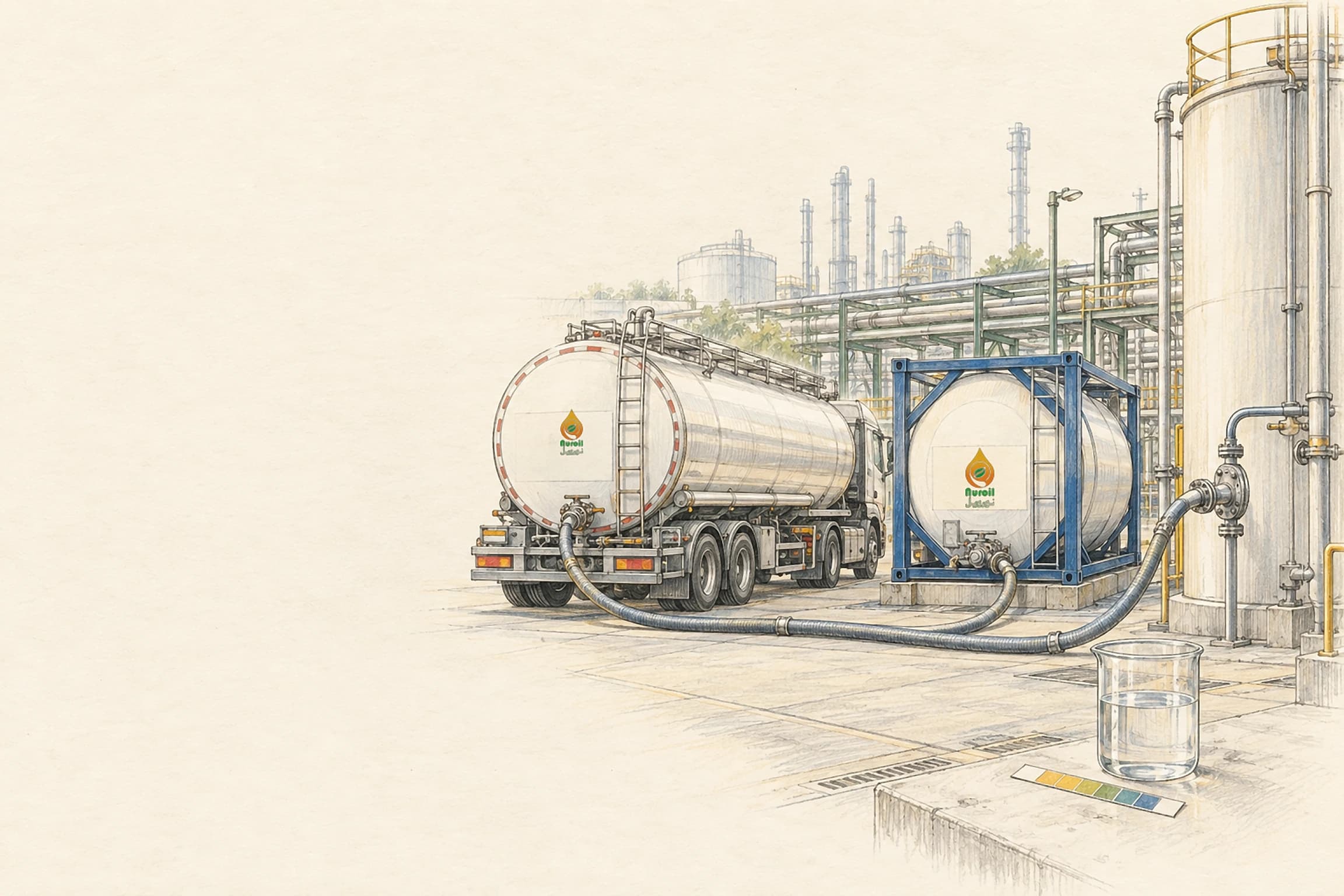
  • Pencil sketch of caustic soda packing

    Packing built around handling

    Moisture-sealed 25 kg and 50 kg bags, jumbo bags and bulk, planned for safe unloading.

02 / THE MATERIAL

What is
caustic soda?

IN SHORT

Caustic soda is sodium hydroxide, NaOH, a strongly alkaline white solid that dissolves fully in water and gives off a lot of heat as it does. It is sold as solid flakes and pearls and as a liquid solution called lye.

Pencil sketch of caustic soda flakes, pearls and liquid lye, with flakes dissolving in water
Chemical
Sodium hydroxide, NaOH
Flakes and pearls
96 to 99%+ NaOH
Lye (liquid)
32 to 50% NaOH
Main uses
Alumina, soap, textiles, water
03 / READING THE GRADES

Reading
the forms.

All forms are the same chemical. Choose by concentration, shape and handling.

  1. 01

    Shape and size

    Flakes are flat irregular pieces. Pearls are small spherical beads of 0.5 to 2 mm.

  2. 02

    Purity

    Flakes are commonly offered across 96 to 99% NaOH. Pearls are typically 99% minimum.

  3. 03

    Dust and dosing

    Pearls flow evenly and make less dust, which suits controlled dosing. Flakes suit general industrial use.

04 / STRENGTHS & LIMITS

What the form
does and does not tell you.

What it tells you

  • Shows the shape, size and typical purity of each form
  • Lets you compare flakes and pearls on the same basis
  • Points to the processes each form suits

What it does not tell you

  • Confirm the exact batch purity, which is on the Certificate of Analysis
  • Guarantee interchangeability in your process
  • Confirm current stock, origin or price
05 / FULL COMPARISON

Catalogue
specifications.

Typical values for the two solid forms. Confirm the specification of the offered batch before ordering.

Technical data sheet · Typical values

Caustic soda flakes

NUR-CS-01Sodium hydroxide · NaOH
NaOH content
96 to 99%
Na₂CO₃
1.0% max
NaCl
0.02% max
Iron
0.005% max (as Fe₂O₃)
Shape
White, irregular flakes
Bulk density / density
About 1,000 to 1,300 kg/m³
Dust
Higher
Delivery
Bags, jumbo bags, bulk

Typical catalogue values. The Certificate of Analysis for the offered batch is the controlling document.

Issued for every batchRequest the Certificate of Analysis
06 / SELECTION

Choosing the right form
for your process.

Start with the feeding system and purity requirement.

  1. 01
    Requirement

    General industrial use, cost-led

    Flakes

    Irregular pieces across a 96 to 99% NaOH range.

  2. 02
    Requirement

    Controlled dosing, lower dust

    Pearls

    Uniform beads that flow and dose evenly.

  3. 03
    Requirement

    Higher purity requirement

    Pearls

    Typically 99% NaOH minimum.

  4. 04
    Requirement

    Continuous dosing, no dissolving step

    Lye

    Liquid 32 to 50% NaOH, pumped and metered; heat storage at 48 to 50%.

  5. 05
    Requirement

    Fast dissolving in tanks

    Flakes or pearls

    Add slowly to water with cooling and agitation.

Open a product page.

07 / APPLICATIONS

Made for the work
your operation does.

Match the product to the crop, equipment or process and confirm the specification before you order.

Pencil sketch of an alumina refinery digester with bauxite ore and alumina powder01

Alumina and metals

Caustic soda digests bauxite in alumina refining and is used in metal processing and cleaning.

Pencil sketch of a soap kettle with bars of soap and vegetable oil02

Soap and detergents

Reacts with fats and oils to make soap, and is a building block in detergent manufacture.

Pencil sketch of a cotton mercerising frame beside a paper roll and wood pulp03

Textiles and pulp

Used in textile scouring and mercerising and in pulp and paper processing.

Pencil sketch of a water treatment clarifier with a chemical dosing skid04

Water treatment and chemicals

Adjusts pH, neutralises acids and feeds the production of other chemicals.

08 / HOW IT IS MADE

From salt and electricity
to your site.

Caustic soda is made by electrolysing brine, then concentrated, solidified and packed.

Cl₂ · H₂01Electrolysis02Concentration03Forming04Testing and packing
  1. 01

    Electrolysis

    Salt brine is electrolysed in the chlor-alkali process to make caustic soda solution, chlorine and hydrogen.

  2. 02

    Concentration

    The solution is evaporated to a molten, highly concentrated product.

  3. 03

    Forming

    The melt is cooled into flakes or prilled into pearls.

  4. 04

    Testing and packing

    Each batch is tested and sealed in moisture-barrier bags, jumbo bags or bulk with a Certificate of Analysis.

09 / COMPATIBILITY & HANDLING

Dissolve with care
and store sealed.

Caustic soda is corrosive and absorbs moisture and carbon dioxide from the air.

Danger
  • H290 May be corrosive to metals.
  • H314 Causes severe skin burns and eye damage.
UN
1823 solid · 1824 solution
Class
8, corrosive
  1. 01

    Add to water

    Always add caustic soda slowly to water with agitation and cooling. Never add water onto solid caustic soda.

  2. 02

    Protect people

    It burns skin and eyes. Wear gloves, face protection and protective clothing.

  3. 03

    Keep it sealed and dry

    Store sealed, dry and away from acids and reactive metals such as aluminium, zinc and tin.

  4. 04

    Follow the SDS

    Read the safety data sheet for handling, spillage and first aid.

TOOL / STRENGTH CALCULATOR

How much caustic soda
for your solution?

Choose what you start from, the strength and the volume you need. The amounts and the heat it gives off update as you go.

Start from
Flakes to dissolve249 kg

About 10 bags of 25 kg

Water
970 L
Solution weight
1.22 t
Density at 20 °C
1.219 kg/L
Heat released
222 MJ
Hot mixup to about 52 °C warmer without cooling

Add slowly with stirring and cooling; let it cool before use.

A planning guide from typical purity and published densities. Your batch Certificate of Analysis and plant procedure decide the final amounts.

10 / REFERENCE METHODS

Documents and
regulatory reference.

Caustic soda is a hazardous, corrosive material, so documents and transport rules matter.

Trade and safety codes

For customs declarations, shipping documents and safety data sheets.

  • HS code2815.11Solid: flakes and pearls
  • HS code2815.12In aqueous solution: lye
  • CAS number1310-73-2Sodium hydroxide
  • EC number215-185-5EU substance identity
  • UN numberUN 1823Solid · Class 8 · PG II
  • UN numberUN 1824Solution · Class 8 · PG II or III
01
Certificate of Analysis
Confirms NaOH content and key impurities for the shipped batch.
02
Safety Data Sheet and Certificate of Origin
Supplied with the shipment documents.
03
Transport classification
Solid sodium hydroxide is classed as corrosive for sea, road and rail transport; confirm destination rules.
11 / PACKING & DELIVERY

Packing
formats.

Availability depends on the product, quantity and receiving facilities. Confirm the arrangement for your order.

  • 25 kg
    01 / SMALLER ORDERS

    25 kg / 50 kg bags

    Moisture-barrier bags for smaller orders and distributor resale.

    Discuss this format
  • 1,000kg
    02 / CONTAINERISED SUPPLY

    Jumbo bags

    Jumbo bags for containerised supply and larger consumers.

    Discuss this format
  • 50%
    03 / TANK AND IBC DELIVERY

    Liquid lye: ISO tank, IBC, drums

    Caustic soda lye by ISO tank, tanker, IBC or drum, to compatible receiving tanks.

    Discuss this format
  • 04 / LARGE VOLUMES

    Bulk supply

    Bulk supply for buyers with suitable corrosion-resistant receiving and storage.

    Discuss this format
13 / PRICE ON THE DAY

Get today’s price.

Prices follow the market, so we quote each order on the day. Share your product, quantity and delivery point and we send a firm offer within 24 hours.

Request today’s price
14 / BUYING THIS RANGE

Frequently asked questions.

Product, documentation, delivery and terms for this range.

Question not listed?

Share your grade, destination and packing and we will answer with the offer.

Discuss your requirement ↗
01What is the difference between caustic soda flakes and pearls?
Both are sodium hydroxide. Flakes are irregular flat pieces for general industrial use; pearls are small spherical beads that support controlled dosing and typically generate less dust.
02Which form should I select?
Choose around your feeding system, dissolution method, dust control and process preference. Share your application and equipment with our team before substituting one form for another.
03What purity is available?
Flakes are commonly offered across a 96 to 99% NaOH range, pearls at 99% minimum. The batch Certificate of Analysis is the controlling document.
04How should solid caustic soda be dissolved?
Dissolution releases substantial heat. Add caustic soda slowly to water with agitation and cooling, never water onto solid caustic soda. Follow the SDS and site procedure.
05What documents come with a shipment?
A batch Certificate of Analysis. Safety Data Sheet and Certificate of Origin are supplied with the shipment documents.
06How should caustic soda be stored?
Sealed, dry and protected from moisture in compatible corrosion-resistant storage, away from acids and reactive metals.
07What packing formats are available?
25 kg or 50 kg bags, jumbo bags and bulk supply, subject to grade, source and shipment volume.
08What is the HS code for caustic soda?
Solid caustic soda (flakes and pearls) is classified under HS 2815.11 and caustic soda lye, in aqueous solution, under HS 2815.12. Confirm the national tariff line with your customs broker, as countries extend the code with their own digits.
09What is the shelf life of caustic soda?
Caustic soda does not break down. Kept sealed in its moisture-barrier bags in a dry, covered store, it keeps its specification. Once opened it absorbs moisture and carbon dioxide and forms sodium carbonate, so reseal part-used bags and use the oldest stock first.
10Are caustic soda pearls more expensive than flakes?
Usually a little, because prilling is an extra production step and pearls are made to a tighter purity. Prices follow the market, so we quote each order on the day for your form, quantity and delivery point.
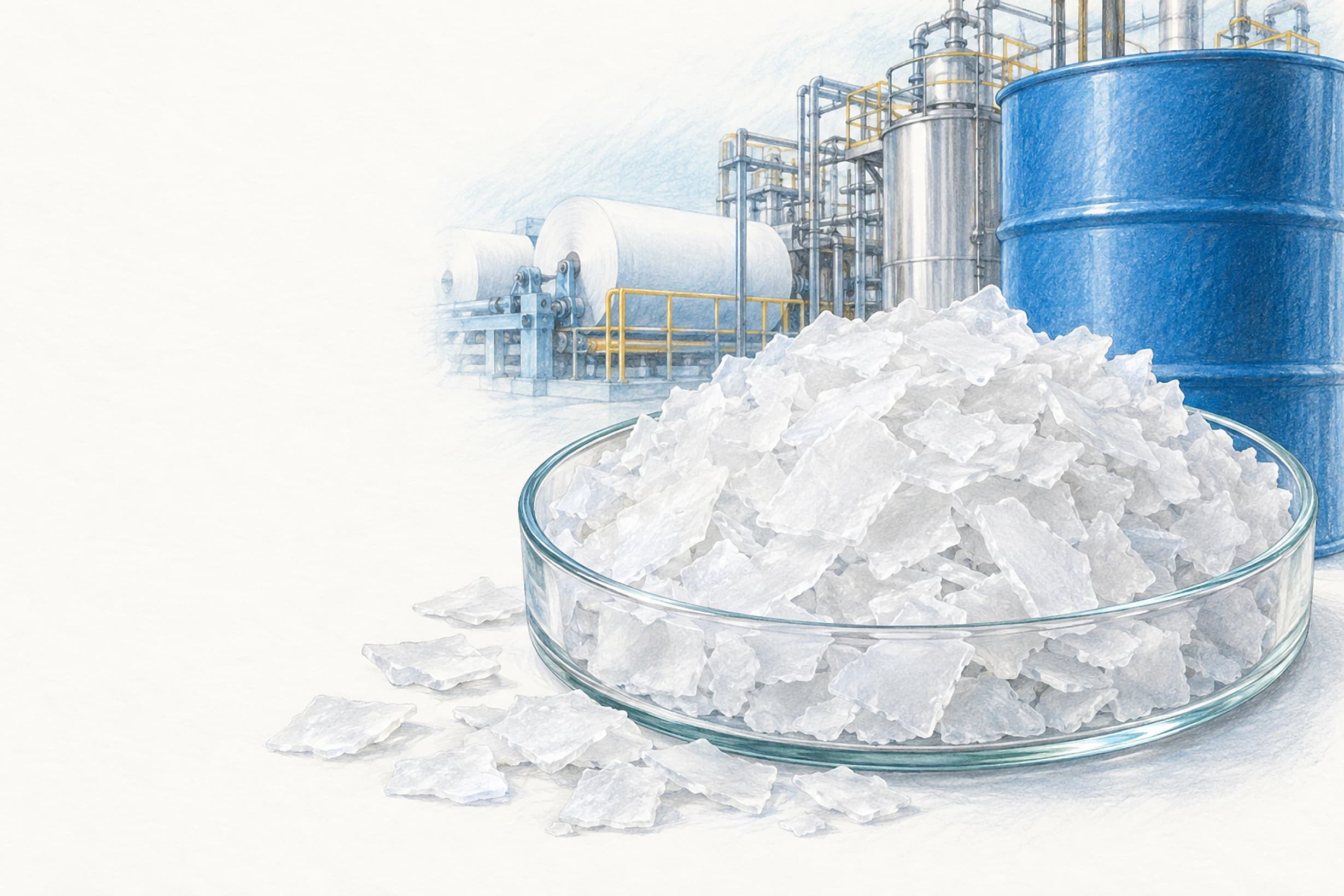
THE CAUSTIC SODA RANGE

Choose a form

  1. Caustic Soda FlakesSolid flakes in bags or bulk
  2. Caustic Soda PearlsFree-flowing pearls
  3. Caustic Soda LyeLiquid, 32–50% NaOH
FROM THE KNOWLEDGE CENTRE

Guides & articles

Written by our trade desk to help you specify, compare and buy with confidence.

All guides & articles
ArticleAlkalis · 3 minFlakes, pearls or lye: which form of caustic soda to buy

Caustic soda flakes, pearls and lye are the same chemical in different forms. How to choose by dissolving speed, handling,…

Read
ArticleAlkalis · 3 minHow caustic soda is used for pH control in water treatment

Why water plants dose caustic soda: raising pH, cutting pipe corrosion, restoring alkalinity after coagulation and regenerating…

Read
ArticleAlkalis · 3 minThe role of caustic soda in soap and detergent making

How caustic soda turns oils into soap, why saponification values matter, and how it neutralises sulphonic acid in detergent…

Read
GuideAlkalis · 3 minCaustic soda specifications and what each parameter means

A reference to the parameters on a caustic soda specification: NaOH content, sodium carbonate, sodium chloride, iron and other…

Read
GuideAlkalis · 3 minSafe handling, protective equipment and dissolving of caustic soda

Reference guide to handling caustic soda safely: hazards, PPE, the right way to dissolve flakes and pearls, first aid and spills.

Read
GuideAlkalis · 3 minStorage and packing options for caustic soda

Reference on packing and storing caustic soda: bags, big bags and drums for solids; IBCs and tanks for lye; moisture, CO2 and…

Read
LET’S TALK ABOUT YOUR REQUIREMENTS

Your next shipment starts here.

Request a quote