Caustic soda lye is handled routinely in steel, stainless steel, nickel alloys and several plastics. The right choice depends mainly on temperature, how much iron contamination the process can accept, and the size of the installation. This guide collects the main rules used in producer handbooks.
Materials at a glance
| Material | Typical use | Main limits |
|---|---|---|
| Carbon steel | Most common for tanks and pipes at low to moderate temperature | Best at about 27–38 °C; above about 49 °C corrosion and iron pickup rise, and unrelieved welds can crack |
| Epoxy-lined carbon steel | Large tanks where iron pickup must be limited | Lining temperature rating; inspection of coating |
| 304L / 316L stainless steel | Tanks, pumps, valves, low-iron service | Acceptable to about 93 °C |
| Nickel and nickel alloys | Hot, strong caustic; heating coils | Cost |
| Polyethylene, polypropylene, PVC, CPVC | Small tanks, IBCs, dosing lines | Each plastic's maximum temperature; silica-free solvent cement for PVC/CPVC |
| Glass-fibre reinforced plastic (FRP) | Tanks | Must use resin, reinforcement and corrosion barrier suited to caustic |
Aluminium, copper, zinc, lead and their alloys, including brass and bronze, must never be used with caustic soda.
Storage tanks
- Construction: vertical or horizontal; steel tanks are typically built from plate at least 6 mm thick with around 3 mm corrosion allowance.
- Low-iron service: stainless steel for smaller tanks; epoxy-lined steel is usually more economical for large ones.
- Plastic tanks: polypropylene or FRP. Caustic attacks the glass fibres of poorly built FRP, so the fabricator must design for caustic service.
- Connections: product outlet at least about 100 mm above the floor to keep sediment out of the line, and a drain at the lowest point.
- Heating: external exchanger with circulation, or internal coils; nickel alloys are preferred for coils, though stainless steel is common on cost grounds and can crack at high temperature.
- Insulation: about 50 mm of polyurethane foam or cellular glass where 50% lye must be kept warm.
- Containment: a bund sized to hold the contents in case of tank failure, and an overflow piped to a safe area.
Pipework and valves
- Lines of 50 mm (2 inch) and up are usually schedule 40 carbon steel with welded or flanged joints. Fit wrap-around polypropylene flange guards to stop sprays from a leaking gasket.
- Slope lines to drain fully; avoid loops and pockets; provide water or air connections for purging.
- Where iron is unacceptable, use CPVC, polypropylene, or PP- or PTFE-lined steel, within their temperature and pressure ratings.
- Quarter-turn plug or ball valves in ductile iron, cast steel, stainless steel, Alloy 20 or PTFE-lined bodies are standard. Simpler valves tend to be more reliable.
Pumps and meters
- Centrifugal pumps in stainless steel or Alloy 20 with double mechanical seals or deep packing glands; magnetic-drive pumps avoid seals altogether.
- Shield the seal area and keep suction lines short; a recirculation line protects the pump and helps flow control.
- Magnetic, Coriolis or orifice meters suit strong, hot solutions; rotameters need non-glass tubes and nickel or stainless floats.
Commissioning a steel tank
Before first fill, steel tanks are cleaned of scale and passivated by spraying the walls with warm, dilute caustic. Producer guidance suggests around 10% solution at about 60 °C for two to four hours, then cleaning the floor and filling promptly so the passive layer is not lost. Filtering the first product through a 5–10 micron filter removes leftover particles.
Supply considerations
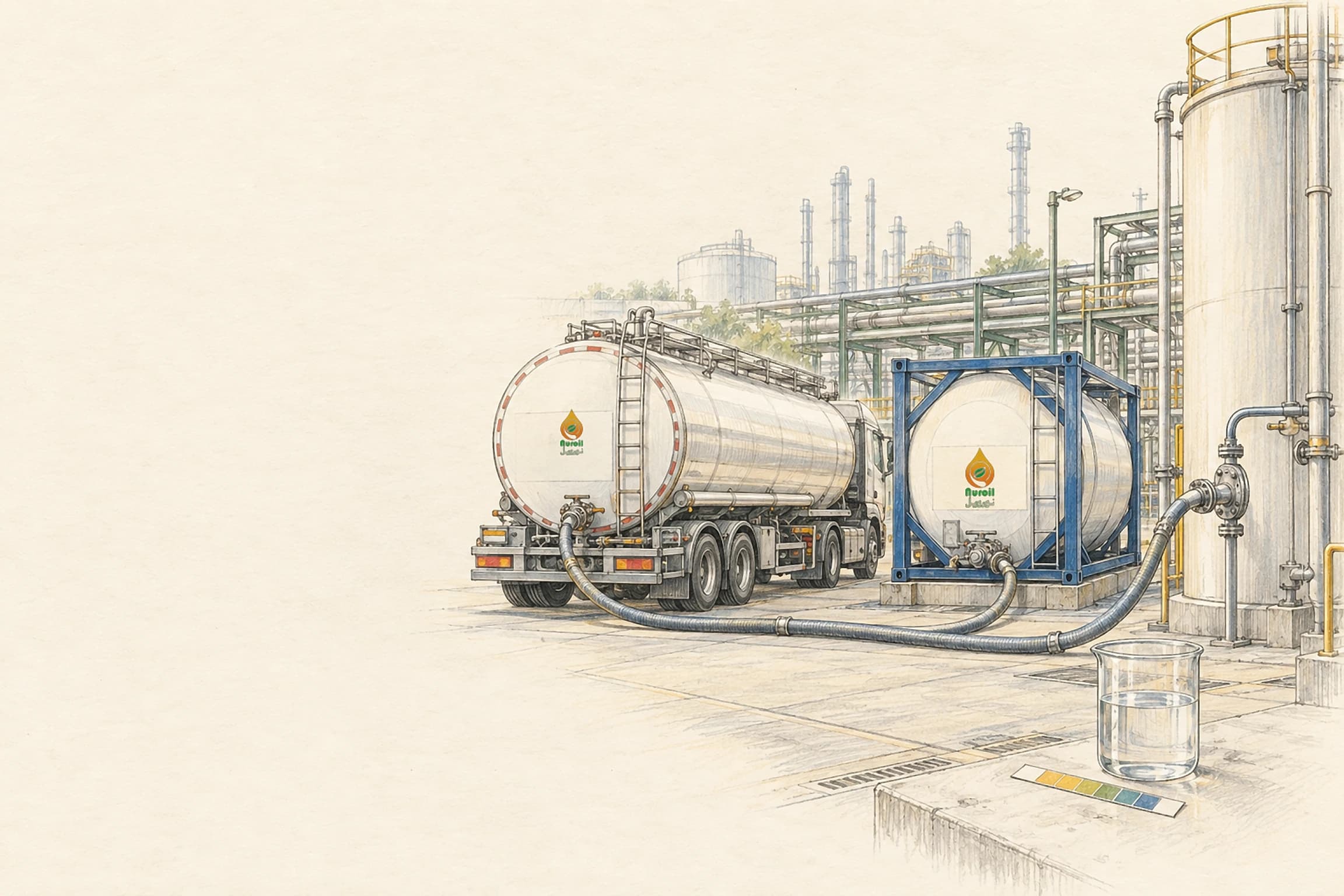
When you ask for lye, tell the supplier the tank material and any iron limit, because carbon-steel tanks and lined ISO tanks give different product quality at the outlet. Nuroil can provide the SDS and certificate of analysis for each cargo; discuss your installation through contact us.