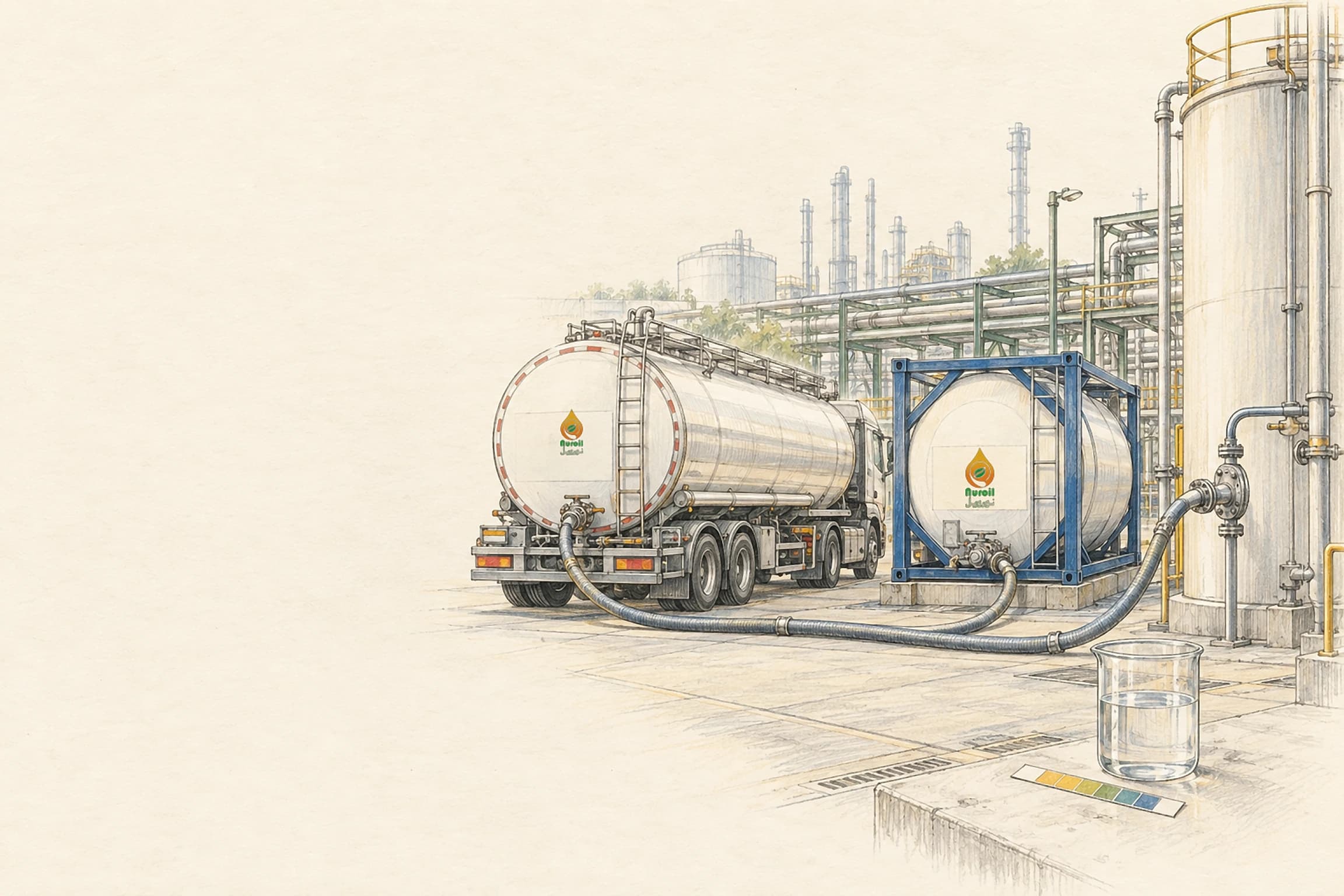
A caustic soda lye delivery should match the certificate of analysis on two counts: strength and purity. Strength affects every dosing calculation and freezing risk; purity matters for drinking water, food, textiles and process chemistry. This guide explains the common checks a receiving laboratory or inspector can make.
Quick check: density at a known temperature
The specific gravity of sodium hydroxide solutions rises steadily with concentration, so a hydrometer or density meter gives a fast estimate. Typical values are about 1.33 at 30% and about 1.48 at 46%; producer tables give about 1.53 for 50% at 15.6 °C. Density falls as the solution warms, so record the temperature and read the supplier's density table at that temperature rather than a single figure.
Density is a screening test, not a final answer. Dissolved salt in lower grades also adds density and can make a solution look stronger than it is.
Reference check: titration for alkalinity
The standard method weighs a sample, dilutes it in carbon-dioxide-free water and titrates with standardised 1 N hydrochloric acid to a modified methyl orange end point. The result is total alkalinity, reported as % NaOH or % Na₂O. A phenolphthalein end point gives hydroxide alkalinity. Producers note that because carbonate in caustic soda is normally very low, using the difference between these two titrations to estimate carbonate tends to overstate it, so carbonate is better measured directly where it matters.
Work fast with samples: lye pulls carbon dioxide and moisture from the air, which lowers apparent strength and raises carbonate.
Impurities and what they tell you
| Parameter | Why it matters | Typical method |
|---|---|---|
| Sodium chloride | Shows the production grade; membrane-grade 50% is usually below 100 ppm, diaphragm grade around 1% | Potentiometric or back titration with silver nitrate |
| Sodium carbonate | Indicates air exposure; can form scale in some uses | Gravimetric CO₂ evolution or carbon analyser |
| Sodium chlorate | Oxidising impurity of concern in some processes | Reduction with ferrous sulphate and back titration |
| Iron | Discolours product; signals corrosion of steel tanks or lines | Colorimetric or instrumental analysis |
| Heavy metals (e.g. mercury, lead, arsenic) | Limits for drinking-water use | Instrumental analysis by an accredited laboratory |
For drinking-water treatment, guidance lists arsenic, iron, cadmium, lead, chloride, mercury, chromium and nickel as possible contaminants, and expects residual levels from the chemical to stay within drinking-water limits. Specify these in the purchase order if they apply.
Sampling properly
- Sample from the vessel top or from the outlet after flushing the sampling device with product.
- Use clean polyethylene bottles, not glass, for storage beyond a short time.
- Take the carbonate sample first and cap it immediately.
- Label with the container number, seal number, date and temperature.
- Keep a retained sample until the batch is consumed.
Interpreting a mismatch
- Low strength, normal impurities: possible water ingress, or a container that held rinse water.
- High iron: unlined steel at high temperature, or heating with steam in steel lines.
- High carbonate: long air contact, open vents, or old samples.
- High chloride: a different grade from the one ordered.
Before raising a claim, repeat the test on the retained sample and check your own method: an unstandardised acid, a warm sample read against a cold density table, or a bottle left open will all give misleading results. If the difference stands, share the figures, sample details and photographs with the supplier and agree on an independent laboratory to settle it.
What to specify when buying
State the concentration range, the grade, and limits for chloride, carbonate, chlorate and iron, plus any drinking-water or food standard you work to. Ask for a certificate of analysis tied to the batch and, for larger cargoes, independent inspection at loading. Nuroil provides a CoA with every delivery and arranges third-party inspection on request; set out your limits when you request a quote.