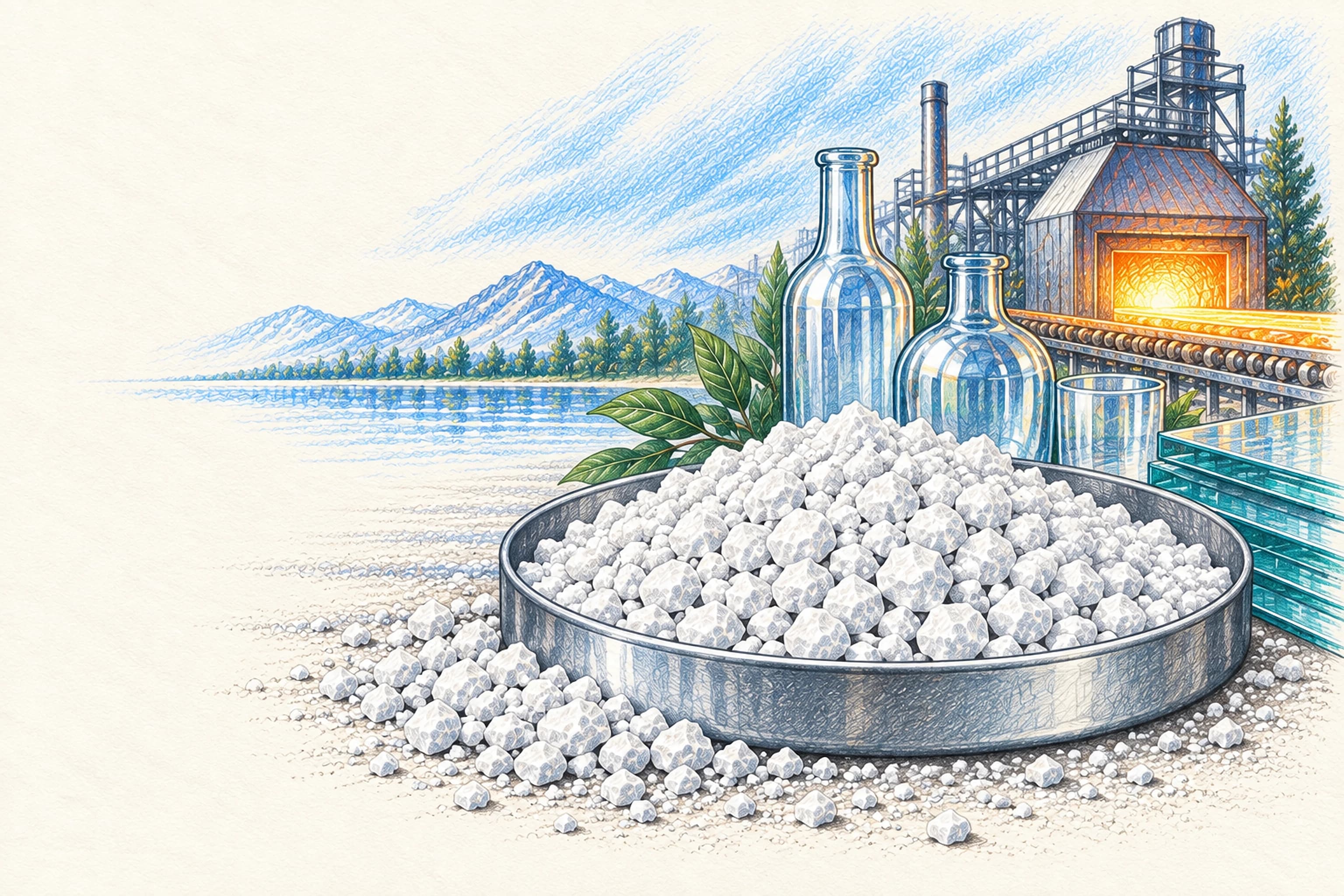
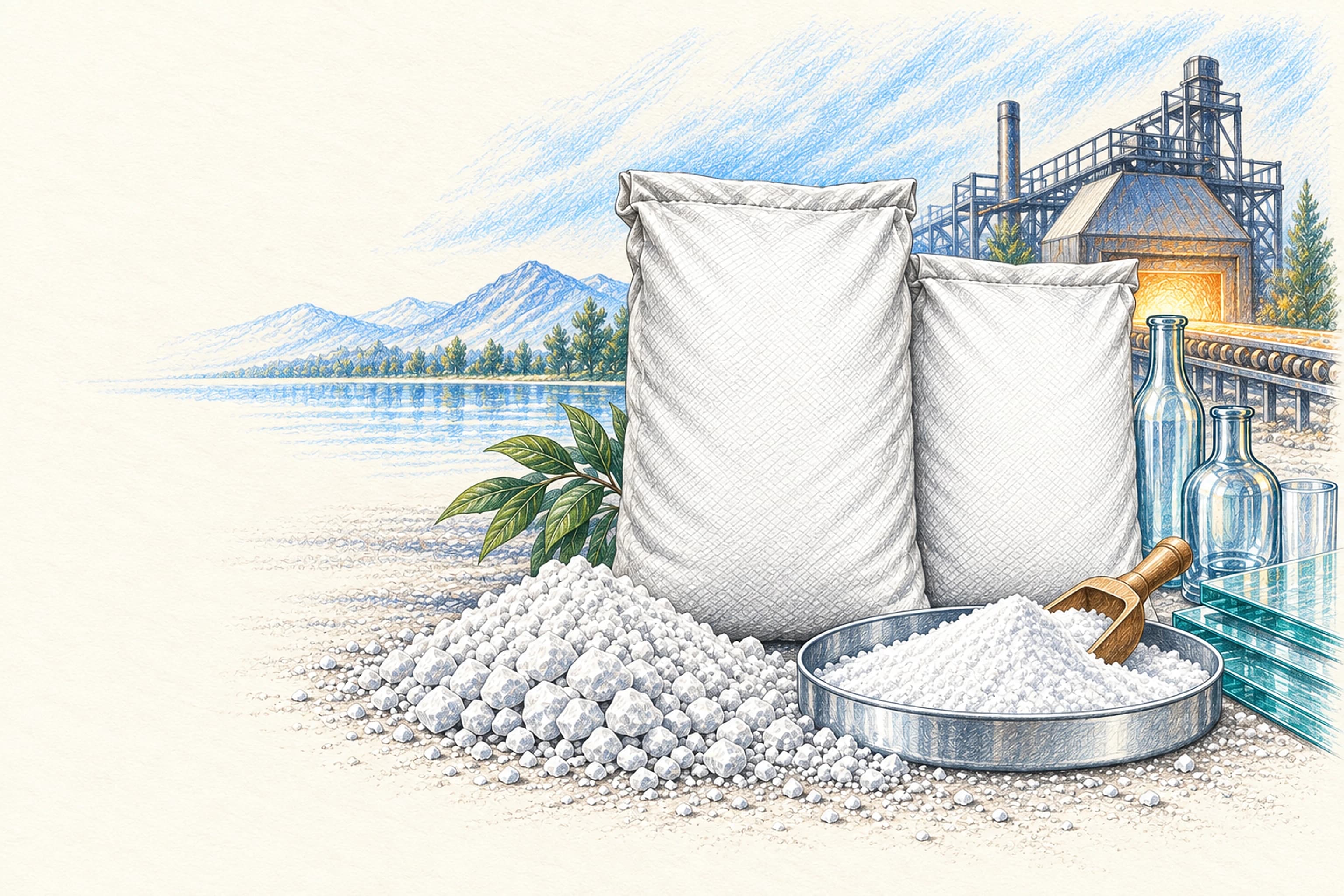
Sodium silicate, often called water glass, is one of the largest chemical uses of soda ash after glass itself. It ends up in detergents, paper, adhesives, foundry binders, water treatment, precipitated silica and many construction products. This article explains how soda ash enters the process and why producers usually prefer the dense grade.
The furnace route in brief
The classic method melts silica sand with sodium carbonate. Sodium carbonate melts at about 851 °C, well below the melting point of silica, so the molten carbonate dissolves the sand. Carbon dioxide is released and a sodium silicate glass forms:
x Na₂CO₃ + SiO₂ → (Na₂O)ₓ·SiO₂ + x CO₂
The glass is cooled, broken into lumps and later dissolved in water to make liquid silicate, or ground to give solid grades. A second route reacts sand with caustic soda solution and steam in a pressure vessel; it uses caustic rather than soda ash.
Ratio: why the soda ash charge matters
Silicates are classified by their weight ratio of SiO₂ to Na₂O, which ranges commercially from about 1:2 to 3.75:1. Grades below about 2.85:1 are called alkaline, those above it neutral. The ratio is set by how much soda ash is charged per tonne of sand. Because soda ash supplies all the sodium, its actual Na₂CO₃ content directly controls the product ratio: a lot that is a little weaker than assumed shifts the ratio upward. Producers therefore check total alkalinity on each delivery and adjust the batch recipe.
Why dense ash suits the furnace
Dense soda ash is a granular product with a bulk density of roughly 1,000–1,100 kg/m³, close to that of sand. Light ash is much fluffier, at about 700–860 kg/m³. In a furnace batch this difference matters in several ways:
- Less dust carry-over. Fine, light particles are more easily swept out by combustion gases, wasting alkali and fouling the flue system.
- Better mixing with sand. Granules of similar size and density stay mixed during conveying; very different particles tend to separate.
- Easier bulk handling. Dense ash flows well in silos and conveyors and takes less storage volume per tonne.
The same reasons make dense ash the standard grade for glass furnaces, which share much of the batch-handling equipment.
Quality parameters that affect silicate
| Parameter | Typical dense ash limit | Effect in silicate |
|---|---|---|
| Na₂CO₃ | 99.2–99.5% min | Sets the alkali charge and ratio |
| Sodium chloride | 0.04–0.2% max | Carries through as an impurity in the finished silicate |
| Sodium sulphate | Around 0.2% max where specified | Adds an unwanted impurity to the melt |
| Iron (as Fe₂O₃) | About 20 ppm max where specified | Tints the glass and the dissolved silicate |
| Water insolubles | About 0.05% max | Adds turbidity to liquid silicate |
| Screen analysis | Few oversize lumps, little fines | Even melting, low dust |
Handling at the plant
Soda ash picks up moisture and can cake if stored damp, which disturbs weighing and batch accuracy. Keep it dry in silos or covered stores and convey with dry air. Because the furnace reaction releases CO₂ from the carbonate, batch calculations must allow for that weight loss: roughly 42% of the mass of pure sodium carbonate leaves as carbon dioxide.
Weighing accuracy matters for the same reason. Most silicate plants weigh soda ash and sand separately before mixing, so bulk density changes do not upset the recipe, but volumetric feeders must be rechecked whenever the supplier or grade changes. Keeping a retained sample of each lot makes it easier to trace a ratio drift back to the raw material.
Specifying dense ash for silicate
In an enquiry, state the minimum Na₂CO₃, limits for chloride, sulphate and iron, the bulk density range and screen analysis you need, and the packing (bulk, big bags or 50 kg bags). Ask for a certificate of analysis per lot. Nuroil supplies dense soda ash with a CoA on every delivery; send your specification through request a quote.