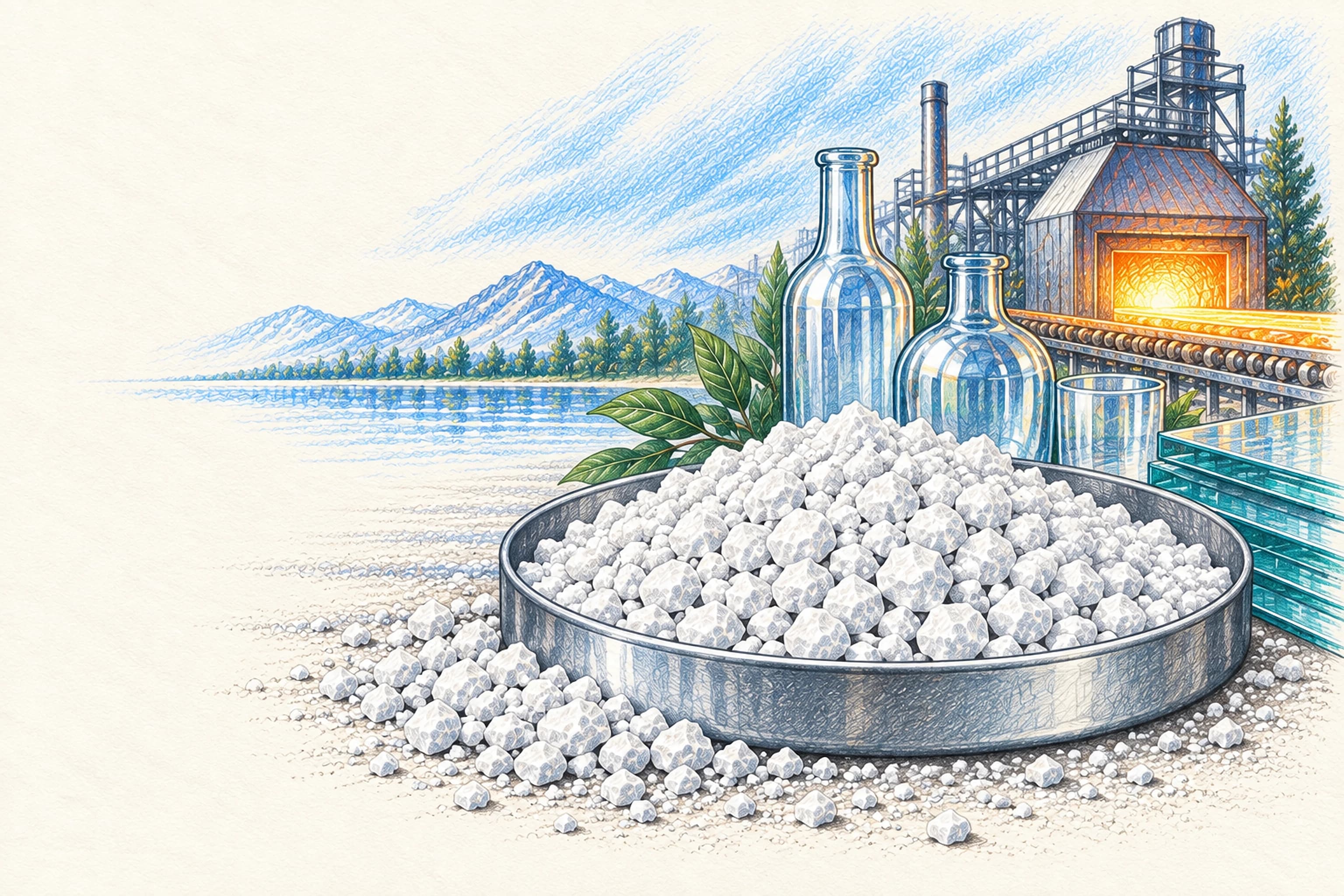
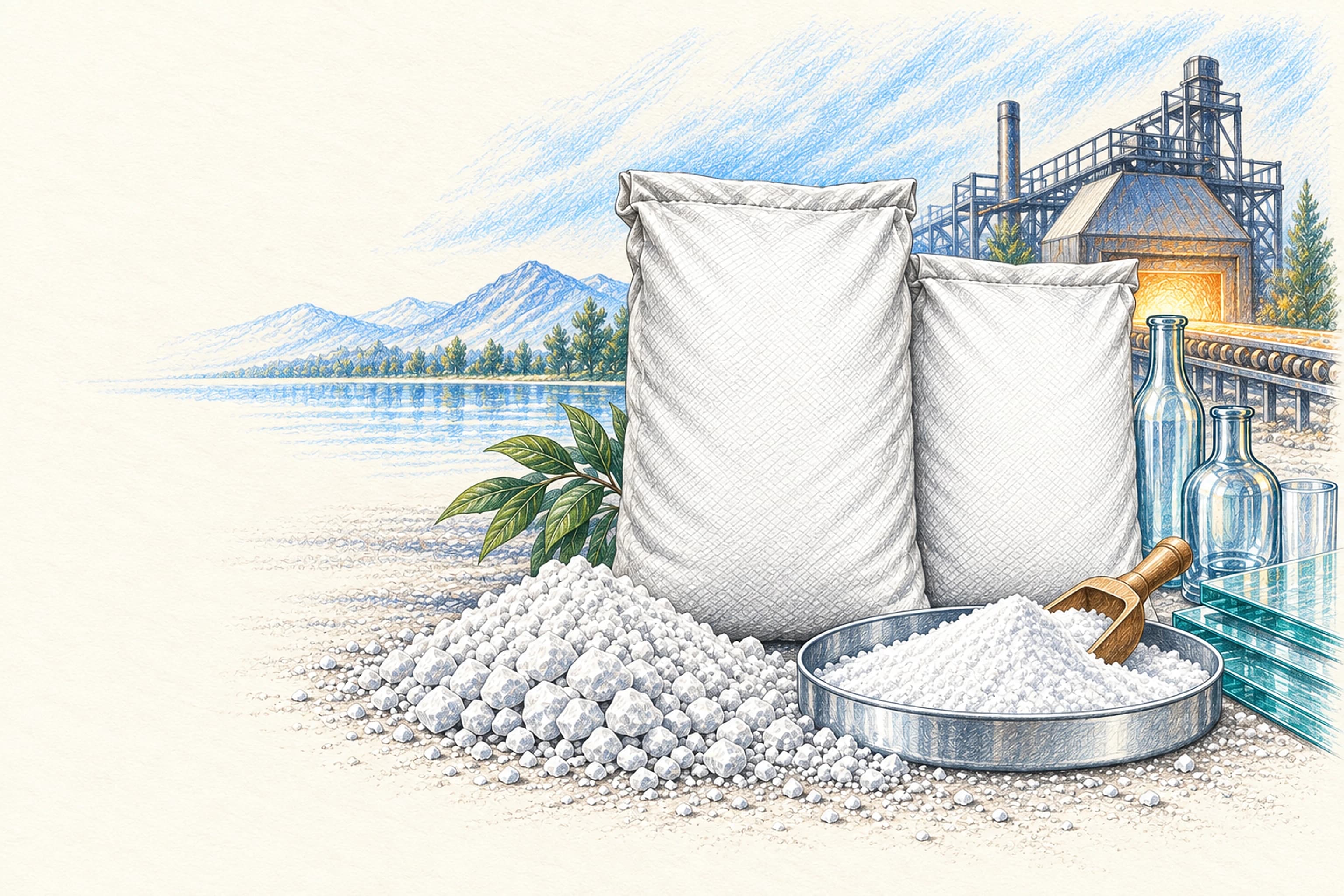
Soda ash is a workhorse in powder detergents. It supplies alkalinity for cleaning, softens water by precipitating calcium and magnesium as carbonates, and acts as a low-cost carrier. Many smaller producers make powders by dry blending rather than spray drying. For them, the physical form of soda ash matters as much as its purity, because the wrong grade can make a blend separate in the bag.
What soda ash does in the powder
- Alkalinity: raises wash pH, which helps remove fatty and acidic soils.
- Water softening: reacts with hardness ions to form insoluble carbonates, so surfactants are not wasted on hard water.
- Bulk and carrier: makes up a large share of many formulations and can absorb some liquid ingredients.
The segregation problem
A dry blend only stays uniform if its particles behave alike when shaken, poured or conveyed. Formulators aim to give all major dry ingredients a similar particle size and bulk density. Detergent technical literature notes that a material with a markedly larger or smaller particle size than the rest of the formula tends to segregate, and that differences in density can cause separation even when sizes match. In a laundry powder, the risk is that minor ingredients such as enzymes, bleach or perfume granules drift away from the carbonate base, so one scoop is strong and the next is weak.
Match the soda ash to the rest of the blend, not to a habit. The right grade is the one whose size and density sit closest to the other granules.
Light, medium-dense and dense compared
| Grade | Typical bulk density | Behaviour in a dry blend |
|---|---|---|
| Light ash | About 700–860 kg/m³ | Absorbs liquids well; dusty; can segregate from coarser granules |
| Medium-dense ash | Between light and dense | Designed to approach finished-powder density; good liquid uptake; dissolves faster than dense |
| Dense ash | About 1,000–1,100 kg/m³ | Low dust, free flowing; less liquid absorption; slower to dissolve |
When dense ash is the right choice
- Formulations built around other dense, granular ingredients such as granular sodium sulphate or coarse silicate.
- Products where dust in the packing hall is a problem.
- Bulk systems with silos and screw conveyors, where free flow matters.
- Industrial and institutional powders that are dissolved in hot water or in dosing systems, where dissolution speed is less critical.
When another grade may be better
- When the blend must absorb a high level of liquid surfactant, light or medium-dense ash usually takes up more liquid before the powder becomes sticky.
- For cold-water consumer powders, faster-dissolving grades help avoid residues; suppliers note that medium-dense ash dissolves much faster than dense.
- Where the other ingredients are fine powders, a fine soda ash grade may segregate less than dense granules.
Practical checks before switching grade
- Compare the screen analysis of the soda ash with those of your other main ingredients.
- Run a small blend, vibrate a filled pack, then sample top and bottom for alkalinity or a marker ingredient.
- Check liquid uptake by spraying your surfactant at the intended dose and judging flow.
- Dissolve the finished powder at your target wash temperature and look for residues.
Keep the trial results with the formulation record. When a new supplier or lot arrives, a quick screen analysis and bulk density check against those records shows whether the material will behave the same way, before a full production batch is at risk. Store bags dry, too: soda ash that has picked up moisture forms lumps that upset both blending and dissolving.
Specifying for a detergent plant
Give the supplier your bulk density range, screen analysis limits, minimum Na₂CO₃ and maximum chloride and iron, and say whether you need 50 kg bags or big bags. Ask for a certificate of analysis with each lot so physical properties stay consistent. Nuroil supplies dense soda ash with a CoA per delivery; enquire through request a quote.