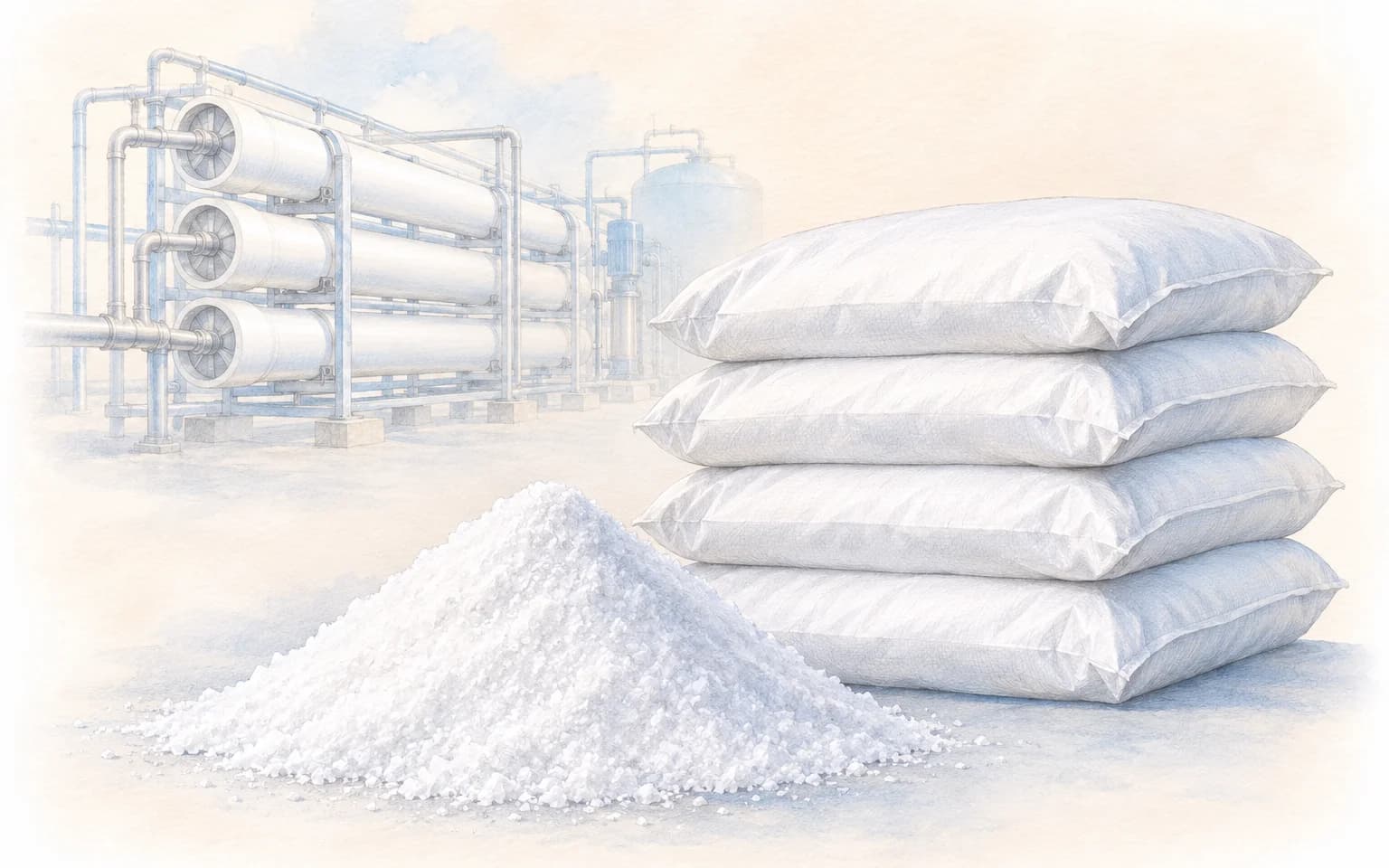
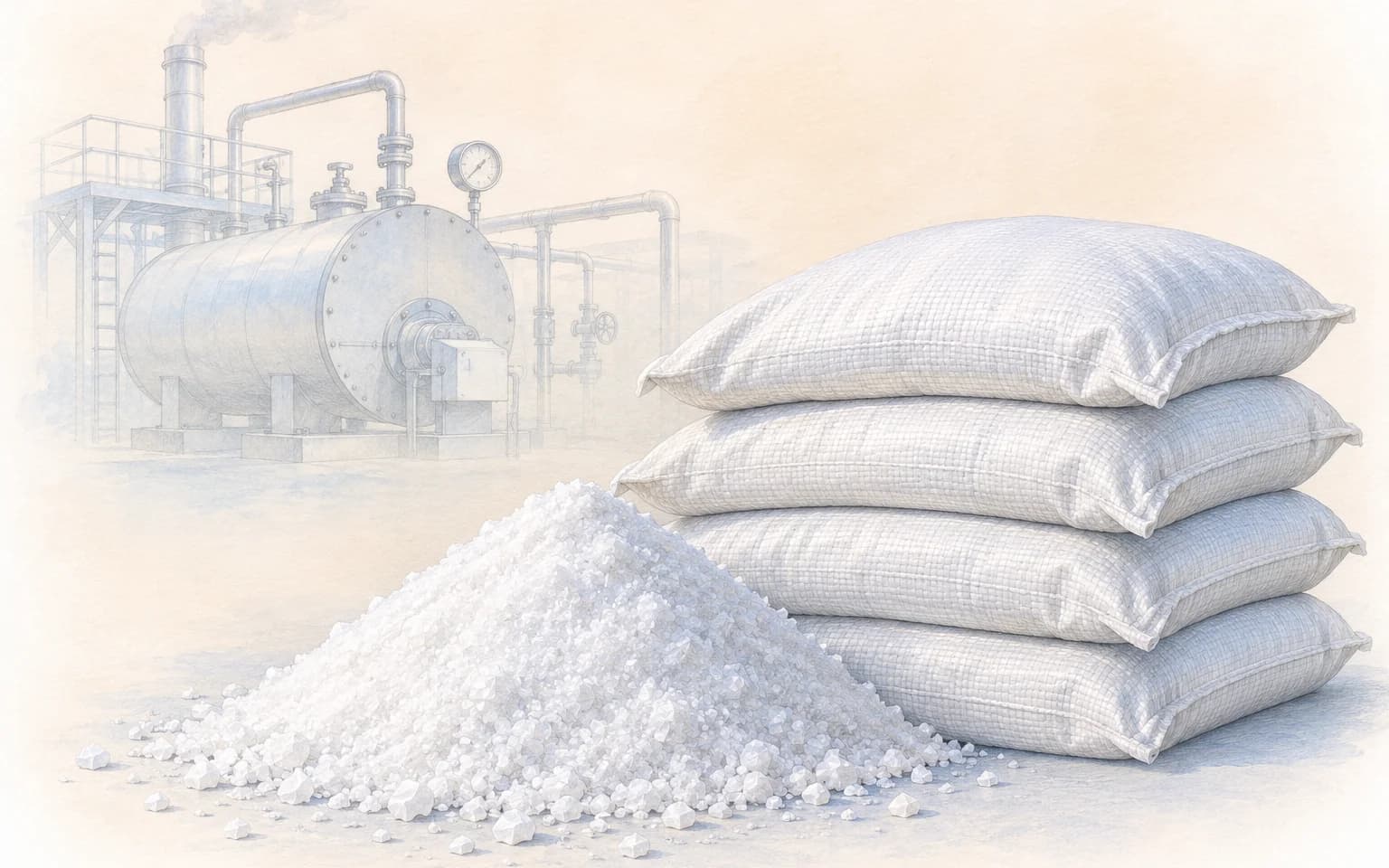
Anhydrous sodium sulphite, 96–98% Na₂SO₃, the standard oxygen scavenger for boiler feedwater, and a dechlorination agent for process water and effluent.
Sodium sulphite, Na₂SO₃, is a white powder that dissolves in water to a mildly alkaline solution. It reacts with dissolved oxygen to form sodium sulphate, which is why it is dosed into boiler feedwater: it removes the oxygen that would otherwise pit tubes and drums. It also reduces free chlorine to chloride.
The anhydrous form carries more active sulphite per kilogram than the heptahydrate. It slowly oxidises in moist air, so it is kept sealed and dry, and away from acids, which release sulphur dioxide.
The standard oxygen scavengerRemoves dissolved oxygen from low- and medium-pressure boiler feedwater, the main cause of pitting in tubes and drums.
Easy to controlThe sulphite residual in boiler water is measured with a simple titration, so dosing is easy to keep right.
Also dechlorinatesReduces free chlorine in process water and treated effluent before discharge.
Documented qualityEach offered batch comes with its Certificate of Analysis and safety data sheet.
What Nuroil does on every order
Why choose sodium sulphite from Nuroil?
Checked against the batch CoA
Sulphite content, iron and insolubles are reviewed on the batch certificate before loading.
Straightforward shipping
Not dangerous goods for transport, so it ships as general cargo on most routes.
Packed against air and moisture
Lined bags, sealed tight so the sulphite keeps its strength.
One desk, firm offers
FOB, CFR or CIF from our Sharjah trade desk, usually within 24 hours.
02 TECHNICAL DATA
Technical specification.
Sodium sulphite (Na₂SO₃)
96% min (97–98% min on many offers)Iodometric titration
Iron (Fe)
0.003–0.005% maxColorimetric / ICP
Water-insoluble matter
0.02–0.05% maxGravimetric
Free alkali (as Na₂CO₃)
0.1–0.4% maxTitration
pH (5% solution)
About 9–10.5pH meter
Appearance
White powder or fine crystalsVisual
Reference standard
HG/T 2967 (Chinese producers)
0198% MIN
High purity
Lowest iron and insolubles; preferred for boiler feedwater, photography and chemical synthesis.
0296–97% MIN
Standard technical
The common grade for dechlorination, pulp and paper, textiles and general water treatment.
03CATALYSED
Blended on site
For fast oxygen removal in cold feedwater, a cobalt catalyst is usually added by the treatment supplier; ask about your programme.
04FOOD GRADE
On request
Food grade (E221) is a separate product with its own certificates; ask if you need it.
Selection guidance Tell us the boiler pressure or process, the dosing method and the volume, and we will confirm the grade.
Both are sulphur-based reducing agents. Sulphite is the boiler oxygen scavenger; metabisulphite is the usual dechlorinator.
Property
Sodium sulphiteThis page
Sodium metabisulphite
Formula
Na₂SO₃
Na₂S₂O₅
Solution pH
Alkaline, about 9–10
Acidic, about 4–5
Oxygen scavenging
Standard for boilers
Used, but lowers pH
Dechlorination
Effective
Most used
Best suited to
Boiler feedwater, alkaline systems
RO feed, pools, effluent dechlorination
03 HOW IT IS MADE
From sulphur dioxide to sulphite powder.
Sulphur dioxide, from burning sulphur, is absorbed into a soda ash solution to form sodium bisulphite, which is then neutralised with more soda ash or caustic soda to sodium sulphite. The salt is crystallised in its anhydrous form, separated and dried.
01
Sulphur and soda ash
Sulphur is burned to sulphur dioxide; soda ash makes the absorbing solution.
02
Absorption
Sulphur dioxide is absorbed to bisulphite, then neutralised to sulphite.
03
Crystallisation
Anhydrous sodium sulphite crystallises from the hot liquor and is separated.
04
Drying and packing
The powder is dried, tested for sulphite content and sealed in lined bags.
04 APPLICATIONS
Where it works.
01
Boiler feedwater
Oxygen scavenging in low- and medium-pressure boilers, with a sulphite residual held in the boiler water.
02
Dechlorination
Removing free chlorine from process water and treated effluent before discharge.
03
Pulp and paper
Sulphite pulping and bleaching processes.
04
Textiles
Bleaching, desulphurising and an antichlor after chlorine bleaching.
05
Chemicals and photography
Reducing agent in chemical synthesis and photographic developers.
06
Mining and tanning
Ore flotation and leather processing.
05 SAFETY & HANDLING
Low hazard. Keep acids away.
This summary does not replace the Safety Data Sheet. Review the SDS and site procedure before first handling.
Not classified
GHS Not classified as hazardous by most producers.
EUH031 Contact with acids liberates toxic gas.
UN
Not regulated
Transport
Not dangerous goods
01
Never mix with acids
Acids release sulphur dioxide, a toxic, choking gas.
02
Keep from strong oxidisers
It reacts with oxidisers such as hypochlorite and nitrates, giving off heat.
03
Control dust
Use dust masks and eye protection when handling the powder; it can irritate eyes and airways.
04
Asthma sufferers take care
Sulphites can trigger reactions in sensitive people; avoid breathing dust or SO₂.
05
Exposure response
Rinse skin or eyes with plenty of water for at least 15 minutes and seek medical advice if irritation persists.
Sealed, dry and cool.
StoreSealed and dry
Moist air slowly oxidises it to sodium sulphate and lowers its strength. Kept sealed and dry it keeps its specification for a long time. Confirm the producer’s shelf life with the offer.
Keep bags closedAir and moisture oxidise it; reseal opened bags at once.
Dry, ventilated storeUnder cover, off the floor and out of direct sun.
SegregateApart from acids and strong oxidisers such as chlorine products.
First in, first outUse the oldest stock first so it is dosed at full strength.
Plan documentation early.
HS code2832.10
CAS number7757-83-7
EC number231-821-4
TransportNot regulated
GHS
Not classified as hazardous by most producers; EUH031, contact with acids liberates toxic gas
Transport
Not dangerous goods by road, sea or air
Product standard
HG/T 2967 industrial anhydrous sodium sulphite, where the producer certifies to it
National regulations
Confirm the destination’s import requirements
06 PACKING OPTIONS
Choose your packing.
Pack sizes and container loads depend on the producer and grade; the offer confirms them.
Smaller orders
25 kg and 50 kg bags
Woven polypropylene or paper bags with polyethylene liner, palletised.
In theory about 8 mg of sodium sulphite removes 1 mg of oxygen. In practice about 10 mg per mg of oxygen is dosed, plus enough to hold the sulphite residual your programme sets.
02Can it be used in high-pressure boilers?
It is used in low- and medium-pressure boilers. At high pressure it can decompose to sulphur dioxide and hydrogen sulphide and adds dissolved solids, so other scavengers are used there.
03What is catalysed sodium sulphite?
Sodium sulphite with a trace of cobalt catalyst, which speeds the reaction with oxygen in cold feedwater. It is usually blended by the water-treatment supplier.
04Is it dangerous goods for shipping?
No. Anhydrous sodium sulphite is not dangerous goods by road, sea or air, according to producer SDSs.
05What is the HS code?
Sodium sulphite is classified under HS 2832.10. Its CAS number is 7757-83-7.
06Anhydrous or heptahydrate?
Anhydrous sodium sulphite carries about twice the active sulphite per kilogram of the heptahydrate, so less product and freight for the same dose.
07What documents come with a shipment?
A Certificate of Analysis and Safety Data Sheet, with the Certificate of Origin as required.
Include the purity, the use, quantity, packing and destination for a tailored offer. We reply with a firm FOB, CFR or CIF offer, usually within 24 hours.