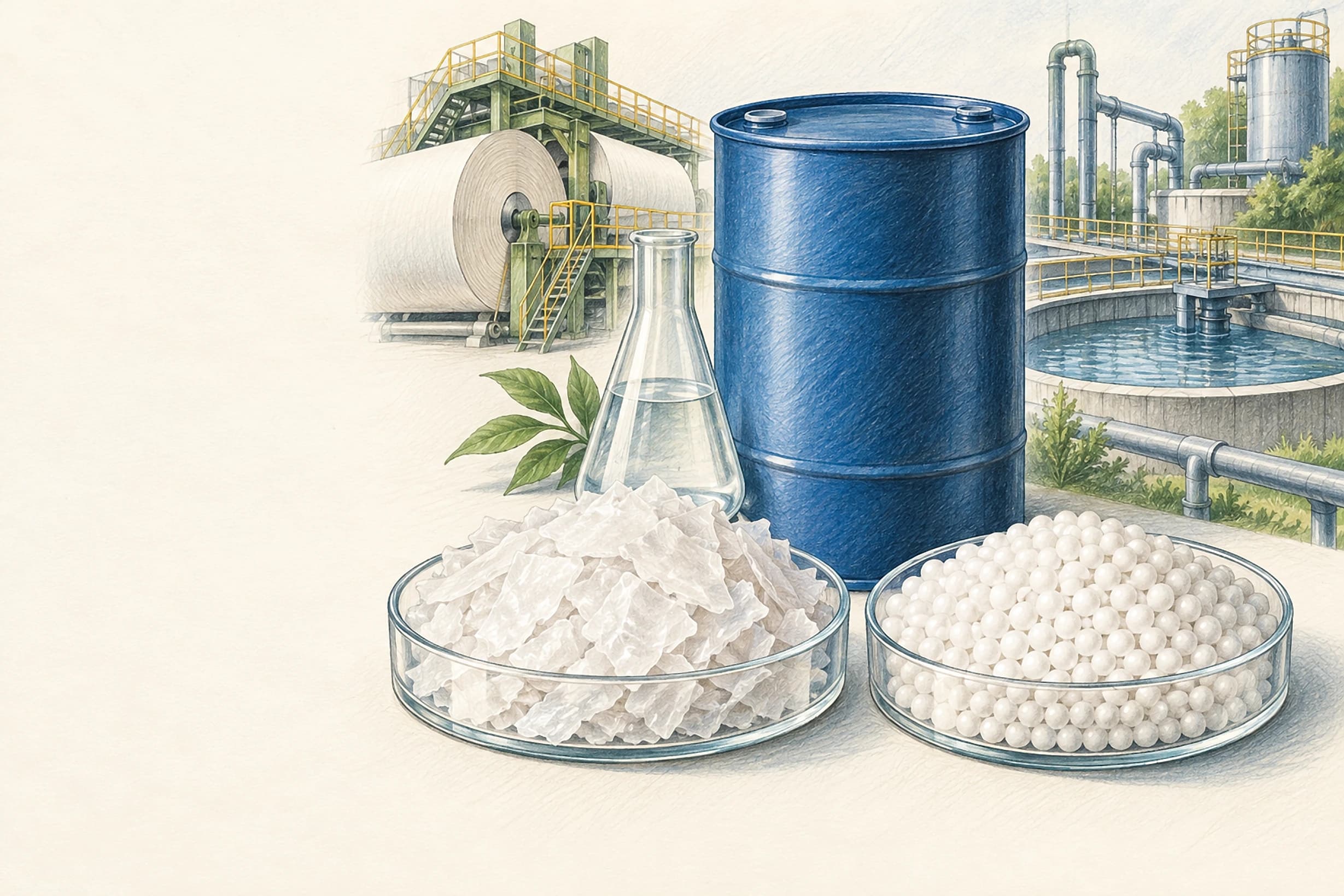
Formaldehyde, HCHO, is the simplest aldehyde, a gas supplied as a clear water solution of about 37% by weight, known as formalin. It kills bacteria, fungi and algae by reacting with their proteins, which is why it is used to control microbial growth and souring in process water, oilfield water and industrial systems.
It is also toxic, corrosive to skin and eyes, a skin sensitiser, and classified in the EU as a category 1B carcinogen. It is handled in closed systems, with ventilation and full protective equipment, by trained staff.
Broad-spectrum controlActs on bacteria, including sulphate-reducing bacteria, fungi and algae in process water.
Not deactivated by organicsKeeps working in dirty, organic-rich water where oxidising biocides are consumed quickly.
Two gradesLow-methanol for resin and chemical feedstock; methanol-stabilised to resist polymerising in storage.
Documented qualityEach offered batch comes with its Certificate of Analysis and safety data sheet.
What Nuroil does on every order
Why choose formaldehyde from Nuroil?
Checked against the batch CoA
Formaldehyde, methanol and acidity are reviewed on the batch certificate before loading.
Dangerous-goods paperwork handled
Shipped as class 8 corrosive with the correct UN entry, labels and declarations.
Packed in compatible containers
UN-approved HDPE drums and IBCs or lined or stainless ISO tanks.
One desk, firm offers
FOB, CFR or CIF from our Sharjah trade desk, usually within 24 hours.
02 TECHNICAL DATA
Technical specification.
Formaldehyde (HCHO)
36.5–37.5% w/wSodium sulphite titration
Methanol
1.5% max (low-methanol) or 7–12% (stabilised)Gas chromatography / density
Acidity (as formic acid)
0.03–0.05% maxTitration
Iron (Fe)
About 1–5 mg/kg maxColorimetric / ICP
Ash
0.005% maxGravimetric
Colour
10 APHA (Pt-Co) maxAPHA (Pt-Co)
Density at 20 °C
About 1.08–1.12 g/cm³, lower with more methanolDensity meter
Appearance
Clear, colourless liquid with a pungent odourVisual
01LOW METHANOL
Below 1.5% methanol
The feedstock grade for urea-, phenol- and melamine-formaldehyde resins; must be kept warm enough not to polymerise.
02STABILISED
7–12% methanol
Methanol keeps it from forming paraformaldehyde in cool storage; the usual grade for biocide and laboratory use.
03DRUMS AND IBCS
Site dosing
For dosing into process water, oilfield systems and smaller plants.
04BULK
ISO tanks
For resin plants and large users with dedicated storage tanks.
Selection guidance Tell us the use, your storage temperature and the volume, and we will confirm the grade.
The same 37% formaldehyde with different methanol levels. The right one depends on the use and the storage temperature.
Property
Low-methanol
Methanol-stabilised
Methanol
Below 1.5%
About 7–12%
Resistance to polymerising
Needs warm storage
Tolerates cooler storage
Flash point
Higher
Lower; check the SDS
Resin feedstock
Preferred
Methanol unwanted
Best suited to
Resin and chemical plants with heated storage
Biocide dosing, drums and laboratories
03 HOW IT IS MADE
From methanol to formalin.
Methanol vapour and air pass over a hot silver or iron–molybdenum oxide catalyst, which oxidises the methanol to formaldehyde gas. The gas is absorbed in water to give a solution of about 37%.
01
Methanol and air
Methanol is vaporised and mixed with air.
02
Catalytic oxidation
The mixture passes over a silver or metal-oxide catalyst to form formaldehyde gas.
03
Absorption
The gas is absorbed in water in a column to give the 37% solution.
04
Testing and filling
Each batch is tested for formaldehyde, methanol and acidity, then filled into drums, IBCs or tanks.
04 APPLICATIONS
Where it is used.
01
Process water
Controlling bacterial slime and fouling in industrial process and wash water.
02
Oilfield water
Control of sulphate-reducing bacteria in injection and produced water, and in drilling fluids.
03
Paper mills
Slime control in white-water and paper-machine systems.
04
Resins
Urea-, phenol- and melamine-formaldehyde resins for wood panels and laminates.
05
Chemicals
Feedstock for hexamine, pentaerythritol and other intermediates.
06
Textiles and leather
Finishing and tanning auxiliaries.
05 SAFETY & HANDLING
Toxic and carcinogenic. Closed handling.
This summary does not replace the Safety Data Sheet. Review the SDS and site procedure before first handling.
Danger
H301+H311+H331 Toxic if swallowed, in contact with skin or if inhaled.
H314 Causes severe skin burns and eye damage.
H317 May cause an allergic skin reaction.
H335 May cause respiratory irritation.
H341 Suspected of causing genetic defects.
H350 May cause cancer.
UN
2209 · 1198 if flash point ≤ 60 °C
Class
8, corrosive · PG III
01
Avoid all contact and vapour
Toxic if swallowed, in contact with skin or if inhaled; may cause cancer. Use closed transfer and good ventilation.
02
Full protection
Chemical goggles and face shield, nitrile or butyl gloves and a suitable respirator where vapour may be present.
03
Skin sensitiser
Repeated contact can cause allergy; replace contaminated gloves and clothing.
04
Keep from incompatibles
Keep it apart from oxidisers, strong acids and alkalis, ammonia and phenols; mixtures can react with heat.
05
Exposure response
Rinse skin or eyes immediately with plenty of water for at least 15 minutes, remove to fresh air and seek medical attention.
Closed, ventilated and in range.
StoreIn its range
Too cold and it forms white paraformaldehyde; too hot and it slowly forms formic acid. Low-methanol grades need warmer storage than stabilised grades. Confirm the producer’s storage range and shelf life with the offer.
Hold the temperatureWithin the producer’s range for the grade, out of direct sun.
Ventilated, bunded storeClosed containers in a ventilated store with spill containment.
SegregateApart from oxidisers, acids, alkalis and ammonia, and from food.
Restrict accessStore locked up, labelled, with exposure monitoring where staff work.
Formalin is the common name for a water solution of about 37% formaldehyde by weight, usually with some methanol to keep it from polymerising.
02How is it used as a biocide in process water?
It is dosed, usually as a slug or batch treatment, to kill bacteria, fungi and algae. Your water-treatment programme sets the dose and frequency; we supply the chemical.
03Why does formalin turn cloudy?
In cold storage it forms paraformaldehyde, a white solid. Methanol-stabilised grades resist this; low-methanol grades must be kept warmer.
04Is it dangerous goods for shipping?
Yes. Formaldehyde solution with at least 25% formaldehyde is UN 2209, class 8, packing group III. If the flash point is 60 °C or below it ships as UN 1198, class 3 with subsidiary class 8.
05What is the HS code?
Formaldehyde (methanal) solution is classified under HS 2912.11. Its CAS number is 50-00-0.
06Is formaldehyde a carcinogen?
Yes. The EU classifies it as a category 1B carcinogen, and IARC lists it in Group 1. Use closed handling, ventilation and exposure monitoring.
07What documents come with a shipment?
A Certificate of Analysis and Safety Data Sheet, with the Certificate of Origin and dangerous-goods declaration as required.
Include the grade (low-methanol or stabilised), the use, quantity, packing and destination for a tailored offer. We reply with a firm FOB, CFR or CIF offer, usually within 24 hours.