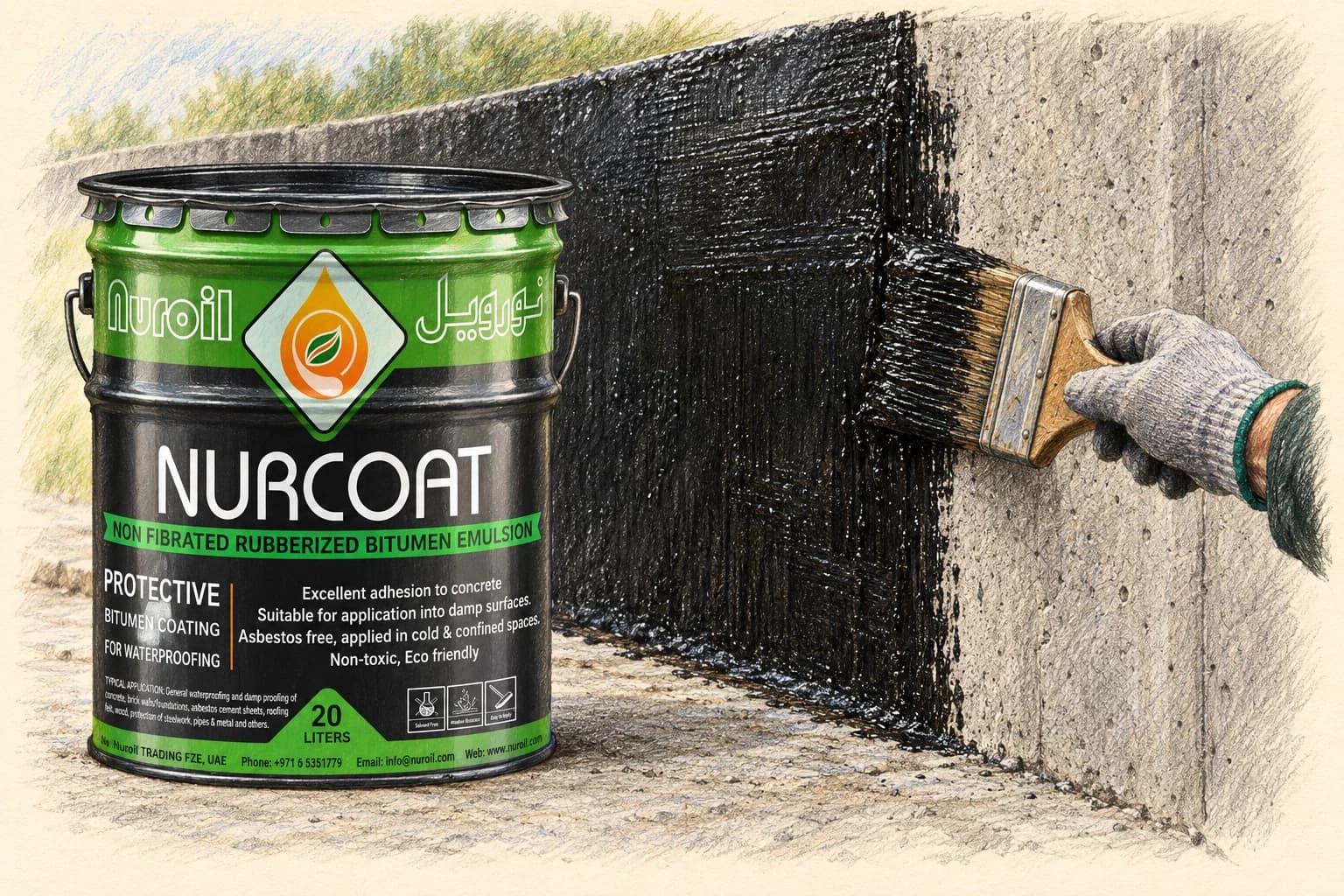
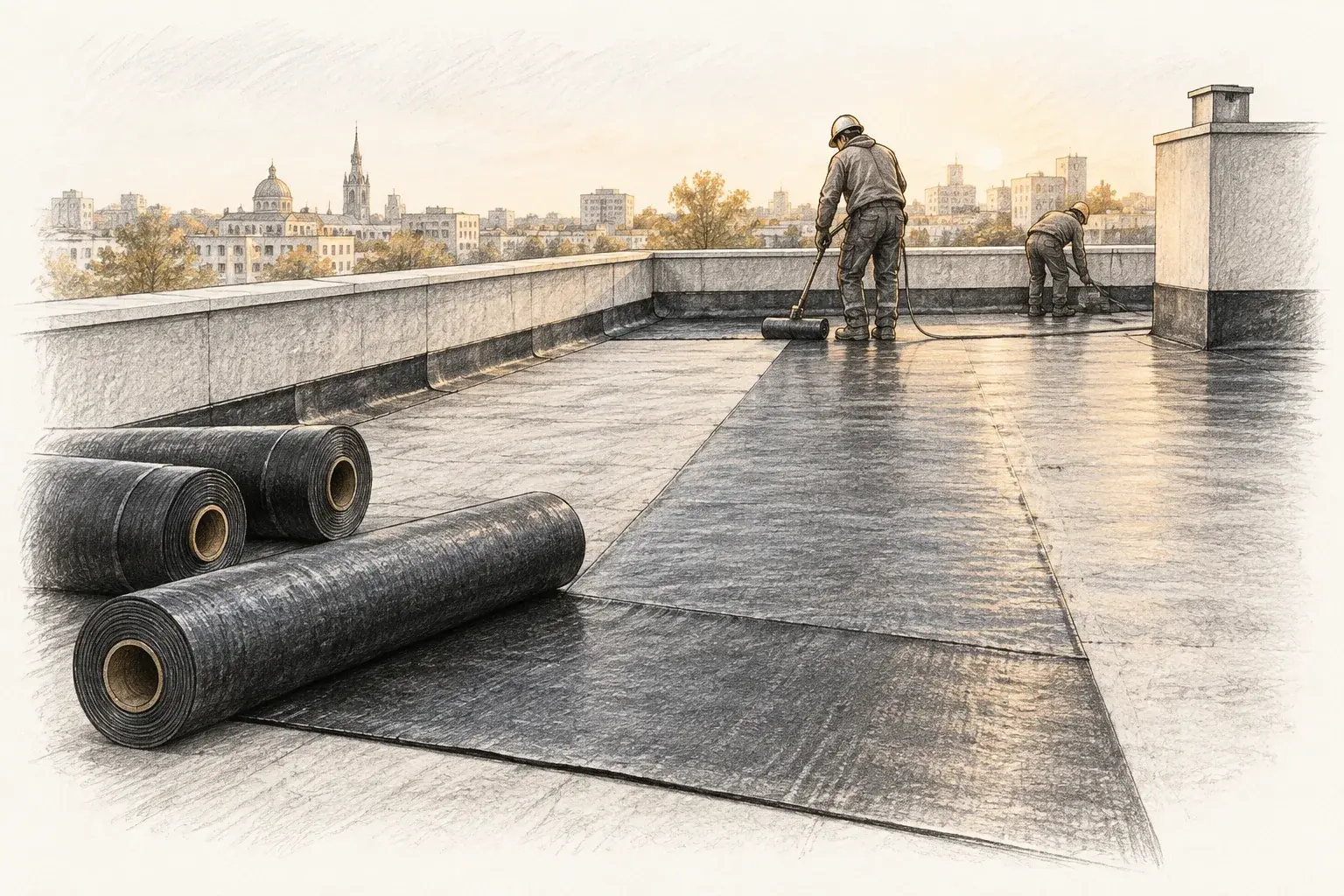
Water-based rubberized bitumen coatings are widely used in hot climates because they are cold applied, low in solvent and tolerant of damp concrete. Heat, however, changes how they behave on the wall. A coat that dries well on a mild morning can blister, crack or stay soft underneath when the same product goes onto concrete at 50 °C in direct sun. Planning around temperature is part of getting a durable film.
How an emulsion coating dries
A rubberized bitumen emulsion is a dispersion of rubber-modified bitumen droplets in water. After application the water evaporates and is partly absorbed by the substrate; the droplets then merge into a continuous film. This process is sometimes called breaking and coalescence.
Heat speeds up evaporation, which sounds helpful, but it does so first at the surface. If the top of a thick coat skins over quickly, water below can be trapped. As the coating heats further, that water tries to escape and can form blisters or pinholes, or leave a soft layer that never develops full strength.
What the data sheets say
Manufacturers in the Gulf region publish drying and recoat figures at elevated temperatures. One regional data sheet gives a drying time of one to two hours at 35 °C, with a recoat interval of about six hours. Another states an application temperature range of 5 to 55 °C and a service temperature range of roughly -5 to 75 °C for the cured film. These are useful limits, but they refer to air and material temperature. A dark concrete wall or slab in direct summer sun can be considerably hotter than the air around it.
| Site condition | Risk | Practical response |
|---|---|---|
| Hot substrate in direct sun | Rapid skinning, trapped water, blisters | Coat early morning or late afternoon; shade the work area |
| Thick single coat | Sagging on walls, soft core | Apply more, thinner coats to reach the target thickness |
| Very dry, porous blockwork | Water drawn out too fast, poor bond | Use a diluted primer coat, two if needed |
| Long gap between coats | Dust and loss of tack on the earlier coat | Clean and re-prime if the interval exceeds the data sheet limit |
| Hot drums stored in sun | Product thickens or degrades, shorter shelf life | Store under cover, away from direct sunlight and heat |
Scheduling the work
In hot seasons the most reliable approach is to plan the coating work around the coolest part of the day. Many contractors coat at first light and stop before the wall faces full sun, then return for the next coat once the previous one has dried right through. Checking the surface temperature with a simple contact or infrared thermometer helps decide whether to start.
Keep each coat within the coverage rate recommended for that product. Published figures for foundation coatings often fall between about 1 and 4 m² per litre per coat. Going thicker than intended to save a coat is a common cause of trouble in heat.
Checking the film
- Press lightly with a gloved finger before recoating. The coat should be dry right through, not just touch dry on top.
- Look for blisters, pinholes and cracking at the end of each day. Small defects can be opened, allowed to dry and over-coated.
- Measure wet film thickness with a comb gauge while applying, so coverage stays consistent across the wall.
- Do not fix protection board or backfill until the cure time on the data sheet has passed; one manufacturer specifies at least 48 hours.
In hot weather, more thin coats applied at cooler times of day give a better film than fewer thick coats applied at midday.
Storage on site
Heat affects the material before it is opened. Data sheets ask for drums and pails to be kept in a covered, shaded area away from direct sunlight and other heat sources; prolonged exposure can thicken the product and shorten its shelf life. Order in quantities that will be used within the shelf life, and rotate stock so older batches are used first.
Buying for hot-climate projects
When you request a quote, mention the expected site temperatures and the application season, and ask the supplier to confirm the product's application temperature range, drying and recoat times at around 35 °C, and its shelf life. Request the technical data sheet, safety data sheet and certificate of analysis. Nuroil supplies rubberized bitumen coating in pails and drums; send your requirements through request a quote.