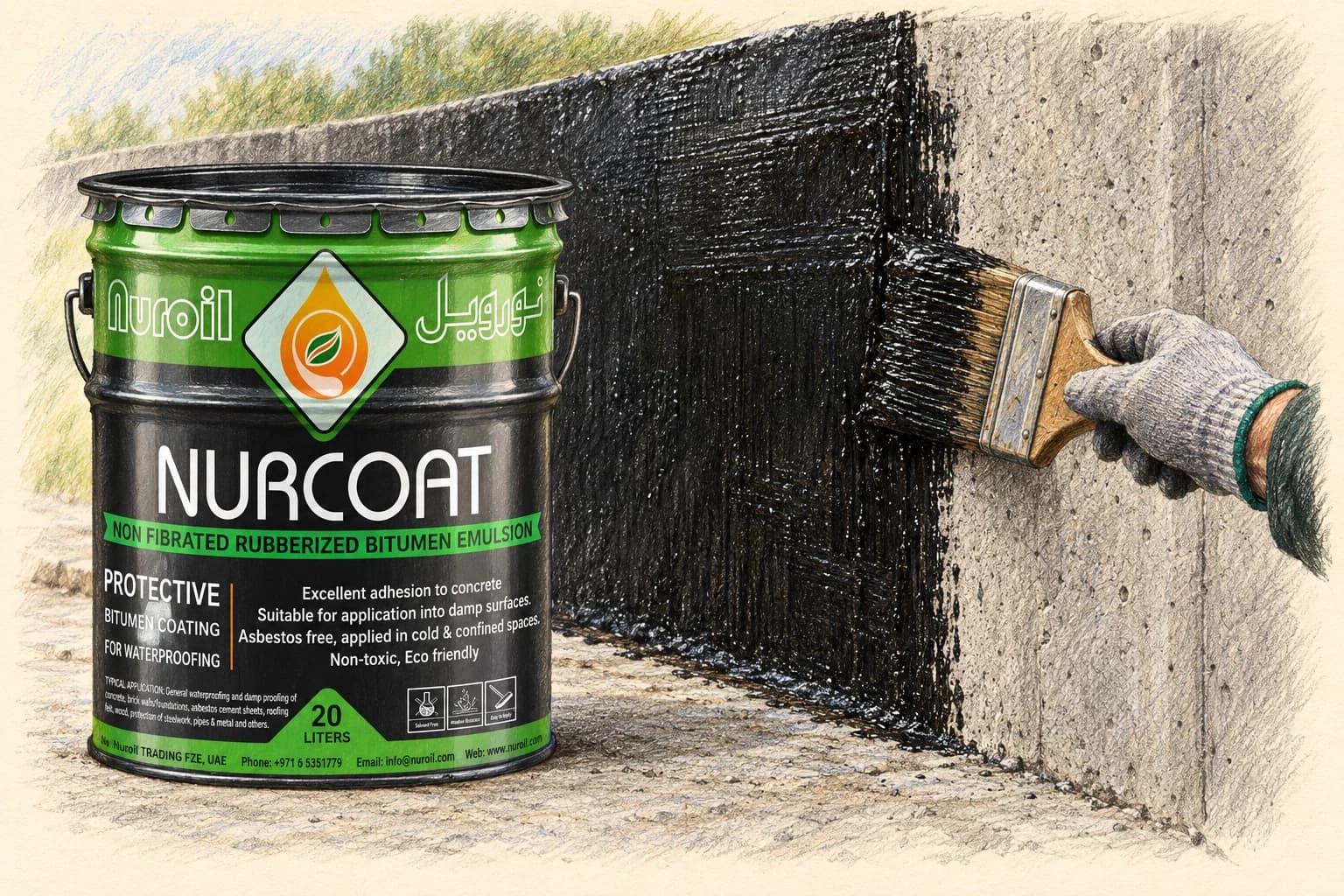
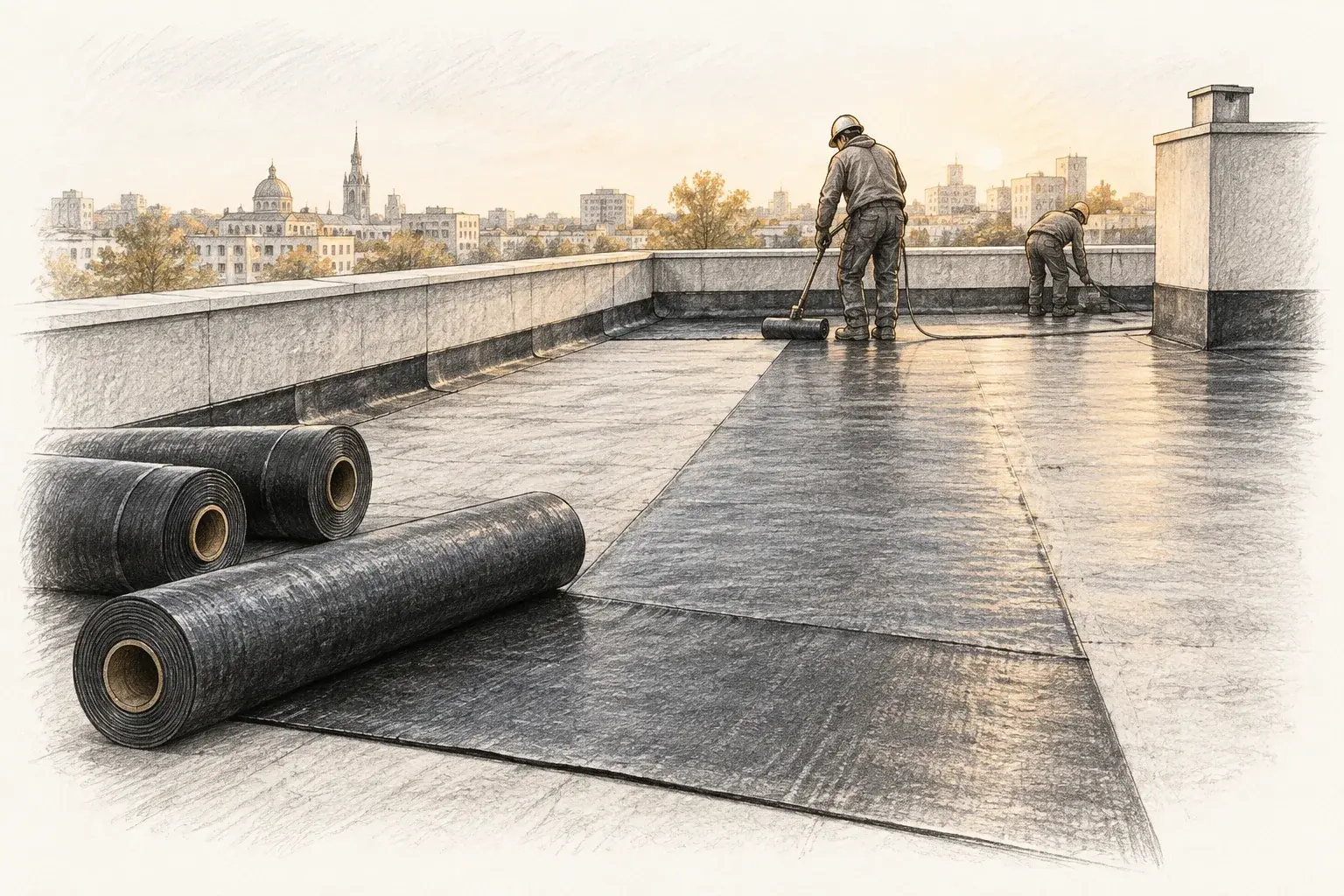
Most buyers know rubberized bitumen coating as a black dampproofing layer for foundations. Data sheets from regional manufacturers list several other uses for the same product: a curing membrane on freshly cast concrete, a vapour barrier coating, and a damp-proof layer inside sandwich or cavity walls. Each use relies on the same property, a continuous, low-permeability film, but each has its own limits.
As a curing compound for fresh concrete
Concrete needs to keep its water for the first days after casting so that cement hydration continues and the surface does not crack. Curing compounds work by forming a film that slows evaporation. Because a water-based rubberized bitumen coating can be applied to damp, freshly cast concrete, it can be sprayed or brushed onto below-ground elements as soon as the formwork comes off.
The advantage on a foundation job is that one product does two jobs. The coating cures the concrete and then stays in place as the dampproofing layer, so the element can be backfilled without a separate curing step.
There are limits. One manufacturer notes that the curing efficiency of a bitumen emulsion is not as high as that of purpose-made resin-based curing compounds. Where a project specification sets a measured water-retention requirement for curing, check whether the coating has been tested for it. A black film also absorbs heat, so it is not suitable as a curing membrane on exposed slabs that must stay cool or that will receive another finish.
Coverage for curing use is usually lighter than for dampproofing. One data sheet gives about 5 m² per litre per coat for curing and 4 m² per litre for general use.
As a vapour barrier coating
A cured rubberized bitumen film slows the passage of water vapour. That makes it useful where moisture would otherwise migrate from the ground or a wet space into an element that should stay dry, for example:
- the underside or edges of slabs on grade before screed or insulation;
- walls of plant rooms, tanks and wet areas behind finishes;
- the warm side of some insulated build-ups, where the designer has placed the vapour control layer.
Vapour resistance depends on film thickness and continuity. A thin, patchy coat gives far less protection than a full, even film. If a design calls for a stated vapour resistance, ask the supplier for test data rather than assuming it.
Inside sandwich and cavity walls
In double-leaf masonry or sandwich panels, the coating is applied to the inner face of the outer leaf or to the face of the inner leaf to stop moisture crossing the cavity. Because the coating is cold applied and water-based, it can be used in partly enclosed spaces without the solvent vapour problems of solvent-based products. Good ventilation is still needed while it dries.
Check compatibility before the coating comes into contact with insulation boards. Water-based coatings are generally gentler on polystyrene than solvent-based materials, but the product data sheet should confirm it.
Uses at a glance
| Use | Main benefit | Main limitation |
|---|---|---|
| Foundation dampproofing | Seamless, flexible film over complex shapes | Not designed for hydrostatic pressure |
| Curing fresh concrete | Cures and dampproofs in one step | Lower curing efficiency than resin compounds |
| Vapour barrier | Continuous film, easy to apply | Performance depends on film thickness |
| Sandwich or cavity walls | Cold applied, low solvent | Must be protected from damage during construction |
One rubberized coating can cure, dampproof and vapour-proof a buried element, but each role should be checked against the specification it has to meet.
Specifying for these uses
When enquiring, say which uses you intend so the supplier can confirm suitability and coverage. Ask for the technical data sheet showing solids content, rubber content and drying time, any test reports for curing efficiency or vapour resistance, and the certificate of analysis for the batch. Nuroil supplies rubberized bitumen coating with a CoA on every delivery; you can send your details through contact us.