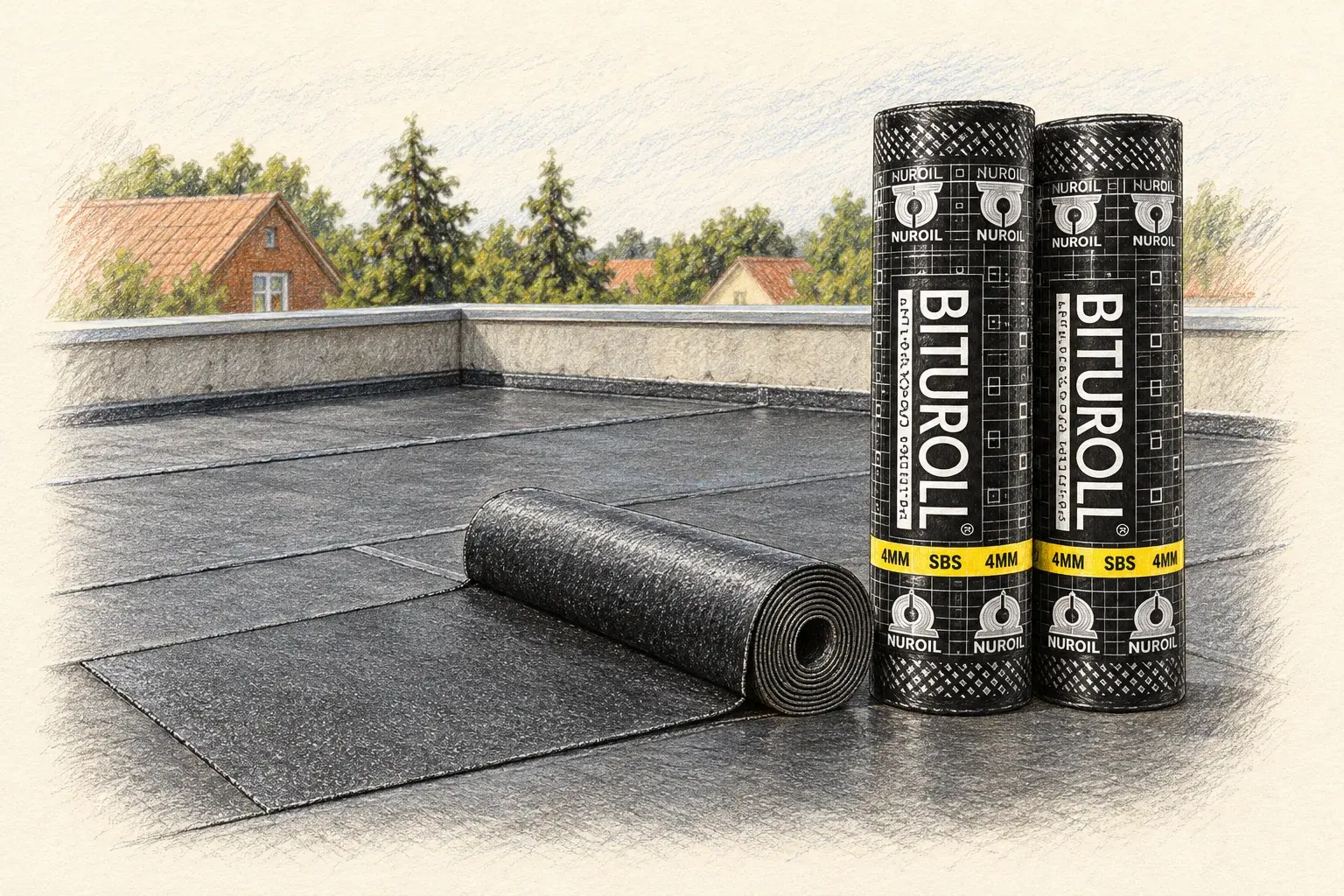
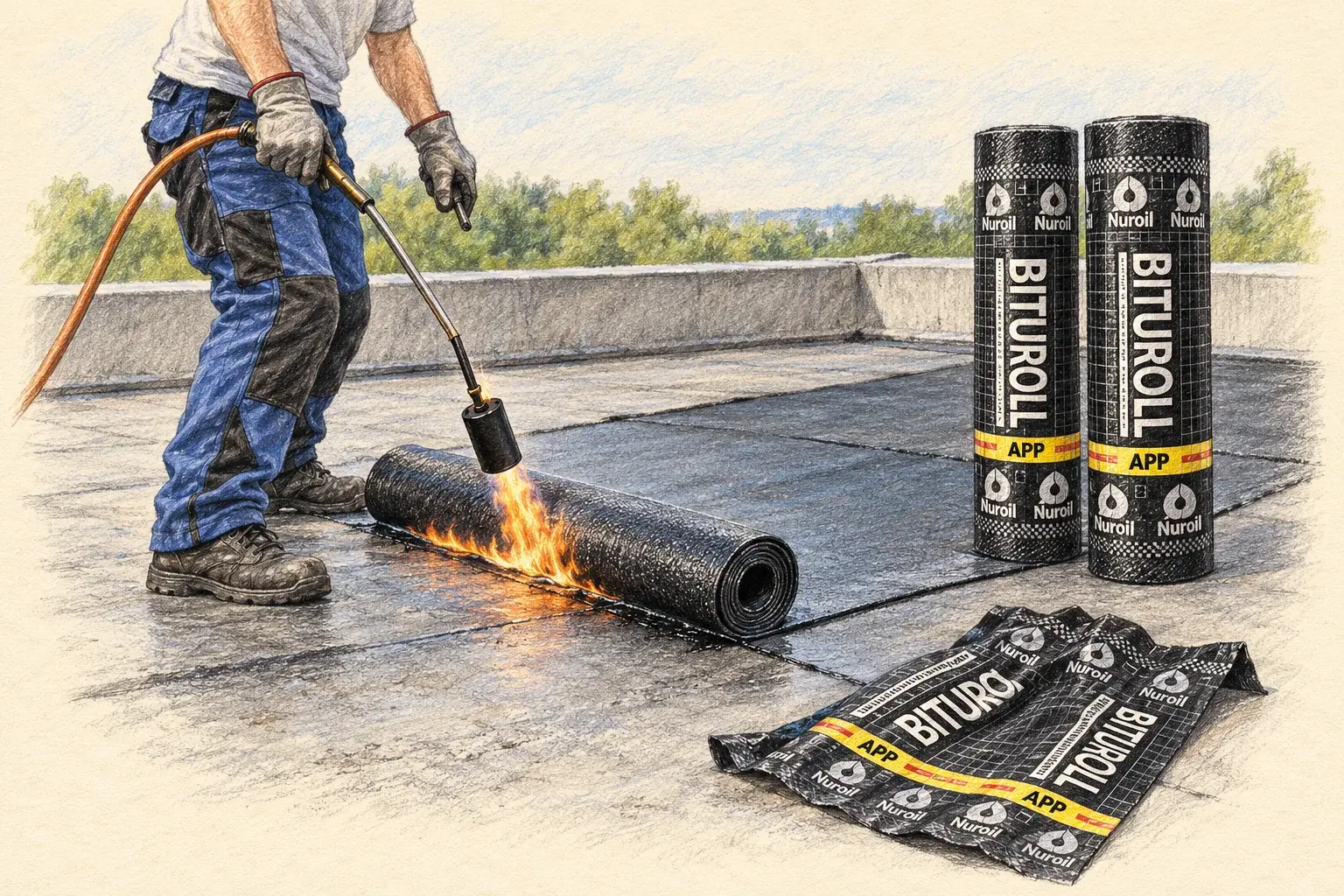
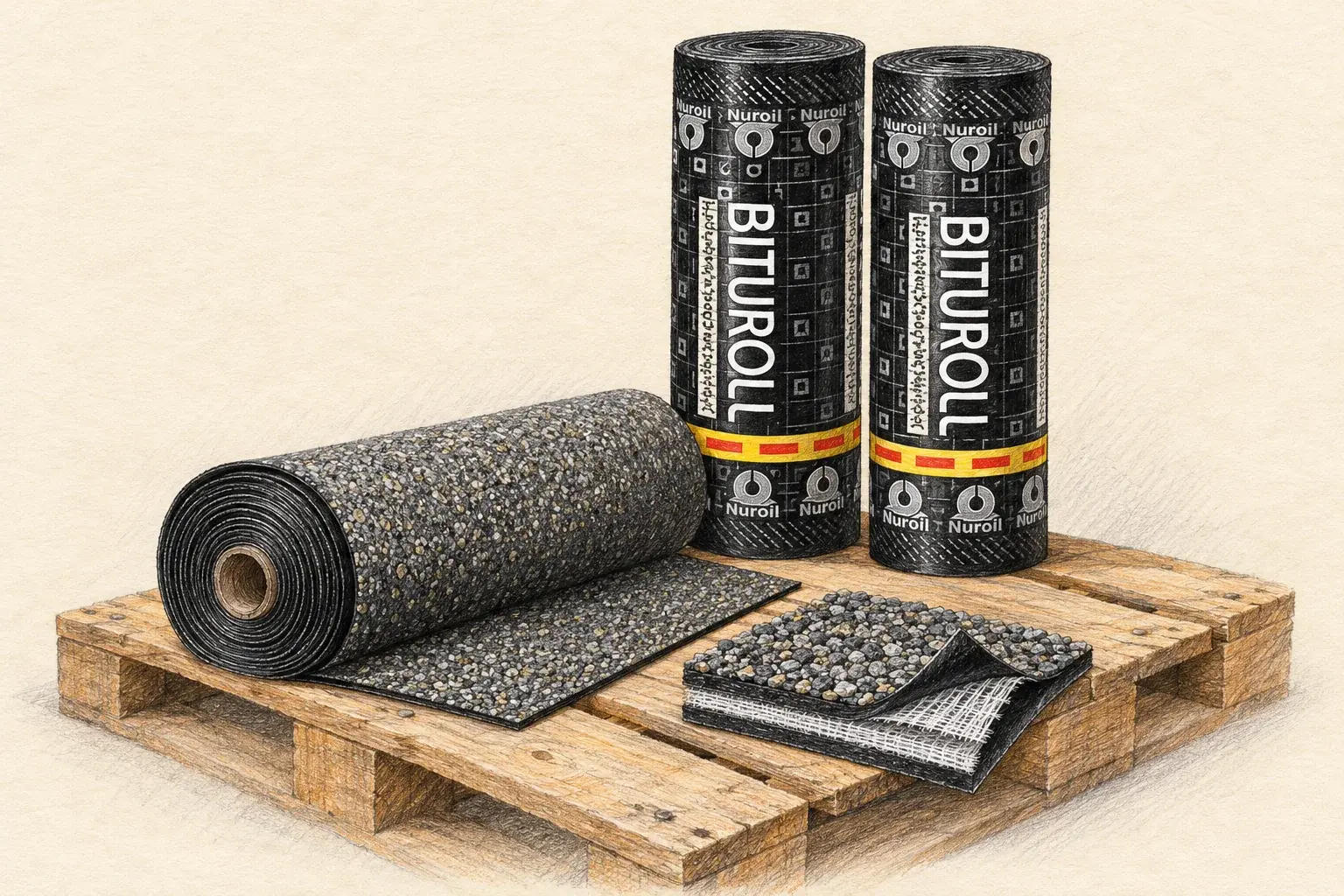
Most torch-applied waterproofing membranes are made of bitumen modified with a polymer and reinforced with a carrier of polyester or glass fibre. The two polymers in widest use are SBS (styrene-butadiene-styrene) and APP (atactic polypropylene). Both turn ordinary bitumen, which is brittle in cold and soft in heat, into a more durable sheet. They do it in different ways, and the difference decides where each works best.
How the two polymers change bitumen
SBS
APP
Key differences in practice
| Property | SBS modified | APP modified |
|---|---|---|
| Nature of compound | Elastomeric, rubber-like | Plastomeric, stiffer |
| Low-temperature flexibility | Better; stays pliable in cold weather | Lower; stiffens sooner as temperature falls |
| Heat resistance | Good | Higher; resists flow on hot roofs |
| UV resistance when exposed | Needs mineral or other surface protection | Better natural resistance, though often still mineral-surfaced |
| Accommodating movement | Better elongation and recovery | More limited |
| Application | Torch, hot bitumen, cold adhesive or self-adhesive versions | Mainly torch-applied |
Exact values vary by product. Manufacturers state cold flexibility as the lowest temperature at which a sample bends round a mandrel without cracking, and heat resistance as the temperature at which the compound starts to flow. Compare these figures on data sheets rather than relying on general rules. Some manufacturers note that cold flexibility is a useful general indicator of membrane quality.
Where SBS is the better choice
- Climates with cold winters or large day-night swings.
- Structures with movement: lightweight decks, expansion joints, timber or metal substrates.
- Foundations and basements, where the membrane must tolerate settlement and backfill.
- Multi-layer roof systems where good fusion between layers is wanted.
Where APP is the better choice
- Hot climates with strong sun, such as much of the Middle East, Africa and South Asia.
- Exposed roofs where heat build-up on dark surfaces is high.
- Stable concrete decks with little movement.
Hybrid products also exist, combining an elastomeric layer underneath with a heat-resistant upper compound.
Reinforcement and finish also matter
The polymer is only part of the specification. The carrier gives strength:
- Polyester gives high tensile strength, elongation and puncture resistance, so it pairs well with SBS for movement.
- Glass fibre gives dimensional stability but little stretch, and suits stable substrates and underlayers. A fibre glass reinforced membrane is a common economical choice.
Thickness (commonly 3 to 5 mm) and the top surface (plain polyethylene film, sand or mineral granules) are set according to whether the sheet will be covered or left exposed.
Pick the polymer for the climate and movement, the reinforcement for the loads, and the surface for the exposure.
A quick decision path
- Will the membrane see sub-zero temperatures or significant movement? If yes, lean towards SBS.
- Will it be exposed to strong sun with little cold weather? If yes, APP is a strong option.
- Will it be buried or covered by screed or tiles? Then exposure matters less, and movement and cost decide.
What to include in a membrane enquiry
State the polymer (SBS or APP), thickness, reinforcement type and weight, top and bottom surface finish, roll size and number of rolls. Mention the standard the project uses and the required cold flexibility and heat resistance values if there is a specification. Ask for the product data sheet and a test certificate per batch. Nuroil supplies both SBS and APP modified membranes on FOB, CFR or CIF terms.