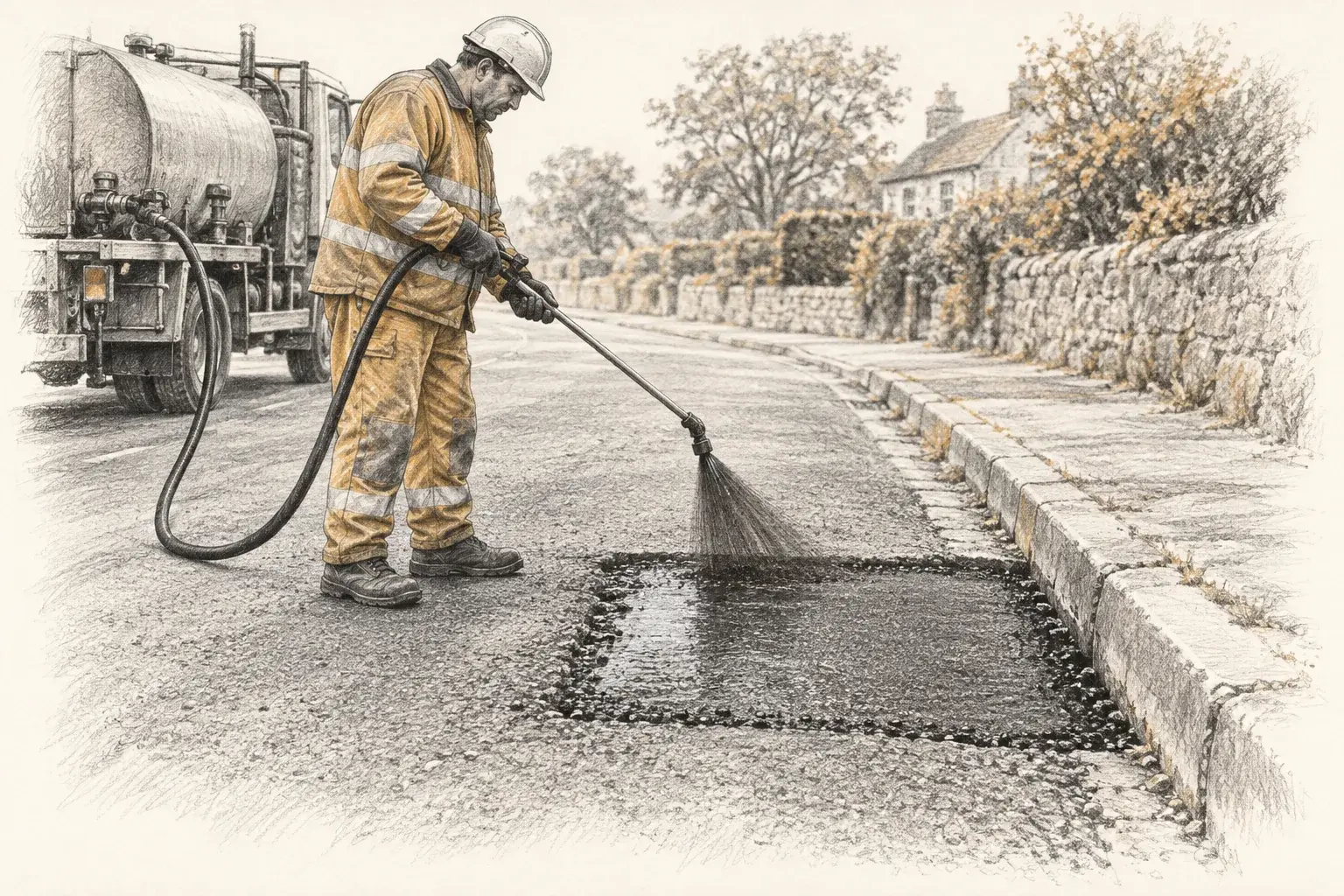
Potholes form when water gets into cracks in an asphalt surface and traffic breaks the weakened material away. Hot asphalt gives the best permanent repair, but it needs a nearby mixing plant, heated transport and dry, warm weather. Cold asphalt, also called cold mix or cold patch, fills that gap. It can be stored, carried in bags or tubs, and placed straight from the pack, at almost any time of year.
What cold asphalt is
Cold patching material is graded aggregate coated with a bitumen binder that stays workable at ambient temperature. The binder is either a bitumen emulsion or a cutback bitumen (bitumen thinned with a solvent), sometimes with polymers or additives to improve adhesion and strength. As the water or solvent leaves the mix after placing, and as traffic compacts it, the patch stiffens.
A good cold mix has to balance two opposite needs. It must stay loose and workable in the bag or stockpile for months, yet become firm enough in the hole to resist traffic. ASTM D6704 gives a laboratory test for the workability of stockpiled or packaged cold mix, made with either emulsion or cutback binders, though the standard notes its precision is too limited to use for purchasing decisions.
What large field trials found
A major US highway research programme placed more than 1,250 cold-mix pothole patches at test sites in different climates and followed their performance for several years. Its main findings, published by the Federal Highway Administration, are useful for any road owner:
- Patch life depends heavily on the quality of the material. With good material, patches often stayed in service for years, even though they were intended as temporary.
- The simple throw-and-roll method performed as well as the more labour-intensive semi-permanent method in most situations, and was more cost-effective.
- When poor-quality material was used, no amount of careful placement made up for it.
Placement methods compared
| Method | Steps | When to use |
|---|---|---|
| Throw and roll | Fill hole (removing loose water and debris where practical), overfill slightly, compact with truck tyres | Fast emergency repairs, busy roads, bad weather |
| Throw and roll with edge seal | As above, then seal patch edges with a bitumen tack coat and sand | Where water entry at the edges is a concern |
| Semi-permanent | Clear water and debris, cut square vertical edges, tack the sides, fill, compact with a plate compactor or roller | Planned repairs where lane closure time is available |
Practical steps for a lasting patch
- Clear the hole. Remove standing water, loose stones and debris as far as practical.
- Shape it if time allows. Straight, vertical sides help hold the patch in place.
- Tack the edges. A light coat of bitumen emulsion helps the new material bond to the old surface.
- Fill in layers. For deep holes, place and compact in lifts rather than all at once.
- Overfill. Leave the patch slightly crowned so compaction under traffic brings it level.
- Compact well. Use a plate compactor, hand roller or vehicle wheels. Poor compaction is the main reason patches dish and break up.
Good material placed simply often beats poor material placed carefully. Spend effort on choosing the mix first.
Storage and handling
Bagged or tub cold asphalt keeps best sealed, out of direct sun and away from frost. Stockpiled material should be covered. In cold weather, keeping the material in a warm store before use makes it easier to work. Cutback-based products contain solvent, so they should be kept away from ignition sources and handled as described in the SDS.
What to ask for when buying cold asphalt
State the intended use (emergency patching, utility trench reinstatement, car parks), the expected traffic, climate, binder preference (emulsion or cutback), aggregate size, pack size (bags, tubs or bulk) and quantity. Ask for the data sheet, shelf life and storage guidance, and the SDS. Nuroil supplies ready-to-use cold asphalt for road and site maintenance, with a CoA and the usual export documents.