When a waterproofing membrane blisters, peels or leaks within a few years, the material itself is often blamed. Very often the real cause sits underneath it: a dusty, damp or contaminated surface that the membrane never bonded to properly. A good membrane on a poor substrate behaves like a poor membrane. This article explains what goes wrong and what good preparation looks like.
Why bond matters
A bonded membrane works because it is fully stuck to the structure. If water finds a small defect, it cannot travel far sideways under a well-bonded sheet or coating, so a leak stays local and can be found. When the bond is weak, water spreads along the gap and appears somewhere else, making the leak hard to trace. Poor bond also lets trapped moisture or air expand in the sun, producing blisters that eventually split.
Bond has two parts. A clean surface allows the primer to bond chemically, and a suitable texture allows it to key in mechanically. Remove either and adhesion drops.
What gets in the way
- Laitance: a weak layer of fine cement and water that rises to the top of fresh concrete. It looks solid but crumbles under load, and a membrane bonded to it peels away with a dusty underside.
- Dust and loose material: from grinding, sweeping or wind-blown sand. Dust prevents primer from wetting the concrete.
- Curing compounds, release agents, oil and grease: these are designed to repel or seal, and they do the same to primers.
- Moisture: research on bridge-deck waterproofing has linked adhesion failure mainly to humid and wet concrete. Each membrane has its own limit for substrate moisture.
- Sharp defects: honeycombing, fins, tie holes and trowel ridges that can puncture sheets or create thin spots in coatings.
Preparing concrete properly
The International Concrete Repair Institute (ICRI) publishes a scale of concrete surface profiles, CSP 1 (almost smooth) to CSP 10 (very rough), with physical comparison chips for checking on site. Membrane manufacturers often call for a low to moderate profile. Too smooth gives poor key, while too rough can trap primer in grooves and leave voids under sheets. A typical sequence is:
- Allow new concrete to cure for the period the membrane maker requires.
- Remove laitance and contamination by mechanical means such as grinding or shot blasting.
- Fill holes, repair honeycombing and round off sharp internal and external corners, often with a fillet.
- Vacuum or blow off all dust.
- Check moisture against the product limit, for example with a hygrometer or a simple taped-sheet test.
- Prime, and let the primer dry to the stated condition before applying the membrane.
What the primer does
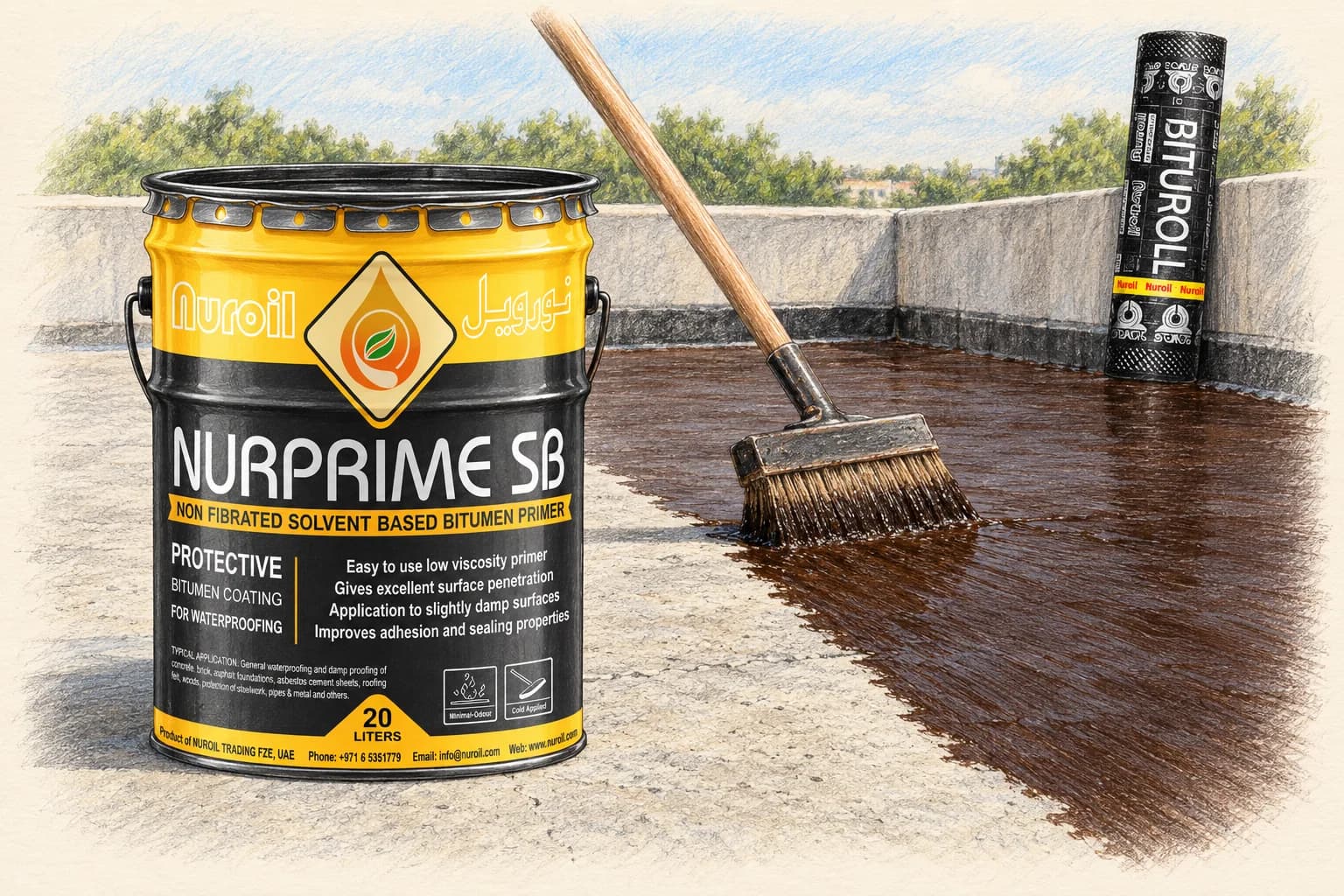
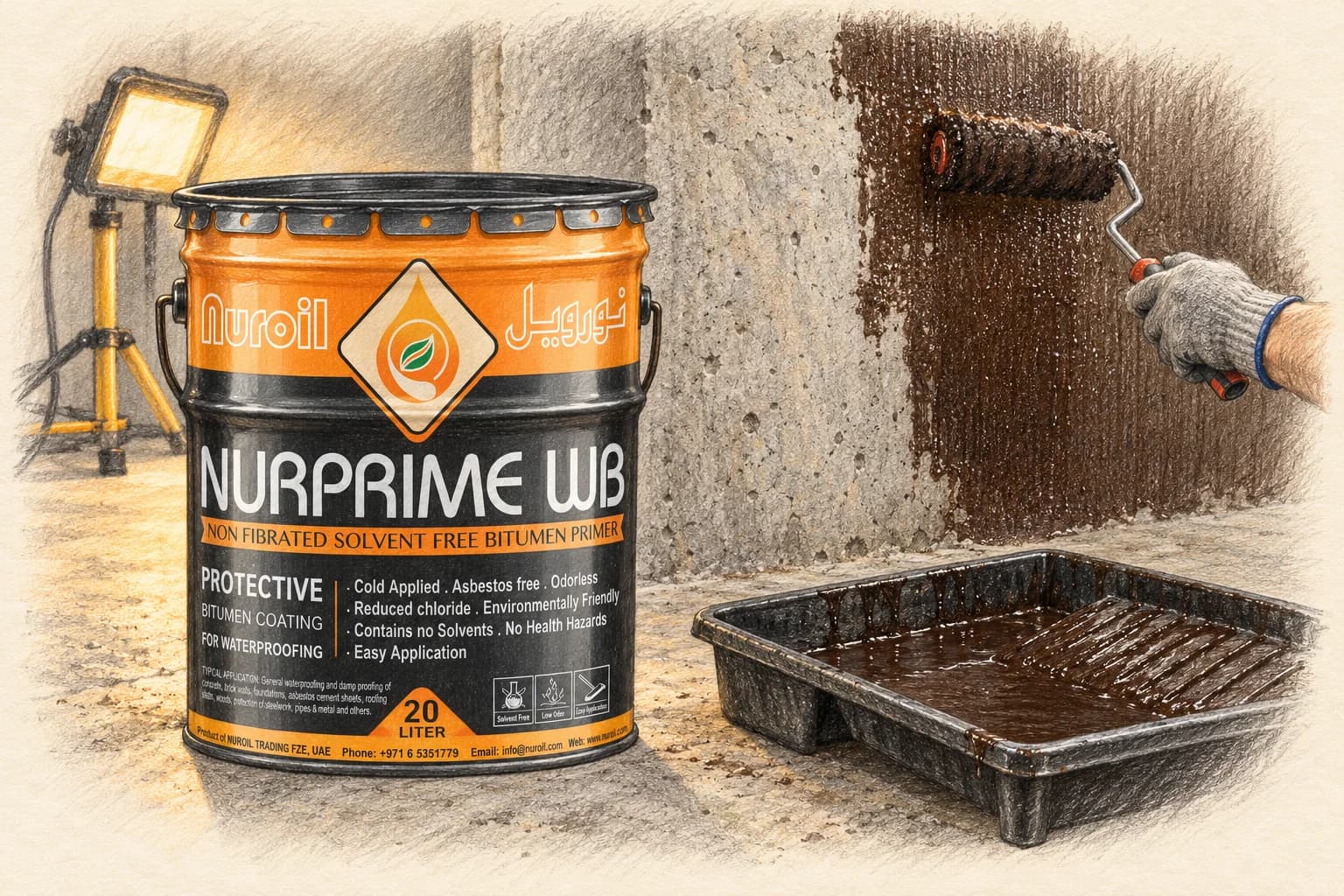
A bitumen primer is a thin, low-viscosity liquid. It soaks into the pores of the concrete, binds the remaining fine dust and leaves a tacky bitumen film that the membrane or coating can fuse to. Without primer, a torch-applied sheet is bonding to bare, dusty cement. With it, the sheet is bonding bitumen to bitumen.
| Failure seen on site | Likely preparation cause |
|---|---|
| Sheet peels with grey dust on the underside | Laitance or dust not removed, or no primer |
| Blisters appearing in hot weather | Damp substrate or primer not fully dry |
| Coating lifts in patches | Curing compound, oil or release agent left on surface |
| Pinholes or punctures | Sharp projections and unfilled voids |
Solvent-based primers penetrate well and dry quickly. Water-based primers avoid flammable vapours and suit enclosed spaces. Primer must be matched to the membrane: some manufacturers only warrant their own primer under their sheet.
The membrane is only as good as the surface it is stuck to. Time spent on preparation is the cheapest insurance on a waterproofing job.
Site checks before the membrane goes down
- Scratch the surface with a key: it should not powder.
- Press tape onto it and pull off: little or no dust should come away.
- Check that the primer is evenly applied, with no puddles and no bare patches.
- Confirm the weather window: no rain or dew forecast before the membrane is complete.
Ordering primers and membranes together
Primers and membranes should be ordered as a matched system. In an enquiry, state the membrane type, the area to be covered, the substrate (new or old concrete, screed, metal) and whether solvent-based or water-based primer is preferred. Ask for the primer data sheet with coverage per litre and drying time, plus the SDS. Nuroil supplies both solvent-based and water-based primers alongside membranes, with a CoA on every delivery.