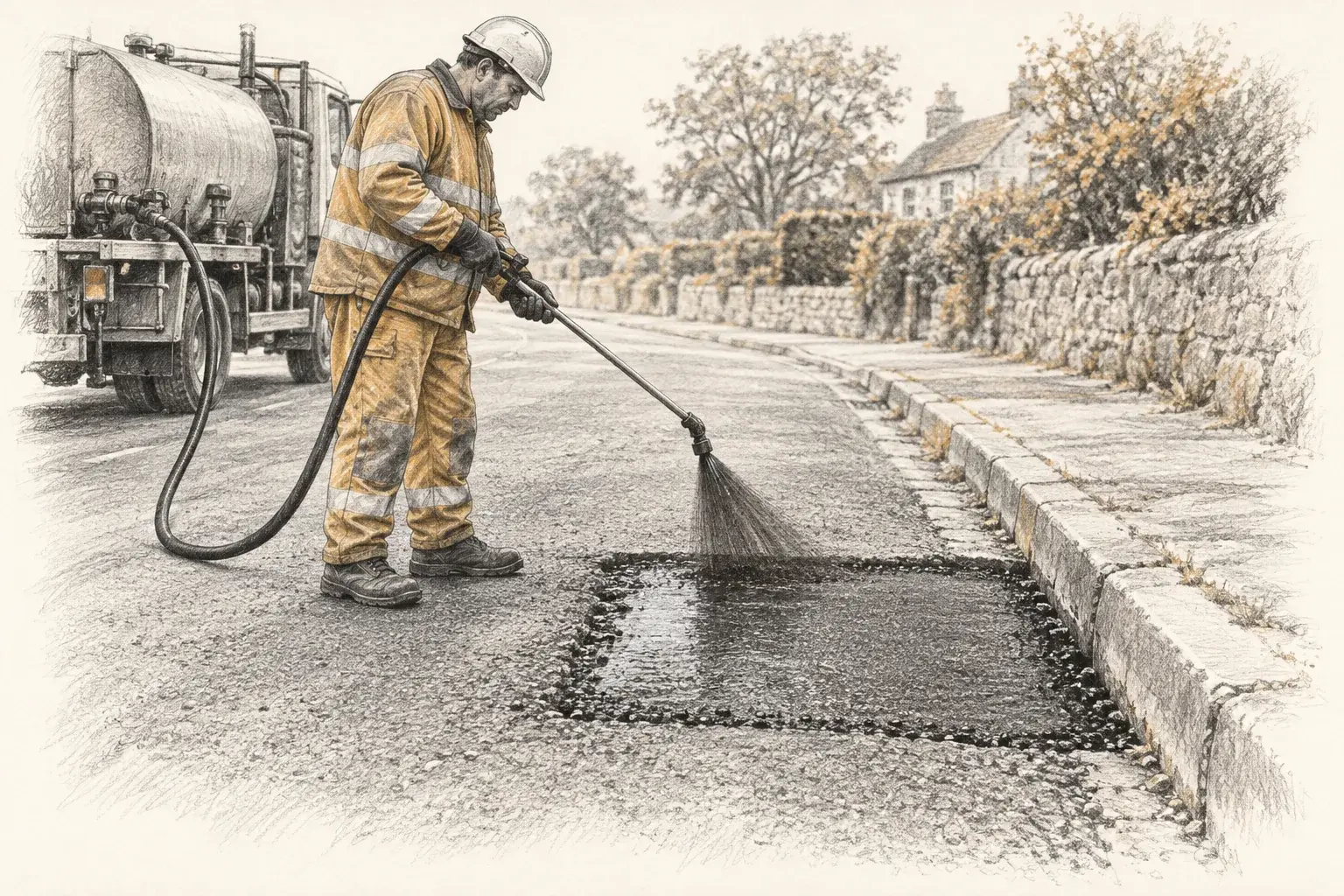
Every ready-to-use cold asphalt has the same basic recipe: graded stone coated with a bitumen binder that stays soft enough to shovel at ambient temperature. What keeps the binder soft is the main difference between products. It is either a bitumen emulsion, where water carries the bitumen, or a cutback, where a solvent thins it. That choice affects how the mix stores, how it cures and how well it stands up to water and traffic.
How each binder works
Emulsion-based cold mix
Cutback-based cold mix
Side-by-side comparison
| Aspect | Emulsion-based | Cutback (solvent) based |
|---|---|---|
| What leaves the mix | Water | Solvent |
| Early stability | Can be low until water drains | Usually workable and cohesive immediately |
| Wet holes | Tolerant of damp surfaces, but standing water slows curing | Generally places well in damp conditions if water is removed first |
| Cold weather | Must not freeze in storage; curing slows in cold | Stays workable in cold; solvent grade chosen for climate |
| Fumes and flammability | Low solvent content | Contains flammable solvent; keep from ignition sources |
| Long-term hardening | Binder sets once water is gone | Continues to stiffen as solvent slowly leaves |
What testing has shown
Research on cold patch materials shows that the binder and its solvent strongly influence performance. A laboratory study of several cold mixes found that those made with lighter, faster-evaporating solvents had higher early and cured strength, better cohesion and better rutting resistance than a mix thinned with diesel. Another study found that solvent-based cutback mixes were less sensitive to moisture than a diesel-based mix. The lesson for buyers is that the type and quality of the cutting agent matters, not only whether a product is labelled emulsion or cutback.
Large highway field trials also showed that material quality had more effect on patch life than placement method. A well-formulated product of either type will outperform a poorly made one.
Matching binder to the job
- Emergency winter or rainy-season patching: cutback products are often favoured because they stay workable in cold and wet conditions and carry traffic quickly.
- Enclosed or sensitive areas: emulsion products reduce solvent odour, useful near buildings, in car parks or under cover.
- Hot climates: a product with too soft a binder can shove or bleed in strong sun. Look for formulations designed for high pavement temperatures.
- Long storage: cutback products in sealed packs usually tolerate long storage well; emulsion products must be protected from freezing.
Ask what is keeping the binder soft and how quickly it leaves. That answer predicts most of a cold asphalt's behaviour in the bag and in the hole.
Safety notes
Cutback cold mix contains flammable solvent, so keep it away from flames and hot work, store it in ventilated areas and avoid prolonged skin contact. Emulsion products are less flammable but still contain bitumen and additives. Use gloves and eye protection when handling either type and follow the product SDS.
What to ask your supplier
Ask which binder type the product uses, how it performs in your climate, its shelf life and storage conditions, and whether it can be opened to traffic straight away. Request the data sheet and SDS. Nuroil's cold asphalt is supplied ready to use, and the team can advise on the version suited to your conditions through request a quote.