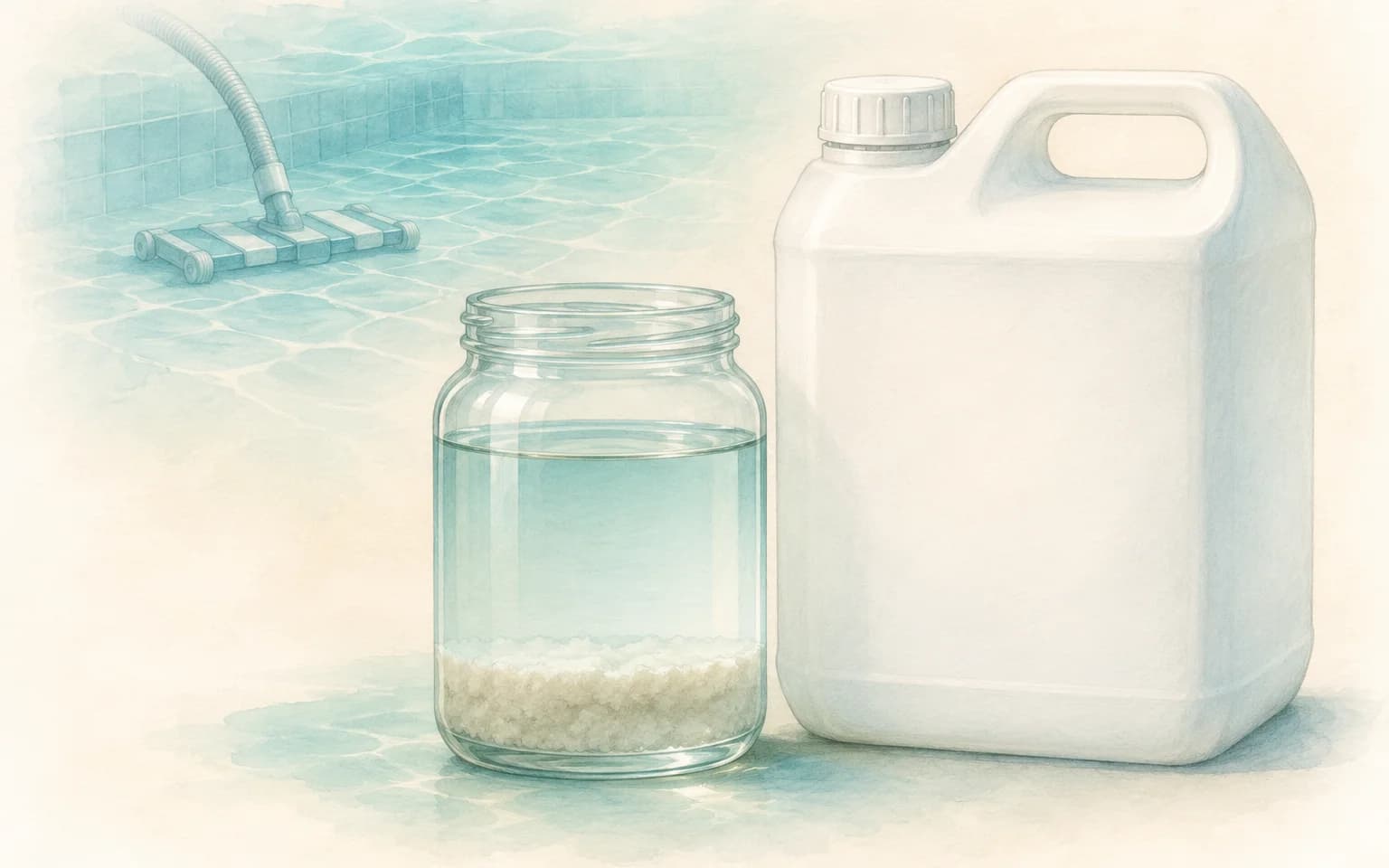
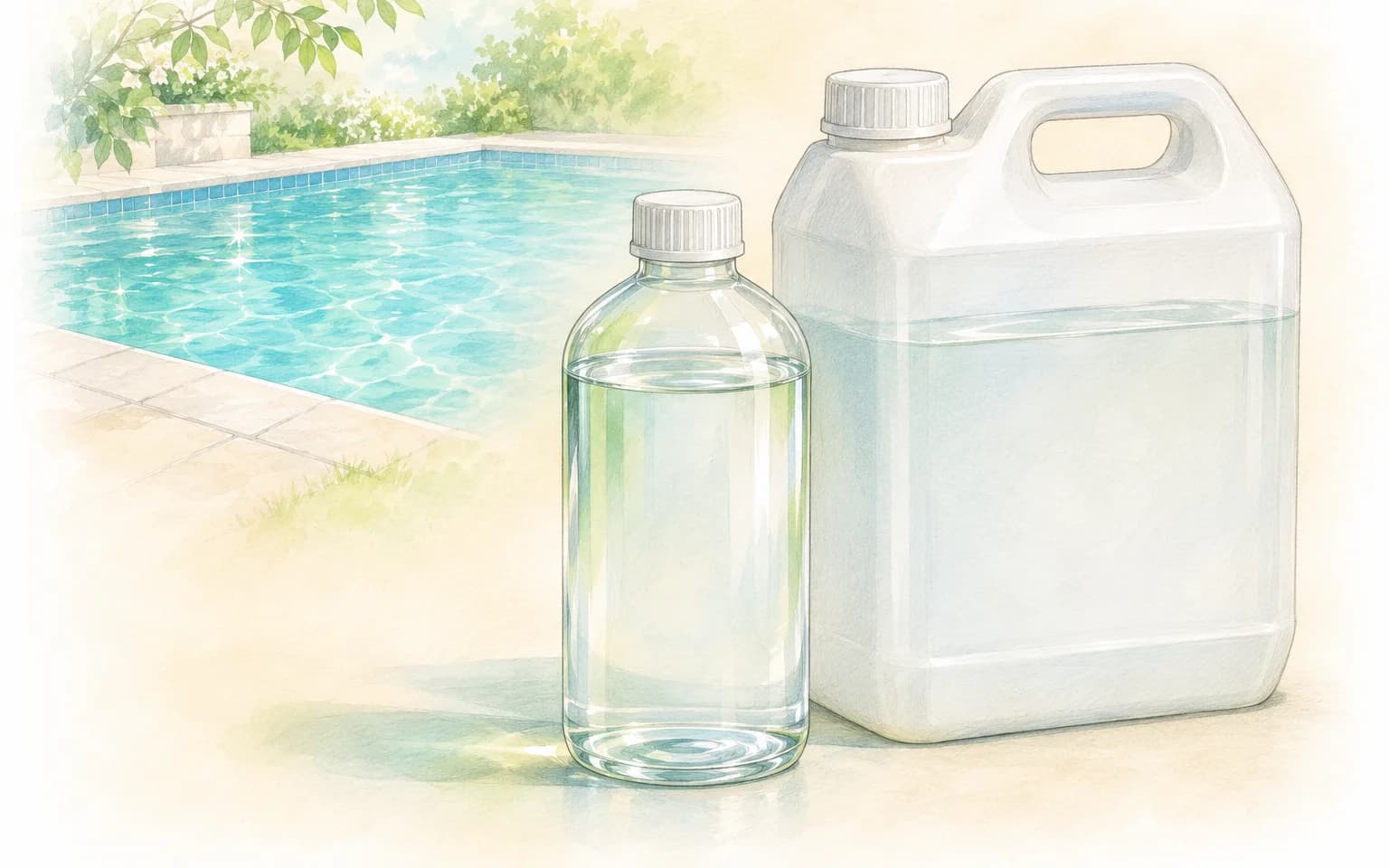
A pool clarifier is a positively charged, cationic polymer in water. The fine particles that make water dull or hazy carry a negative charge and are too small for a sand filter to hold; the polymer draws them together into clumps the filter can catch. Typical formulations use polyDADMAC or a polyamine, sometimes with chitosan, at a few per cent to about 20% active. The offered product’s TDS and SDS give its exact composition.
Unlike a flocculant it works with the pump running and needs no vacuuming, so it suits light haze and routine polishing. Overdosing can make water cloudier, so dose to the label.
Identity
Base
Cationic polymer
Type
Liquid clarifier
CAS
26062-79-3 (polyDADMAC)
Cationic polymer pool clarifierWhy Pool clarifier
Clears light hazeBrings dull or hazy water back to sparkle without draining or vacuuming.
Works through the filterDosed with the pump running; the filter does the rest.
Helps sand filtersLets sand filters hold particles finer than they would catch alone.
Documented qualityEach offered product comes with its TDS, Certificate of Analysis and safety data sheet.
What Nuroil does on every order
Why choose clarifier from Nuroil?
Checked against the batch CoA
Active content, pH and appearance are reviewed on the batch certificate before loading.
Formulation stated
The polymer, its strength and the dose rate are confirmed on the TDS with the offer.
Sealed, labelled containers
Cans, drums and IBCs closed and labelled to the SDS.
One desk, firm offers
FOB, CFR or CIF from our Sharjah trade desk, usually within 24 hours.
02 TECHNICAL DATA
Technical specification.
Active ingredient
Cationic polymer, such as polyDADMAC or polyamine, per TDSProducer formulation
Active content
Typically 2–20%, by formulationSolids / titration
pH (as supplied)
About 4–7pH meter
Density at 20 °C
About 1.0–1.05 g/cm³Hydrometer
Appearance
Clear to slightly hazy, colourless to tinted liquidVisual
01STANDARD
Routine polishing
Ready-to-dose clarifier for weekly or as-needed use in pools and spas.
02CONCENTRATED
Larger pools and repackers
Higher-strength polymer for commercial pools, distributors and dilution.
03SPA GRADE
Spas and hot tubs
Clarifiers made for cartridge filters and small water volumes, per TDS.
Selection guidance Tell us the pool or spa sizes, the filter type and how you dose, and we will confirm the strength.
Both clear cloudy water. A clarifier gathers particles for the filter; a flocculant settles them to the floor.
Property
Clarifier
Flocculant
How it works
Gathers for the filter
Settles to the floor
Speed
1–3 days
Overnight
Work after dosing
None
Vacuum to waste
Pump
Running
Off while settling
Best suited to
Light haze, routine polish
Heavy cloudiness
03 HOW IT IS MADE
From polymer to a pool liquid.
Cationic polymers such as polyDADMAC are made by polymerising quaternary ammonium monomers in water and are supplied as concentrates. The clarifier is blended from the concentrate and treated water, adjusted for pH, often tinted, then filtered and filled.
01
Cationic polymer
PolyDADMAC, polyamine or a blend is the starting concentrate.
02
Blending
The polymer is diluted with treated water to the product strength.
03
Adjusting
pH is adjusted and a colour may be added for identification.
04
Testing and filling
Each batch is tested for solids and pH and filled into cans, drums or IBCs.
04 APPLICATIONS
Where it polishes.
01
Swimming pools
Clearing light haze and keeping water sparkling with sand, glass or cartridge filters.
02
Spas and hot tubs
Clearing body oils and fine particles in small, warm water volumes.
03
After shock dosing
Polishing water after a chlorine shock or algae treatment.
04
Pool openings
Bringing water back to clarity at the start of the season.
05 SAFETY & HANDLING
Low hazard. Still use PPE.
This summary does not replace the Safety Data Sheet. Classification depends on the formulation; review the product SDS and site procedure before first handling.
Not classified
GHS Most formulations are not classified; some list eye irritation (H319) or harm to aquatic life (H412). Per SDS.
UN
Not regulated, per SDS
Transport
Not dangerous goods, per most SDSs
01
Protect your eyes
Most clarifiers are not classified, but some cause eye irritation; wear eye protection and gloves.
02
Dose separately
Never mix with algaecide, chlorine or other pool chemicals in a container; add each to the pool on its own.
03
Dose to the label
Overdosing can make water cloudier rather than clearer.
04
Slippery when spilled
Polymer spills make floors slippery; contain them and rinse with water.
05
Exposure response
Rinse eyes with water for several minutes; seek medical advice if irritation persists.
Closed, shaded and frost-free.
Shelf lifeTypically 2 years
Polymer clarifiers are stable kept closed, out of the sun and above freezing. Confirm the producer’s shelf life with the offer.
Keep containers closedReseal after use and keep the original label.
Shaded, above freezingOut of direct sun and away from heat; do not let it freeze.
SegregateApart from oxidisers such as chlorine products.
First in, first outUse the oldest stock first and keep the batch label with each lot.
Plan documentation early.
HS code3824.99
CAS number26062-79-3
CAS number42751-79-1
TransportNot regulated
GHS
Most formulations not classified; some list eye irritation (H319) or harm to aquatic life (H412); per SDS
Transport
Not regulated as dangerous goods on most SDSs; per SDS
Pool use
Confirm the product suits the local pool code and the filter type
National regulations
Confirm the destination’s chemical-import requirements
06 PACKING OPTIONS
Choose your packing.
Pack sizes, formulation and container loads depend on the producer; the offer confirms them.
Smaller orders
Bottles and cans
HDPE bottles and cans, commonly 1, 5, 20 or 25 litres, for pool companies and retail.
Typical clarifiers are water solutions of a cationic polymer such as polyDADMAC or a polyamine, sometimes with chitosan. Strength varies by producer; the offered product’s TDS and SDS give the exact composition.
02Clarifier or flocculant?
Clarifier for light haze, working through the filter with no vacuuming. Flocculant for heavy cloudiness, when you can switch off the pump and vacuum to waste.
03How long does it take?
Usually one to three days of normal filtration. Backwash or clean the filter afterwards, because it holds what the clarifier gathered.
04Can I overdose it?
Yes. Too much polymer can make water cloudier. Dose to the label and check that pH and sanitiser are in range first.
05Can it be used with algaecide?
Add them separately. Some algaecides and clarifiers are both cationic and do not interfere, but never mix concentrates; follow each TDS.
06What is the HS code?
Formulated clarifiers are usually declared under HS 3824.99; polymer concentrates are sometimes declared under 3911.90. Confirm with the product and destination.
07What documents come with a shipment?
A TDS, Certificate of Analysis and Safety Data Sheet, with the Certificate of Origin as required.