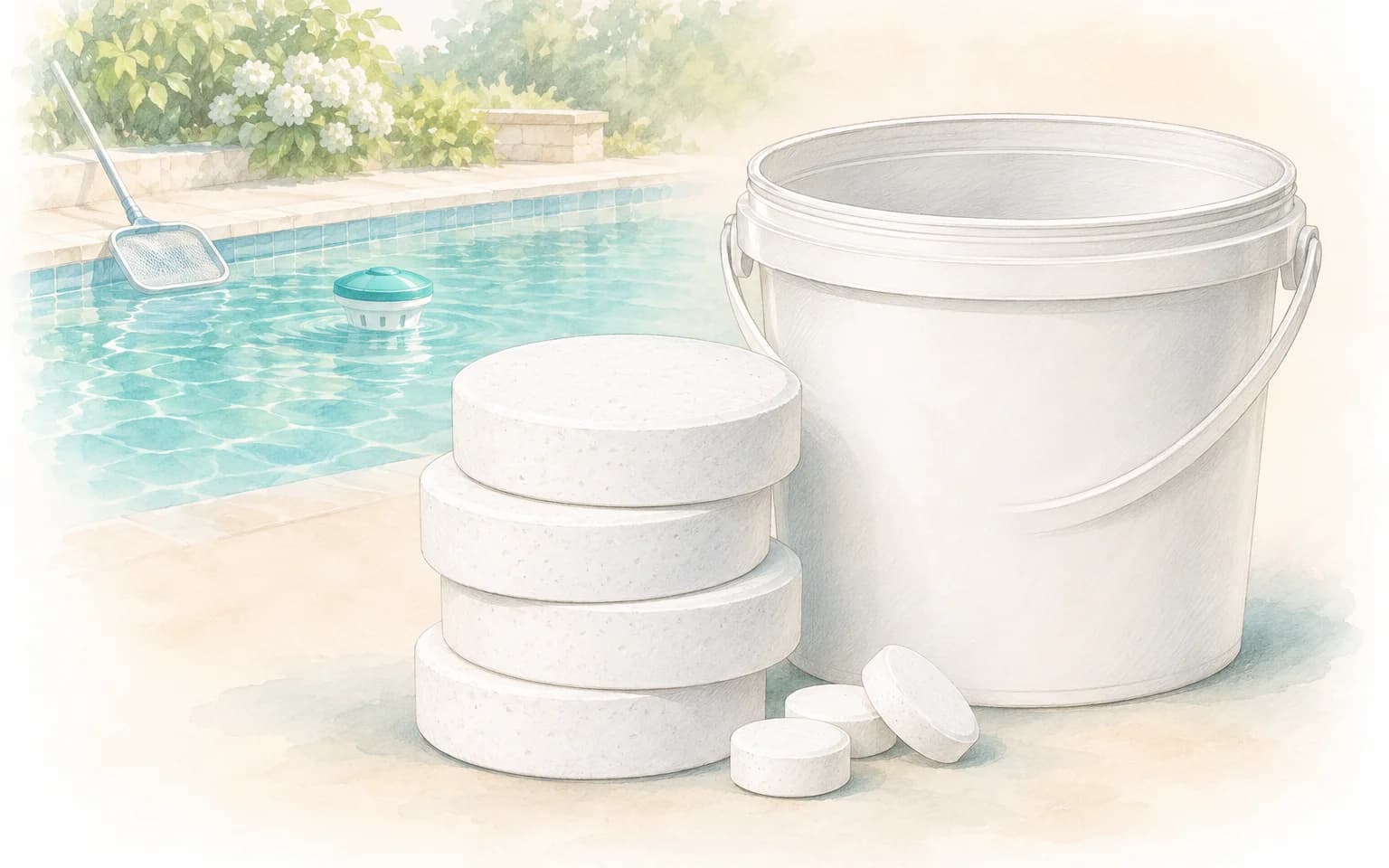
Bromine tablets are pressed from 1-bromo-3-chloro-5,5-dimethylhydantoin, BCDMH, C₅H₆BrClN₂O₂. As the tablet dissolves it releases hypobromous acid, the sanitiser, and a little hypochlorous acid, which turns spent bromide back into active bromine.
Bromine keeps working at the higher pH and temperature of spas, and its combined forms, bromamines, still disinfect and smell far less than chloramines. It is not protected by cyanuric acid, so sunlight breaks it down: it suits spas, hot tubs and indoor pools rather than outdoor pools. It is a strong oxidiser and must be kept apart from chlorine products, acids and organics.
Holds up in hot waterBromine stays active at spa temperatures and is less affected by pH drift than chlorine.
Less odour and irritationBromamines still sanitise and carry little of the sharp smell of chloramines.
Slow, even dosingThe tablets dissolve slowly in a brominator or floater, giving a steady residual.
Documented qualityEach offered batch comes with its Certificate of Analysis and safety data sheet.
What Nuroil does on every order
Why choose bromine tablets from Nuroil?
Checked against the batch CoA
BCDMH content, moisture and tablet weight are reviewed on the batch certificate before loading.
Dangerous-goods paperwork handled
Shipped as UN 3085, class 5.1 oxidiser with a corrosive subsidiary risk, labelled and declared.
Packed to stay dry
Sealed pails and lined drums, kept out of the heat in transit.
One desk, firm offers
FOB, CFR or CIF from our Sharjah trade desk, usually within 24 hours.
02 TECHNICAL DATA
Technical specification.
BCDMH content
96% min, typically 98%Iodometric titration
Active halogen
Often stated as about 60% bromine and 27% chlorine, by producerIodometric titration
Moisture
0.5–1% maxGravimetric
Melting point
About 158–163 °CCapillary
Appearance
White to off-white tabletsVisual
Odour
Faint halogen
Tablet weight
20 g (also 1–5 g and granules on request)Weight
0120 g TABLETS
Spas and indoor pools
The standard tablet for brominators, erosion feeders and floaters.
02SMALL TABLETS
Hot tubs and small spas
Tablets of a few grams for small water volumes and floaters, on request.
03GRANULES
Industrial feeders
Granular BCDMH for cooling-water feeders and compounding, on request.
Selection guidance Tell us the water volume and temperature, the feeder you use and whether the water is indoor or outdoor, and we will confirm the size.
Two halogen sanitisers. The right one depends on water temperature and whether the pool sees the sun.
Property
Bromine tablets (BCDMH)This page
TCCA tablets
Effective at higher pH
Good
Falls off above 7.6
Hot water
Stable
Lost faster
Odour of combined forms
Low
Chloramine smell
Sunlight
Not stabilised
Stabilised by cyanuric acid
Best suited to
Spas, hot tubs, indoor pools
Outdoor pools, daily chlorination
03 HOW IT IS MADE
From dimethylhydantoin to tablets.
5,5-Dimethylhydantoin is suspended in water and halogenated with bromine and chlorine, which precipitates BCDMH. The solid is filtered, dried and pressed into tablets, often with a binder.
01
Dimethylhydantoin
5,5-Dimethylhydantoin is slurried in water.
02
Halogenation
Bromine and chlorine are added in turn to form BCDMH.
03
Drying and pressing
The crystals are filtered, dried and pressed into tablets.
04
Testing and packing
Each batch is tested for BCDMH content and sealed in pails or drums.
04 APPLICATIONS
Where it sanitises.
01
Spas and hot tubs
Continuous sanitising in warm, heavily used water through a brominator or floater.
02
Indoor pools
Hotel, club and therapy pools out of direct sunlight, with less odour than chlorine.
03
Water features
Indoor fountains and decorative water, where approved.
04
Cooling water
Control of algae, slime and bacteria in cooling towers, effective at higher pH.
05 SAFETY & HANDLING
An oxidiser. Keep it apart.
This summary does not replace the Safety Data Sheet. Review the SDS and site procedure before first handling.
Danger
H272 May intensify fire; oxidiser.
H302 Harmful if swallowed.
H314 Causes severe skin burns and eye damage.
H317 May cause an allergic skin reaction.
H410 Very toxic to aquatic life with long lasting effects.
UN
3085
Class
5.1 (8), oxidiser · PG II
01
Never mix with chlorine products
Never put bromine tablets in a feeder that has held TCCA or calcium hypochlorite: the mixture can cause fire or explosion.
02
Never mix with acids
Contact with acids releases toxic bromine and chlorine gases.
03
Away from fuels and organics
As an oxidiser it can intensify a fire; keep it from oil, grease, solvents and ammonia compounds.
04
Protect skin and eyes
Dust and wet tablets burn skin and eyes and can cause skin allergy; wear gloves and eye protection.
05
Exposure response
Rinse skin and eyes with plenty of water for several minutes and seek medical attention; move to fresh air if dust or gas is inhaled.
Cool, dry and on its own.
StoreCool, dry, apart
BCDMH is stable when kept cool, dry and sealed. Heat and moisture start decomposition. Confirm the producer’s shelf life with the offer.
Keep containers closedMoisture starts decomposition and releases halogen fumes; reseal pails and drums at once.
Cool, ventilated storeOut of direct sun and away from heat sources, with good ventilation.
SegregateApart from chlorine products, acids, fuels and organics, as an oxidiser.
First in, first outUse the oldest stock first and keep the batch label with each lot.
Plan documentation early.
HS code2933.21
CAS number16079-88-2
EC number240-230-0
UN numberUN 3085
GHS
Oxidising solid; harmful if swallowed; skin corrosion and eye damage; skin sensitiser; very toxic to aquatic life
Transport
UN 3085, oxidising solid, corrosive, n.o.s. (BCDMH): class 5.1, subsidiary 8, PG II
Biocide registration
Pool and spa sanitisers need product approval in many markets; confirm the destination’s rules
National regulations
Confirm the destination’s import and dangerous-goods requirements
06 PACKING OPTIONS
Choose your packing.
Pack sizes and container loads depend on the producer; the offer confirms them.
Small quantities
Plastic pails
Tablets in sealed pails, commonly 5, 10 or 25 kg, for spa and pool companies.
Bromochlorodimethylhydantoin, the usual active in bromine tablets. It releases hypobromous acid to sanitise, and a little chlorine that reactivates spent bromide.
02Why bromine for spas?
Bromine stays effective at the higher temperatures and pH of spas, and its combined forms smell and irritate less than chloramines.
03Can I use bromine outdoors?
It works, but sunlight breaks it down and cyanuric acid does not protect it, so it is costly to keep a residual in a sunny outdoor pool. Stabilised chlorine suits outdoor pools better.
04Can bromine and chlorine tablets share a feeder?
No. BCDMH and TCCA or calcium hypochlorite can react violently. Use a dedicated brominator and flush any feeder thoroughly before changing product.
05Is it dangerous goods for shipping?
Yes. BCDMH ships as UN 3085, oxidising solid, corrosive, class 5.1 with subsidiary class 8, packing group II. We prepare the dangerous-goods documents with the shipment.
06What is the HS code?
BCDMH is usually classified under HS 2933.21, hydantoin and its derivatives. Its CAS number is 16079-88-2; 32718-18-6 is also used.
07What documents come with a shipment?
A Certificate of Analysis and Safety Data Sheet, with the Certificate of Origin and dangerous-goods declaration as required.