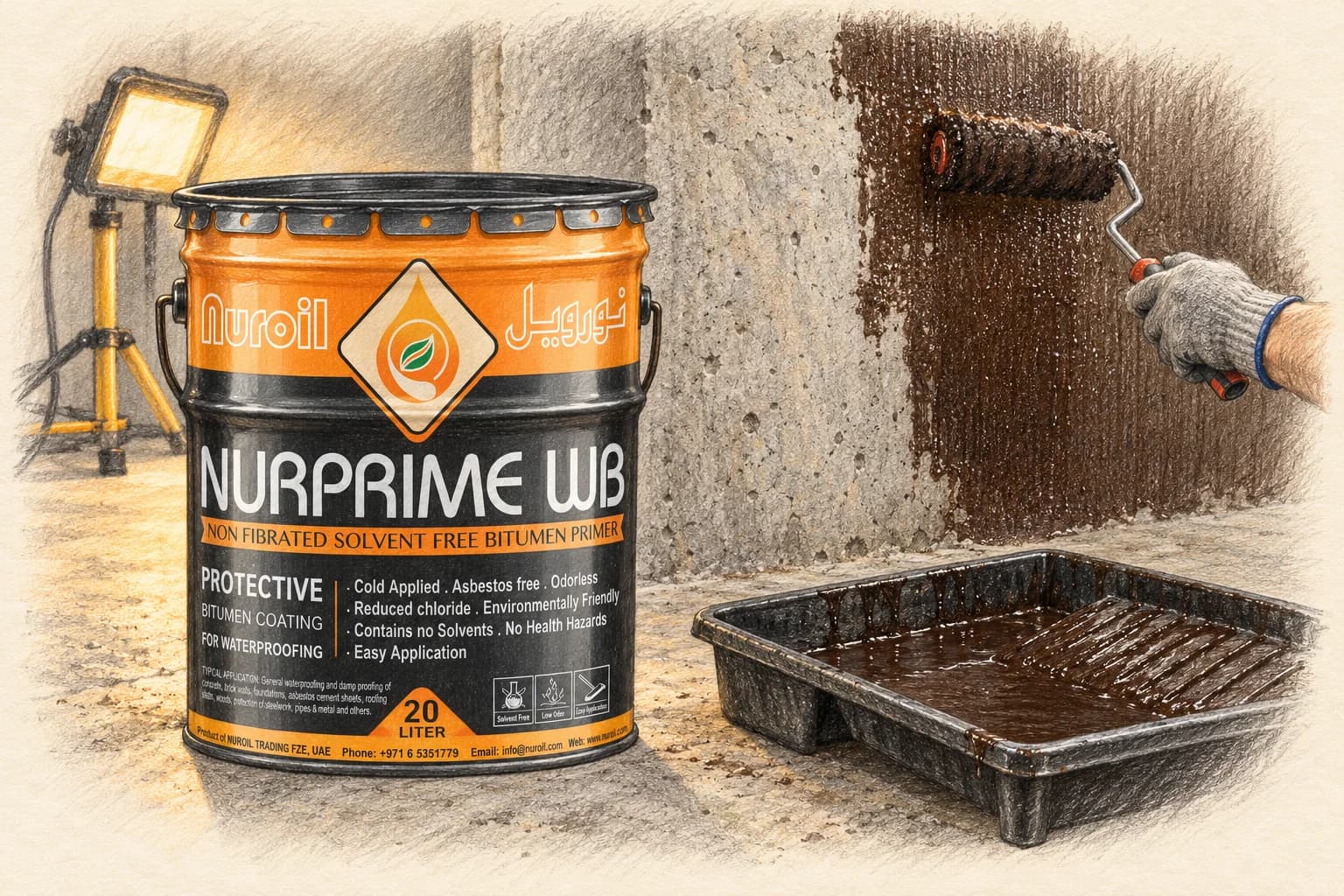
Water-based bitumen primers are easier to handle than solvent primers in many ways: no flammable solvent, little odour and tools that clean up with water. Their weak point is storage. Because the product is an emulsion of bitumen droplets in water, anything that disturbs that balance in the drum, especially freezing, can make it unusable before it ever reaches the wall.
What happens when an emulsion freezes
An emulsion stays liquid because each microscopic bitumen droplet is surrounded by an emulsifier that keeps it apart from its neighbours. When the water phase freezes, ice crystals force droplets together and the protective layer around them breaks down. On thawing, the bitumen has often coagulated into lumps or a separated layer that will not mix back into a smooth liquid.
Data sheets are blunt about this. Several manufacturers state that the product must not be exposed to temperatures below about +5 °C and that once frozen it cannot be recovered. Stirring may make it look acceptable, but the film it forms is likely to be uneven and poorly bonded.
Heat and long storage
Frost is the headline risk, but high temperatures also shorten an emulsion's life. Prolonged heat speeds up water loss through imperfect seals, encourages skinning on the surface and can lead to gradual settling. In hot regions, drums and pails left in direct sun on a site or in an unventilated container yard can reach temperatures well above ambient. Store them shaded, ventilated and off the ground.
Typical shelf life
Published shelf lives for water-based bitumen primers vary by manufacturer, commonly in the range of 12 to 24 months from manufacture when kept unopened in the original container in cool, dry, frost-free conditions. Once a container is opened, the clock runs faster because air and evaporation start to form a skin. Practical rules:
- Use first in, first out, and check the batch or production date on arrival.
- Keep lids closed tightly between uses and do not leave part-used pails open overnight.
- Do not return unused, thinned primer to the original container.
- Stir or mix gently before use to restore uniformity; heavy settling that will not remix is a reason to reject the material.
Shipping and site storage in practice
| Stage | Main risk | Good practice |
|---|---|---|
| Sea freight and transit | Heat in containers; frost on winter routes | Ask about route and season; consider insulated or heated options for cold destinations |
| Warehouse | Frost, direct sun, damaged lids | Indoors, shaded, stacked within the packer's limits, above +5 °C |
| Site compound | Overnight frost, sun on steel drums | Covered, ventilated store; bring only a day's quantity to the work face |
| Open containers | Skinning, contamination | Close lids, use clean tools, discard skins rather than mixing them in |
Checking a delivery
When primer arrives, open a sample container. A sound emulsion should be a smooth, uniform brown-black liquid that pours freely. Warning signs are hard lumps, a rubbery layer on the surface, clear water separated on top that does not remix, or a grainy texture when brushed onto a test panel. Any of these, especially after a cold transit, should be reported before the material is used.
A frozen emulsion primer is not a cheaper primer. It is a failed batch that may still look like primer.
What to agree with your supplier
For a water-based primer order, ask for the production date and shelf life on the CoA or label, storage temperature limits on the technical data sheet, and packing suited to the route (lined steel drums or plastic pails, with secure lids). Tell the supplier about winter destinations or long inland legs so packing and timing can be planned. Nuroil supplies water-based bitumen primers with a CoA for every delivery, with the MSDS and third-party inspection available on request.