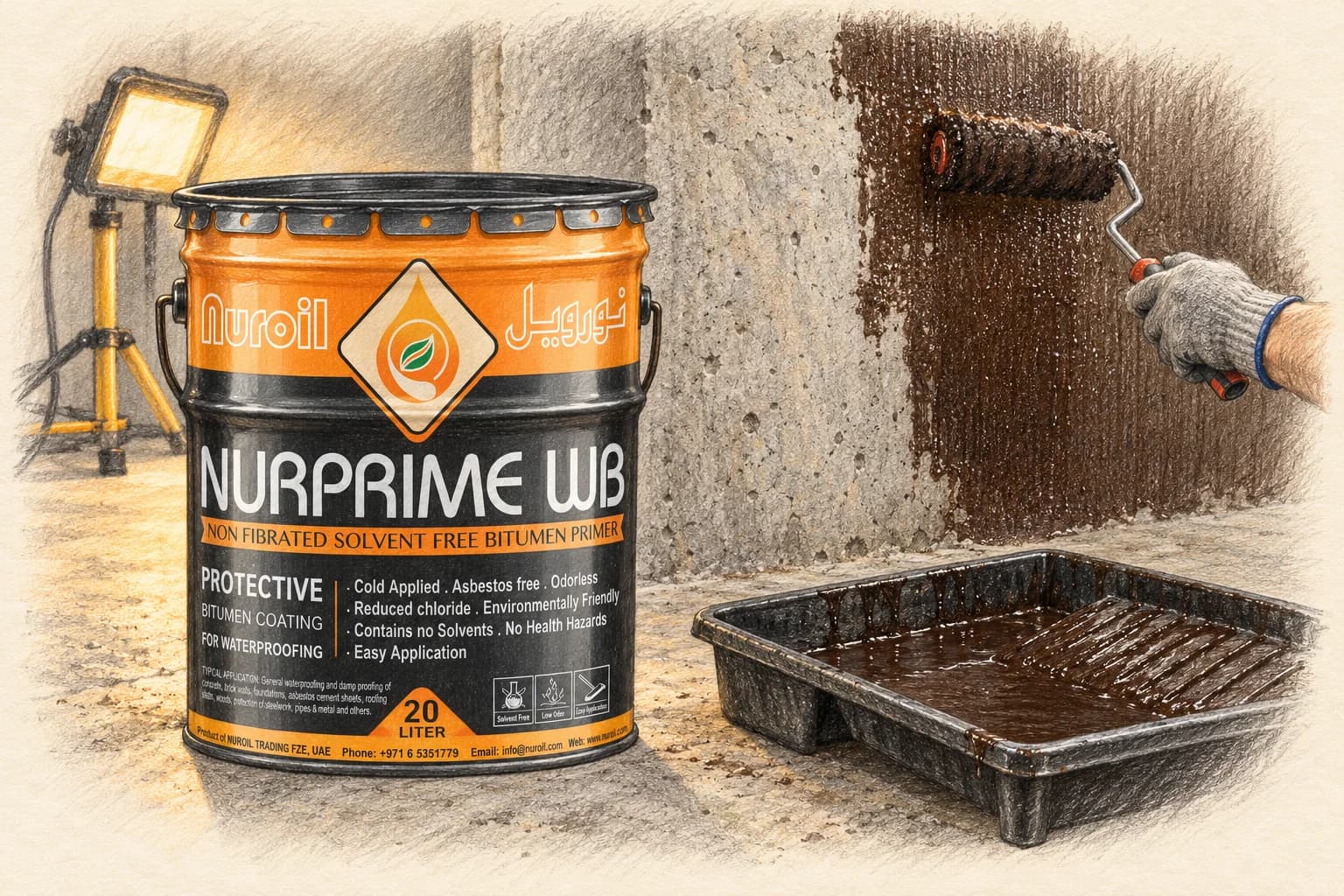
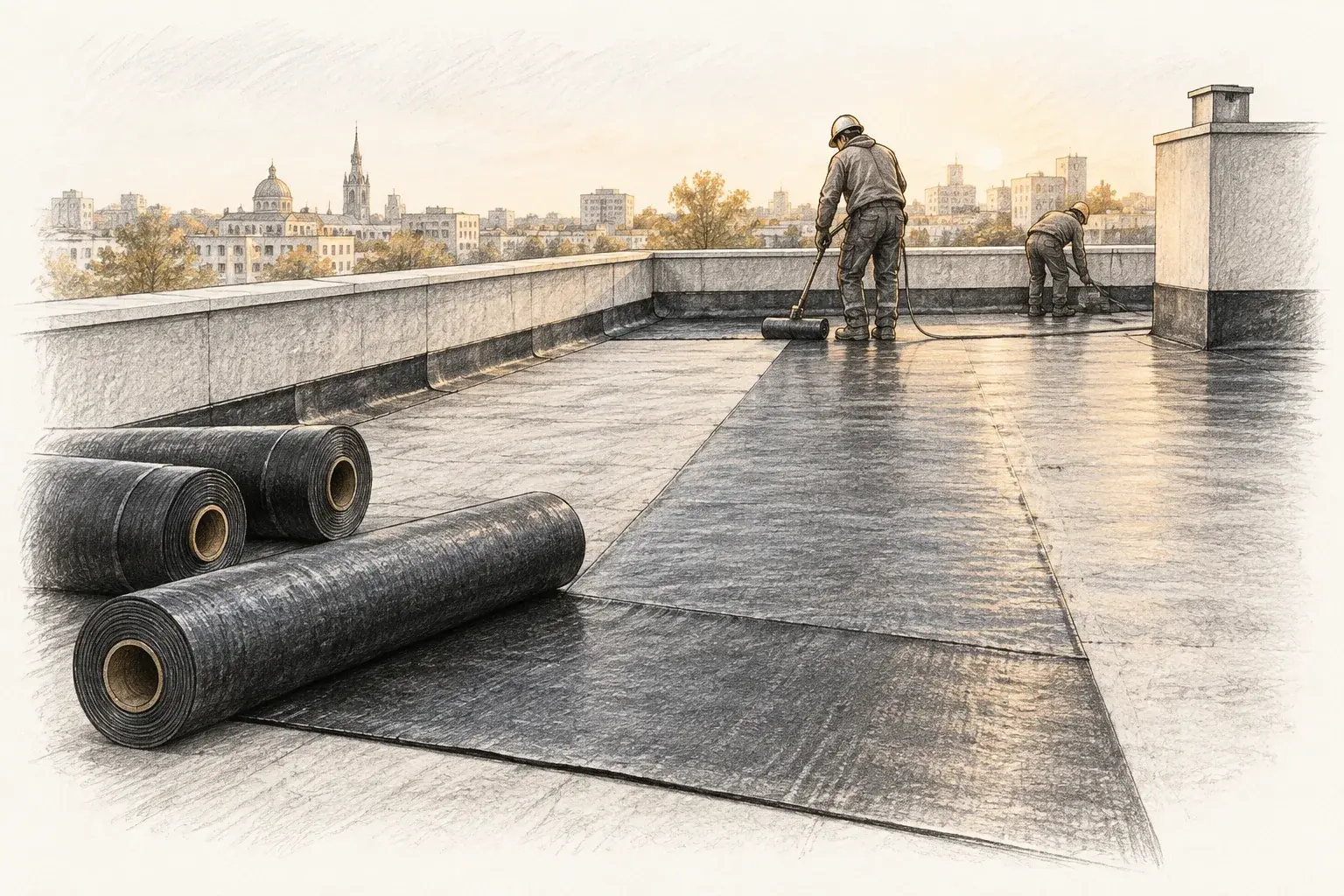
Technical data sheets for water-based bitumen primers look similar from one producer to the next, but the numbers are not always measured the same way. This guide explains the parameters you will usually see, what each tells you about performance on site, and where comparisons between products can mislead.
Composition and appearance
Most sheets describe the product as bitumen emulsified in water, sometimes with polymer or other additives. In the pail it is typically a brown to brown-black liquid that turns black as it dries. That colour change is a useful site indicator: a primer that is still brown has not finished losing its water.
Some sheets identify the emulsifier type or charge. Cationic and anionic emulsions behave differently on different substrates, and the two should never be mixed, as mixing can cause the bitumen to break out of suspension in the container.
Key parameters
| Parameter | What it tells you | Points to watch |
|---|---|---|
| Solids or bitumen content | How much film-forming material remains after the water leaves | Check whether it is stated by weight or volume; higher solids generally means more film per litre |
| Density | Mass per litre, usually close to 1 kg/l for emulsions | Needed to convert between g/m² and l/m² consumption figures |
| Viscosity or consistency | Whether it brushes, rolls or sprays easily and how far it penetrates | Test method and temperature should be stated |
| Coverage or consumption | Area covered per litre or kilogram per coat | Varies widely with substrate porosity; see below |
| Drying time | Touch-dry and overcoat or membrane-ready times | Quoted at a stated temperature, often 23–25 °C |
| Application temperature | Air and surface limits for use | Lower limit is often around +5 °C; upper limits differ |
| Dilution | Whether and how much clean water may be added | Dilution changes coverage and solids; follow the sheet |
| Shelf life and storage | How long it keeps unopened | Usually requires frost-free storage; frozen product is lost |
Reading coverage figures
Coverage is the figure most often compared and most often misunderstood. Published values for water-based bitumen primers range from around 2–5 m² per litre on absorbent concrete to about 10 m² per litre on smooth steel, and consumption is sometimes given by weight, for example 100–200 g/m², or for a diluted mix. To compare two products fairly:
- Convert both to the same unit using density.
- Check whether the figure is for neat or diluted primer.
- Compare on the same substrate type; a figure for steel tells you little about blockwork.
- Remember that higher coverage from a lower-solids product may simply mean a thinner film.
Reading drying times
Sheets may give several times: touch-dry, recoat or overcoat, membrane-ready, and full cure. For an emulsion primer the most important figure is when the next layer can be applied. One published example gives touch-dry in about two hours at 25 °C, recoat after a few hours and a much longer time to full dryness. Lower temperatures, high humidity, poor airflow and heavy application all lengthen these times.
Standards you may see referenced
There is no single global standard that all water-based bitumen primers are tested against. Some products reference standards for emulsified asphalt coatings, such as ASTM D1187 for emulsions used as protective coatings on metal or ASTM D1227 for emulsified asphalt roof coatings, while others are tested to the producer's own methods or a national standard. When a standard is cited, ask which type or class the product meets.
Using the data sheet in an enquiry
Ask for the current TDS and SDS with any quotation, and make sure the batch CoA reports the same parameters, at minimum solids content and density, so delivered material can be checked against what was approved. State your substrate and membrane system so the supplier can confirm compatibility. Nuroil provides a CoA with every delivery of water-based primer; send your specification through the quote form.