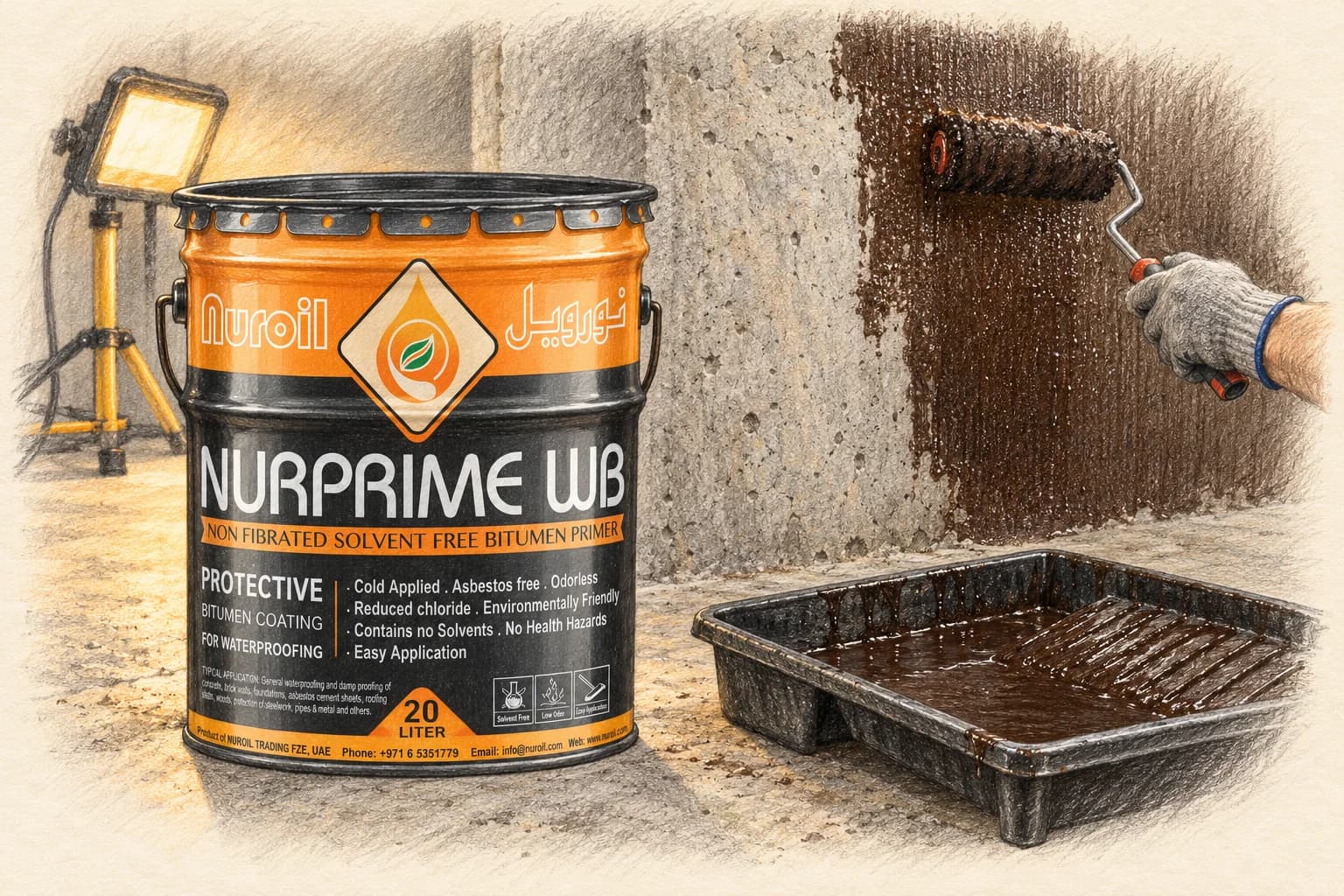
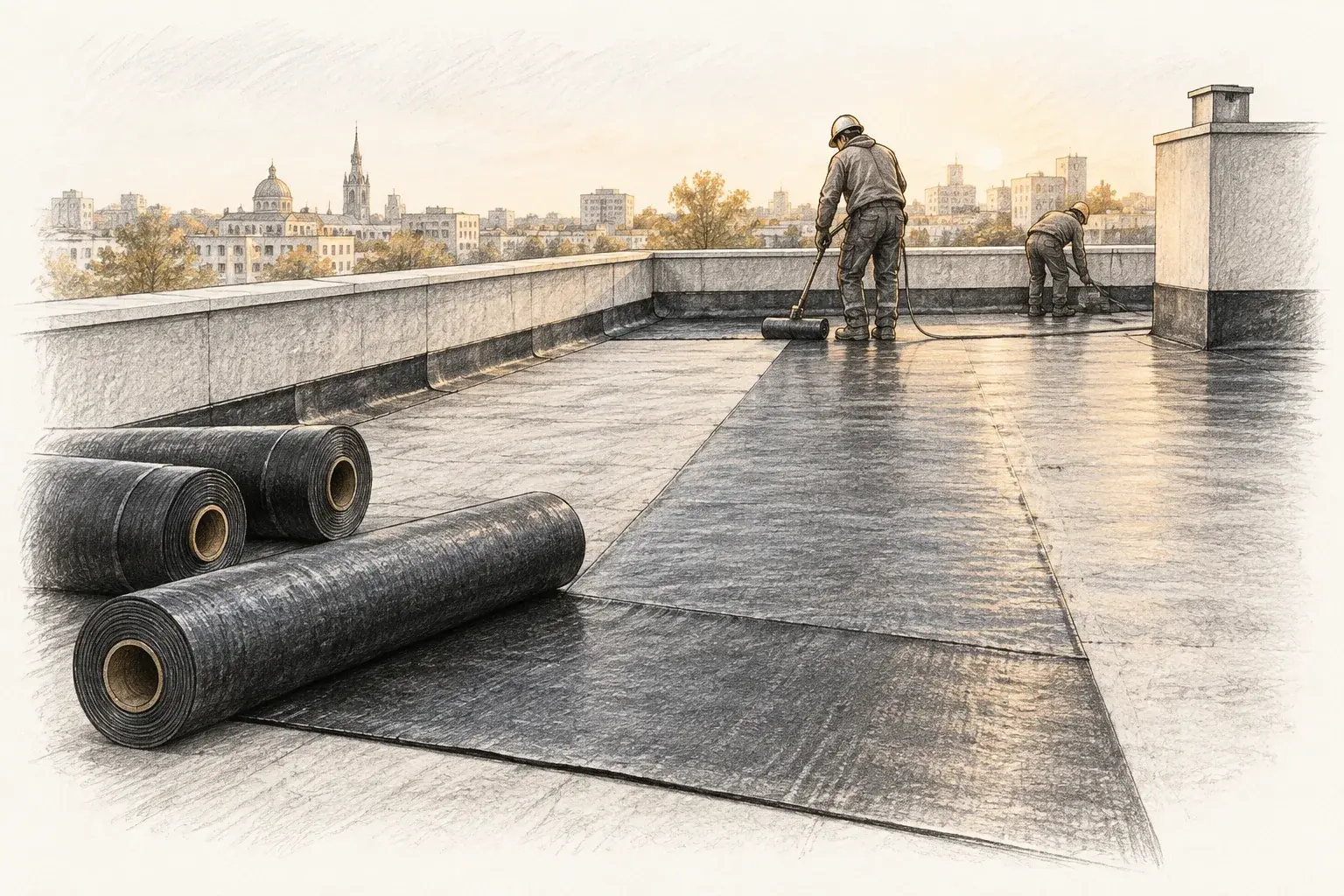
A water-based bitumen primer has one job: to penetrate the surface, bind dust and give the membrane or coating above it something to bond to. It is a thin, low-cost layer, which is why it is easy to underestimate. This guide sets out the sequence most manufacturers' instructions follow. Always use the data sheet for the specific product, because limits and rates differ.
1. Prepare the surface
- Remove laitance, curing compounds, oil, grease, loose mortar and dust. Wire brushing, grinding or pressure washing are common methods.
- Repair holes, honeycombing and sharp edges so the membrane has a continuous, smooth base. Form fillets at internal corners if the membrane system requires them.
- The surface can usually be matt-damp but not wet. Remove standing water and avoid frozen or thawing substrates.
- On metal, remove loose rust and scale and degrease.
2. Check conditions
Typical application ranges start at about +5 °C and stop somewhere between +30 °C and +40 °C depending on the product. Avoid application when rain, frost or dew is expected before the primer dries. In strong sun, the surface can be far hotter than the air, which may make the primer skin before it penetrates; working early or late in the day helps.
3. Mix and, if allowed, dilute
Stir the primer gently until uniform. Some products are supplied ready to use, while others allow dilution with clean water for the first coat on very porous substrates. One published example quotes consumption at 30% dilution. Dilute only within the limits on the data sheet, use clean water, and never mix different primers or add solvents.
4. Apply
Use a brush, roller or low-pressure spray. Work the primer into the surface rather than leaving a thick layer on top. Brushing is better for rough blockwork and corners, rolling for large flat slabs. Avoid ponding in low areas.
| Substrate | Typical coverage range per litre | Notes |
|---|---|---|
| Smooth steel or metal | Up to about 10 m² | Thin film; surface must be clean and degreased |
| Dense concrete or screed | About 4–6 m² | Depends on finish and age |
| Porous concrete, blockwork | About 2–5 m² | May need a diluted first coat or two coats |
These ranges come from published data sheets and are indicative only. Some producers express consumption by weight, for example 100–200 g/m² or 0.3–0.4 l/m².
5. Let it dry and check
Drying times on data sheets are quoted at a stated temperature, commonly one to three hours to touch-dry at 23–25 °C. Before applying the membrane, check that:
- The colour has changed from brown to uniformly black.
- The film is not tacky and does not transfer to a finger.
- Corners, joints and shaded areas are as dry as open areas.
- No dust or debris has settled on the primed surface.
Do not leave primed surfaces exposed for long periods before covering. Dust, rain and foot traffic can spoil the surface, and some systems set a maximum time between priming and membrane application.
6. Clean up
Wash tools with water immediately after use. Dried primer is much harder to remove and may need a solvent cleaner. Do not wash primer residues into drains; follow the SDS for disposal.
The primer coat is cheap. The membrane that fails because the primer was dusty, wet or skipped is not.
Ordering the right quantity
Estimate quantity from the area, the substrate's coverage range and the number of coats, then add an allowance for waste and uneven surfaces. In your enquiry, give the area, substrate and membrane type and the pack size you prefer. Nuroil supplies water-based bitumen primers in pails and drums with a CoA per batch; for solvent alternatives see solvent-based primers.