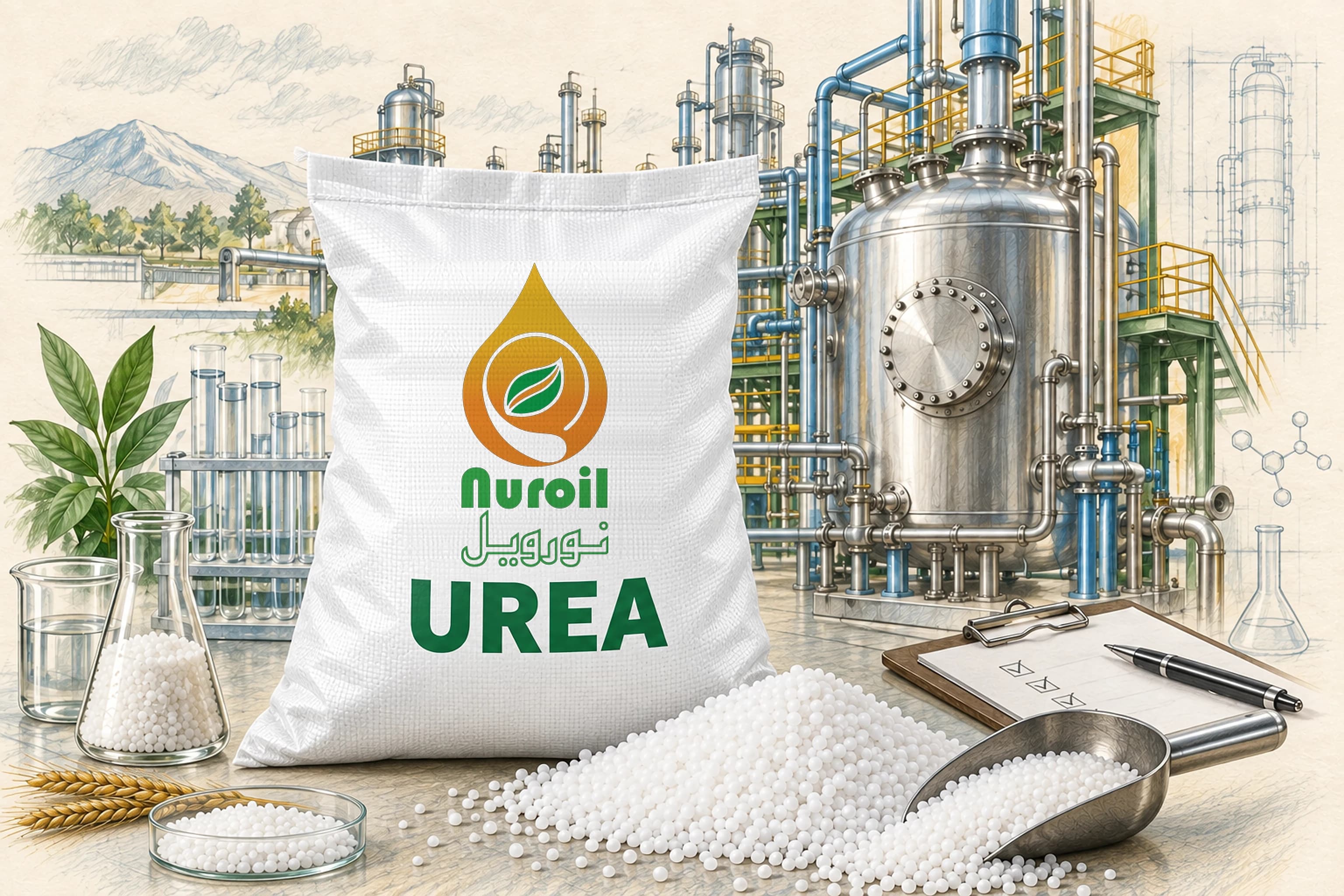
Resin makers, DEF / AUS 32 blenders and plants running urea-based NOx control often buy solid technical urea and dissolve it on site. Solid urea is easy to ship and store, but it has properties that catch out new users: it cakes in humid air, it cools water sharply as it dissolves, and concentrated solutions crystallise at temperatures that are surprisingly warm. This guide covers the practical points.
Storing solid urea
Urea is hygroscopic. When surrounding humidity rises above its critical relative humidity, it absorbs water and the particles bond together as conditions change. To limit caking:
- Store under cover in a dry building, ideally with stable temperature. Producers suggest roughly 10–30 °C and relative humidity below about 70%.
- Keep stacks of bags or bulk bags low to reduce compaction.
- Avoid loading or unloading in rain, and close opened bags.
- Use first-in, first-out rotation.
- Keep urea away from strong oxidisers, acids and especially calcium hypochlorite and other chlorine-releasing chemicals, which can react with it.
Urea is not classed as highly hazardous, but its dust can irritate eyes and airways, and heating it to decomposition releases ammonia. Refer to the SDS for exposure controls and fire-fighting guidance.
The cooling effect of dissolving
Dissolving urea in water absorbs heat. The effect is large enough to matter in production: industry guidance on DEF blending notes freshly made solution cooling to around 4 °C, and at higher concentrations the cooling can push the solution below the point where all the urea stays dissolved. Practical responses include:
- Heating the water before or during dissolving, using steam coils, jackets or heat exchangers.
- Adding urea gradually with strong agitation rather than in one charge.
- Allowing for the temperature drop in batch timing and in reaction control where urea is added to a reactor.
- Confirming full dissolution before filtering or transferring, since undissolved crystals give low concentration.
Crystallisation and freezing points
| Solution | Approximate crystallisation or freezing point | Implication |
|---|---|---|
| 32.5% urea (AUS 32) | About −11 °C | Lowest freezing point of any urea-water mix; thaws without separation |
| 50% urea | About 17–18 °C | Needs heated, circulated storage in most climates |
| Higher concentrations | Higher still | Extensive heating needed; mainly used to cut transport volume |
Heat tracing and insulation on lines carrying concentrated solution prevent crystal build-up in pipes, valves and instruments. Avoid overheating: prolonged high temperature slowly converts urea to ammonia and other by-products, raising alkalinity.
Materials of construction
Urea solutions are mildly corrosive to some metals, and for DEF / AUS 32 contamination limits are very strict. Stainless steel and suitable plastics such as polyethylene are widely used. ISO 22241-3 guidance for AUS 32 lists materials to avoid, including copper and its alloys, zinc-coated steel, aluminium and unprotected carbon steel. Resin and NOx-control plants follow their own engineering standards but generally prefer stainless steel for solution service.
Filtration and water quality
Filter solution before it reaches nozzles, catalysts or packaging. Use water of a quality suited to the end use: demineralised for DEF, and filtered with low dissolved solids for NOx-control dilution water, since hard water forms deposits in injectors.
Plan for heat in both directions: add heat to dissolve urea, and keep concentrated solutions warm enough not to crystallise.
Choosing packing and specifying delivery
Lined bulk bags suit most dissolving plants because they discharge cleanly into a hopper and protect against moisture. Smaller 25 kg or 50 kg bags suit low-volume users. When buying, state the form (prilled or granular), packing, pallet configuration, any requirement for uncoated urea, and documents needed. Nuroil supplies technical-grade urea with a CoA on every delivery and MSDS, certificate of origin and third-party inspection on request. Share your requirements through our quote request page.