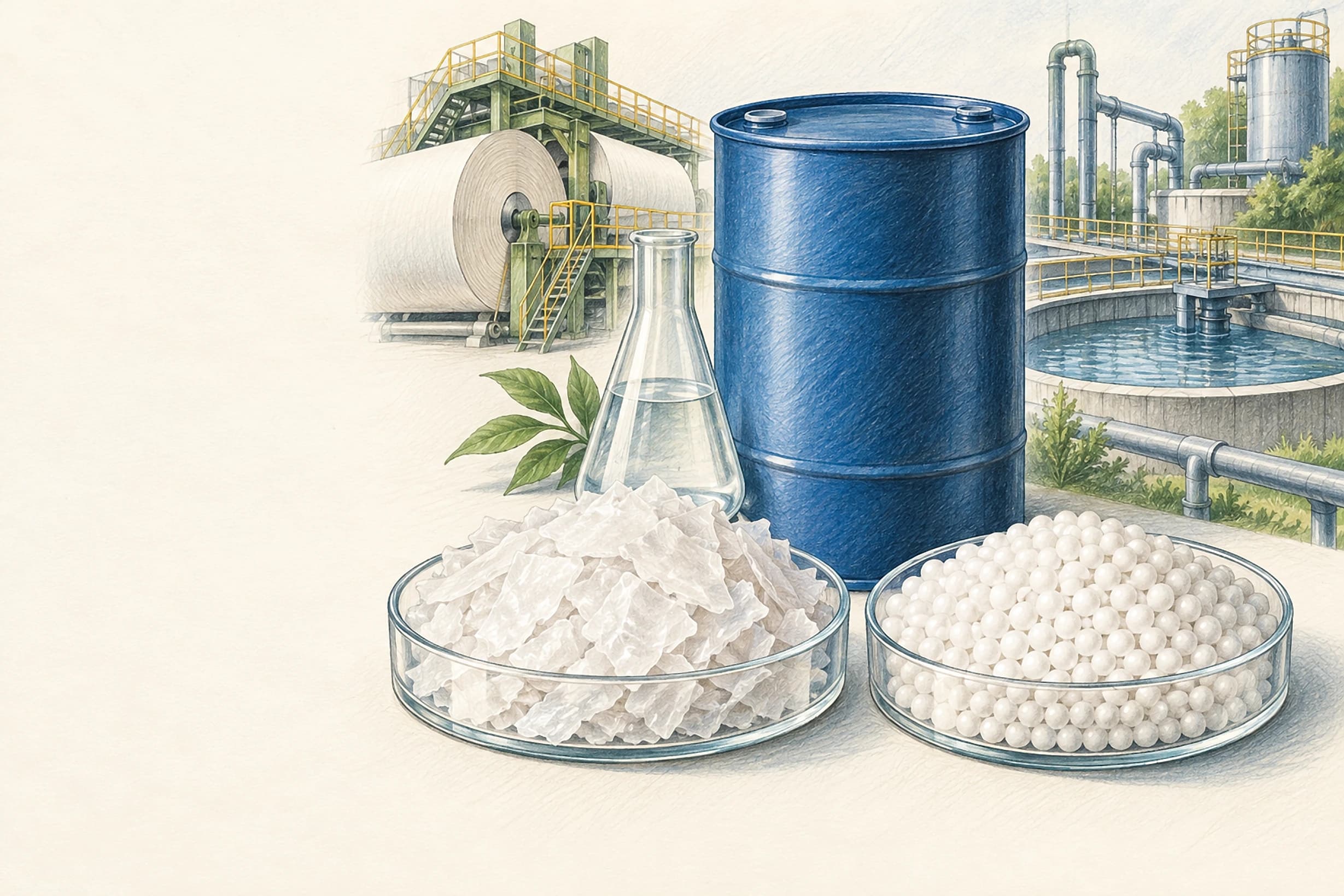
Open almost any dishwashing liquid, laundry liquid or hand wash and the main cleaning work is being done by one or two anionic surfactants. In most mass-market formulations those are sodium lauryl ether sulphate (SLES) and linear alkylbenzene sulphonate (LAS), the latter usually made on site from linear alkylbenzene sulphonic acid (LABSA). This article explains what each one is, how they differ and why they are so often used side by side.
What a surfactant actually does
A surfactant molecule has a water-loving head and an oil-loving tail. In a wash solution the tails attach to grease and soil while the heads stay in the water, so dirt is lifted off the surface and held in suspension until it is rinsed away. Surfactants also lower the surface tension of water, which helps it wet fabric and hard surfaces, and many of them generate foam. Anionic surfactants, whose head group carries a negative charge, are the workhorses of household and industrial cleaning because they clean well and are relatively inexpensive.
LABSA and LAS
LABSA starts life as linear alkylbenzene, made by attaching a long, straight hydrocarbon chain to benzene. This is reacted with sulphur trioxide to give the sulphonic acid, a dark, viscous and strongly acidic liquid that is commonly traded at around 96% active content. On its own LABSA is a corrosive raw material, not a finished surfactant. The detergent maker neutralises it with an alkali, most often caustic soda, to form sodium LAS, the active cleaning agent.
The word "linear" matters. Earlier detergents used branched alkylbenzene sulphonates, which broke down slowly in the environment and caused persistent foam on rivers. Linear versions replaced them from the 1960s because they biodegrade far more readily under aerobic conditions. LAS is also less affected by hard water than traditional soap, which is one reason it remains among the most widely produced synthetic surfactants.
SLES
SLES is made from lauryl alcohol, usually derived from palm kernel or coconut oil. The alcohol is first ethoxylated, which adds a short chain of ethylene oxide units, then sulphated and neutralised to the sodium salt. Grades are described by the average number of ethoxy units, with two or three being common. SLES is typically supplied as a concentrated paste of around 70% active matter, which the formulator dilutes.
The ethoxy chain gives SLES rich, stable foam, good tolerance of hard water and a milder feel on skin than sodium lauryl sulphate. That is why it dominates shampoos, shower gels and hand washes as well as dishwashing liquids. Because ethoxylation can leave traces of 1,4-dioxane, reputable producers strip the product under vacuum or with steam, and buyers for personal care often ask for the residual level on the certificate of analysis.
Why they are used together
| Property | LAS (from LABSA) | SLES |
|---|---|---|
| Form as purchased | Acid, around 96% active, needs neutralising | Neutral paste, commonly around 70% active |
| Main strength | Strong detergency on oily and particulate soil | Dense foam, mildness, hard water tolerance |
| Typical uses | Laundry liquids and powders, dishwash, hard-surface cleaners | Shampoo, body wash, hand wash, dishwash |
| Handling | Corrosive acid; neutralisation releases heat | Viscous gel phase on dilution; needs correct mixing |
LAS brings cleaning power at low cost, while SLES improves foam, feel and tolerance of hard water. Blending the two lets a formulator balance performance, mildness and price. Many dishwashing liquids, for example, combine neutralised LABSA with SLES and then add salt to build viscosity.
Handling and storage points
- LABSA is corrosive to skin and eyes. Store it in stainless steel or suitable lined tanks and wear chemical goggles, gloves and protective clothing when handling it.
- Add caustic soda solution slowly to diluted LABSA with good stirring. The reaction is exothermic, and adding concentrated alkali too fast can create a thick, hard-to-mix mass.
- SLES paste passes through a very viscous gel stage when diluted. Producers usually advise adding the paste to water under steady agitation rather than the reverse.
- Keep both materials sealed and away from temperature extremes, and follow the product safety data sheet for storage and spill guidance.
What to specify when buying
For LABSA, state the required active matter, free sulphuric acid and water limits, colour and packing (drums, IBCs or flexitanks). For SLES, specify active content, degree of ethoxylation, pH, unsulphated matter, sodium chloride content and, for personal care, the 1,4-dioxane limit. Ask for a certificate of analysis for each batch and the current safety data sheet. Nuroil supplies a CoA with every delivery, with certificate of origin and third-party inspection available on request; the request a quote form is the easiest place to set out your specification, and the caustic soda you need for neutralisation can be quoted alongside.