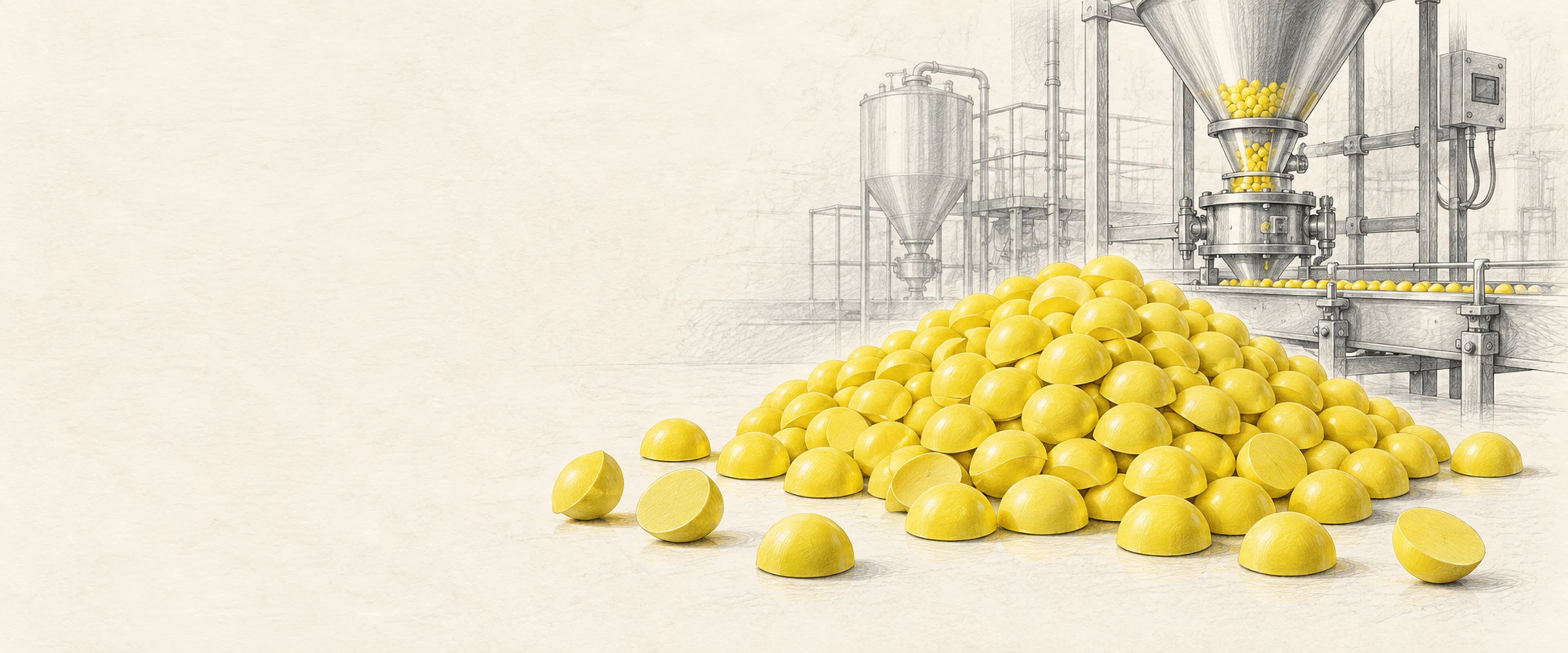
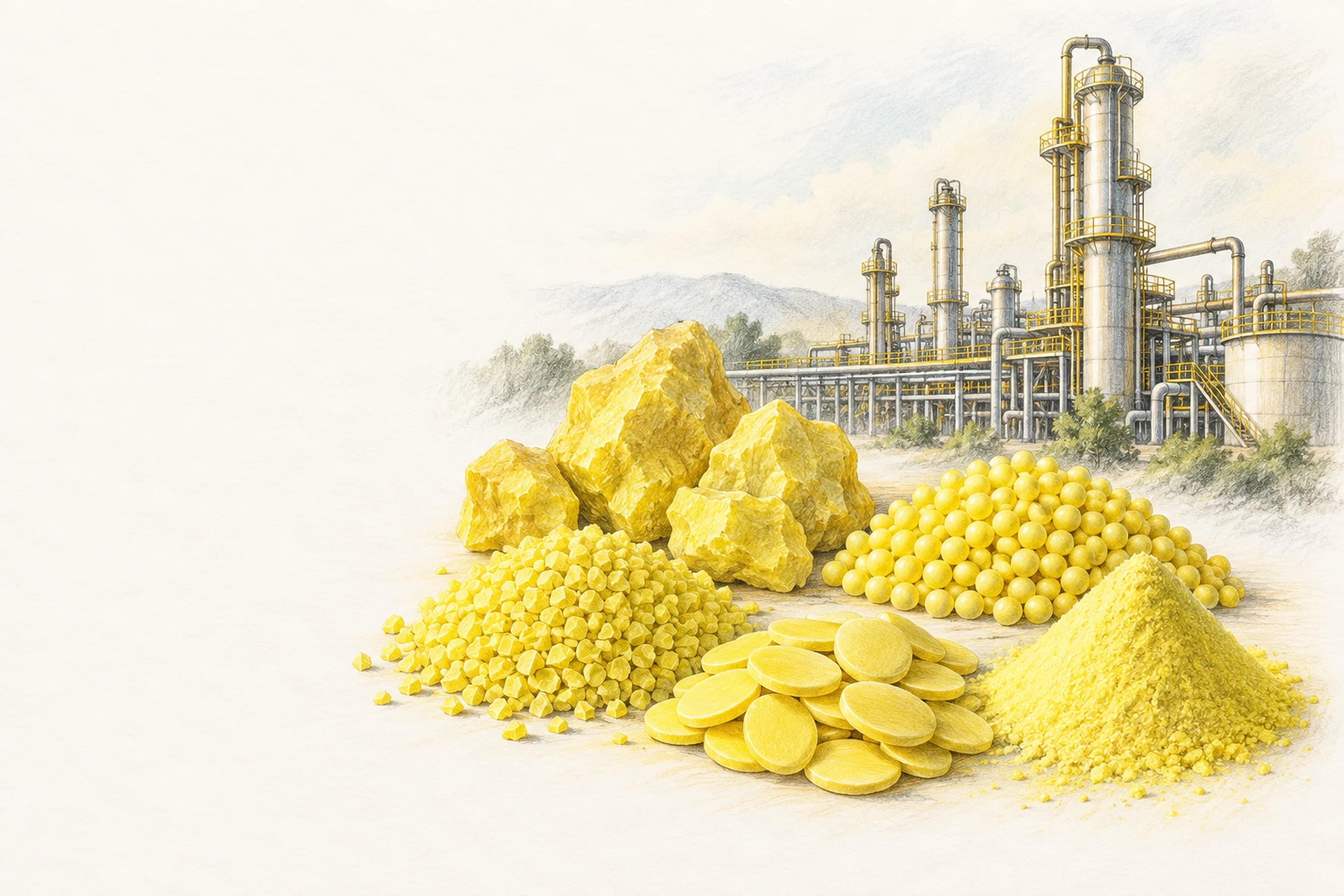
"Sulphur pastilles" can mean two quite different products. One is pure sulphur formed into pastilles for industrial users who will melt or burn it. The other is a sulphur and bentonite pastille designed to break apart in soil as a fertilizer. They look similar in a photograph, but their specifications and uses do not overlap. This guide sets out what to expect on each certificate of analysis.
The two grades at a glance
| Parameter | Pure sulphur pastilles | Bentonite sulphur pastilles |
|---|---|---|
| Main use | Remelting, sulphuric acid, chemicals | Fertilizer and soil amendment |
| Elemental sulphur | Typically 99.5% minimum or higher | Typically around 90% |
| Additive | None | Bentonite clay, usually the balance |
| Behaviour in water | Stays intact | Swells and disperses |
| Colour | Bright yellow | Yellow-grey to tan |
| Key quality tests | Purity, ash, carbon, acidity, moisture, friability | Sulphur content, moisture, size, dispersion, hardness |
Exact limits differ by producer and by the buyer's own specification, so always compare the CoA with your purchase specification rather than with a generic table.
Parameters on a pure pastille CoA
- Purity. Sulphur content on a dry basis. Bright yellow colour is a quick visual sign of high purity.
- Ash. Inorganic residue after burning. Matters to acid plants because ash ends up in the converter or the acid.
- Carbon (hydrocarbon) content. Residual hydrocarbons from the refinery or gas plant. High carbon darkens the sulphur and adds to combustion load.
- Acidity. Expressed as sulphuric acid. Relevant to corrosion in handling and melting equipment.
- Moisture. Pastilles are formed on a dry steel belt and usually carry little moisture compared with water-quenched forms.
- Size and friability. Pastilles are relatively uniform in size. Friability, often assessed with the SUDIC test at different stress levels, indicates how much dust is created during handling.
Parameters on a bentonite pastille CoA
- Total elemental sulphur. The nutrient content. Fertilizer regulations in some markets set a minimum, for example 90% by weight, with bentonite permitted as filler up to about 10%.
- Moisture. Usually limited to around 1% maximum. Low moisture protects the clay from swelling before use.
- Size range. A consistent size spreads evenly and blends without segregation. Ask for the actual sieve analysis rather than a nominal size.
- Hardness or crushing strength. The pastille must survive bagging, transport and spreading without turning to dust.
- Dispersion. Some producers test how quickly a pastille breaks up in water, for example by measuring how much passes a fine sieve after a set time. This is the most direct indicator of agronomic performance.
Choosing between them
It is also worth agreeing how samples will be taken. Pastilles segregate by size in bags and stockpiles, so a sample taken only from the top of a bag can misrepresent the lot. Ask for samples drawn across the lot by the inspector or the producer's laboratory, and keep a sealed reference sample in case of a quality claim later.
For acid production, chemical synthesis or any process that melts the sulphur, pure pastilles are the right grade; the bentonite would only add ash. For soil application, bentonite pastilles are the right grade, because pure pastilles do not disperse and oxidise very slowly. A third option for soil use is finely ground sulphur powder, which acts faster but is dusty and harder to spread.
Write "bentonite" or "pure" into the specification. A request for "sulphur pastilles" alone can be quoted either way.
Writing your specification
A useful enquiry for pastillated sulphur lists the grade, the minimum sulphur content, the maximum moisture, the size range, any limits on ash, carbon or acidity for industrial use, the packing and the destination. Ask for the CoA, and the MSDS, certificate of origin or third-party inspection where needed. Nuroil sources pastillated sulphur from established producers; send your specification through a quote request.