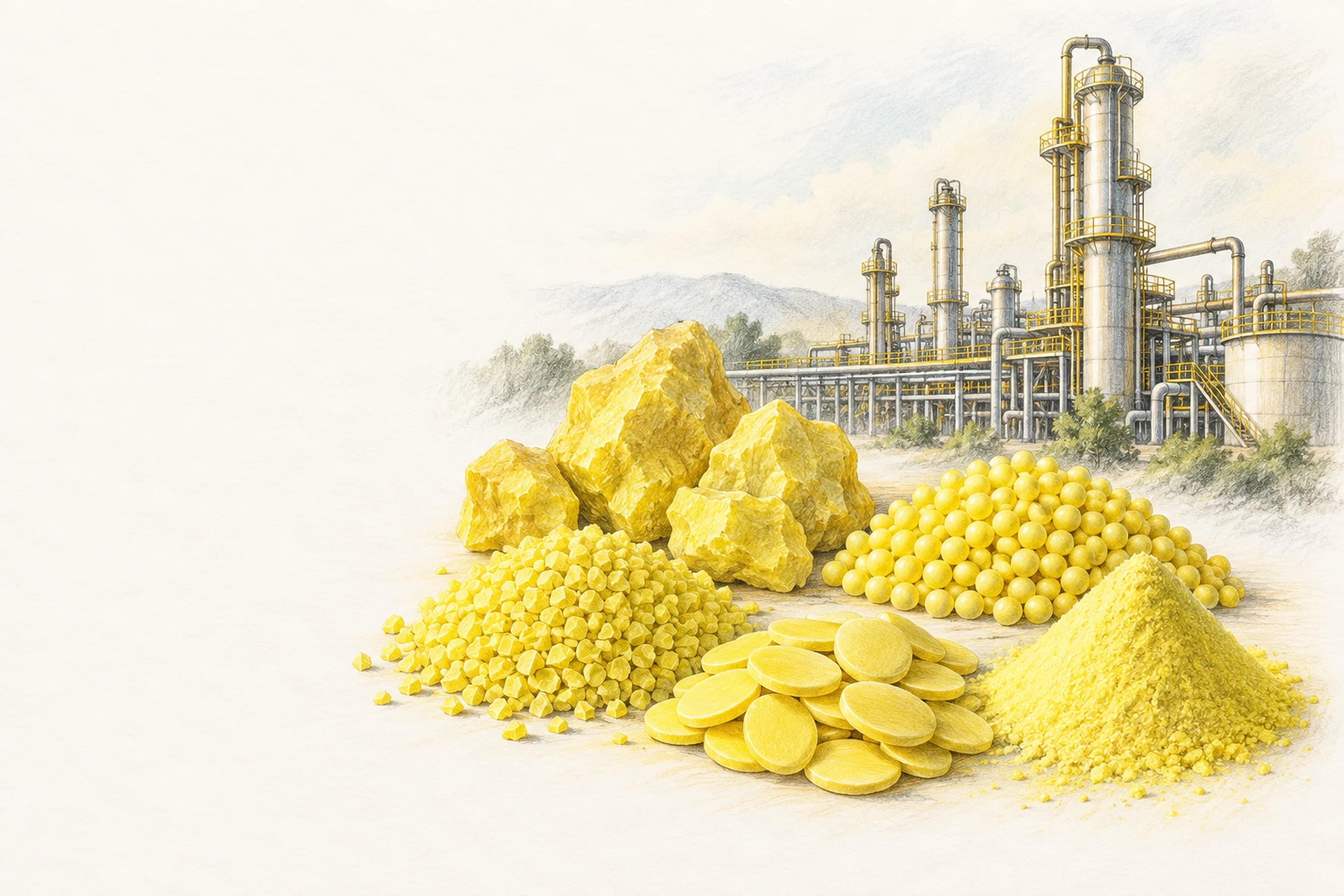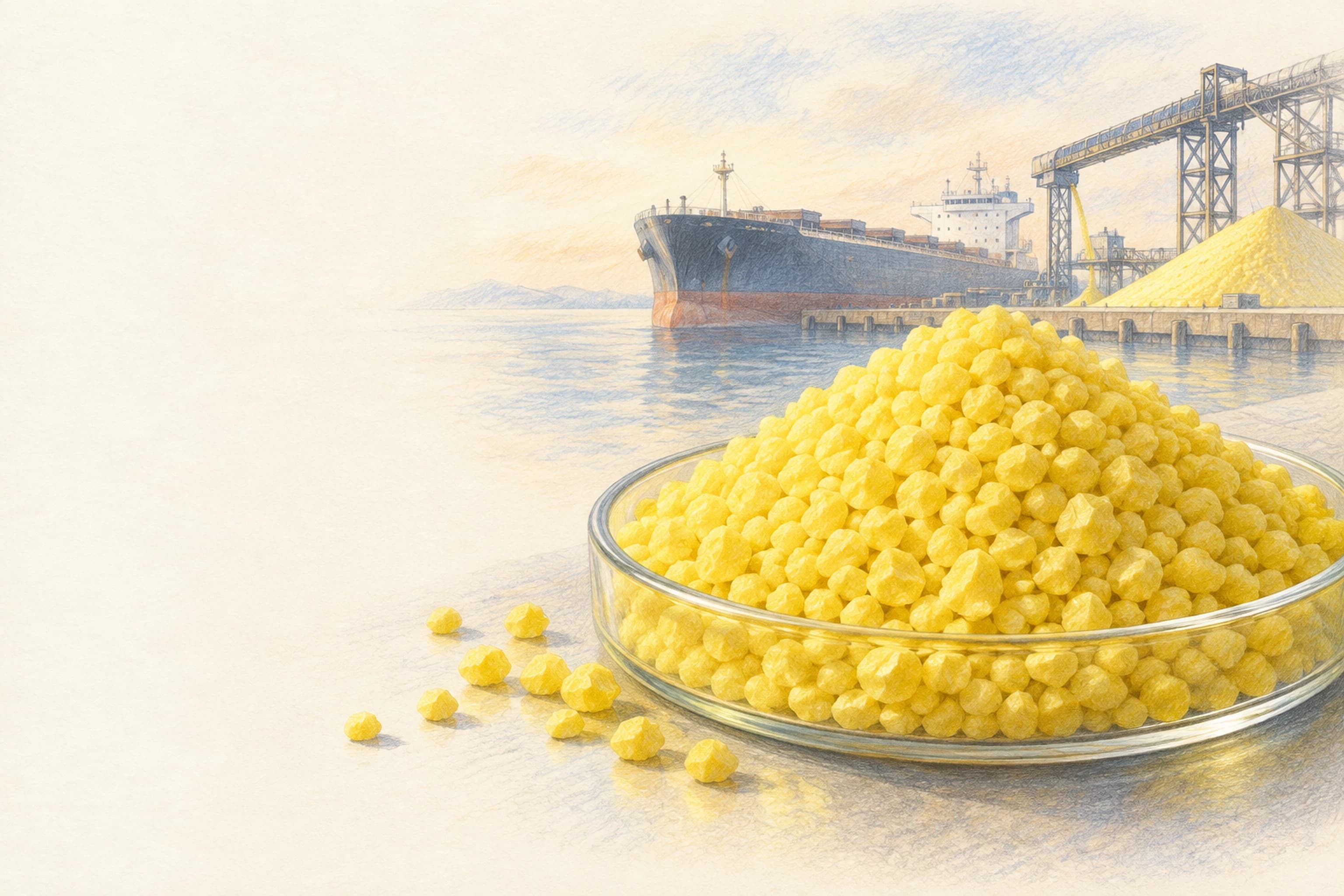
Granular sulphur is one of the most convenient forms of elemental sulphur to ship and store. Farmers and fertilizer distributors sometimes ask whether it can go straight onto fields as a sulphur fertilizer or soil amendment. The answer depends on what you want it to do and how quickly, because elemental sulphur has to be changed by soil bacteria before plants can use it.
From elemental sulphur to plant food
Plants take up sulphur as sulphate. Elemental sulphur must first be oxidised to sulphate, and in soil this is done mainly by bacteria, including species of Thiobacillus. Sulphate fertilizers are available to the crop at once; elemental sulphur has a lag that can range from weeks to years.
The oxidation also produces acidity. That is why elemental sulphur is used to lower the pH of alkaline soils, and why repeated heavy use on already acid soils needs care.
Surface area is the controlling factor
Bacteria work on the surface of each sulphur particle, so the rate of oxidation depends on the total surface area applied, not on the weight. A coarse particle has very little surface for its mass. Laboratory data reported by soil scientists show the time to oxidise half the sulphur rising from about a day for particles of a few micrometres to roughly a thousand days for particles of 2 mm.
Commercial granular sulphur is typically made in the 2 to 6 mm range for clean handling. As intact granules, it therefore releases sulphate very slowly. Agronomic research suggests particles need to be far finer, in the tens of micrometres, to contribute meaningfully in the early part of a growing season.
| Sulphur form | Typical particle size in soil | Speed of sulphate release |
|---|---|---|
| Sulphate fertilizers | Dissolves | Immediate |
| Finely ground elemental sulphur | Micrometres | Weeks, depending on soil |
| Sulphur with swelling clay (dispersing granules) | Breaks into fine particles when wet | Moderate; depends on how well it disperses |
| Plain granular sulphur | Granules of several millimetres | Slow; months to years |
Soil conditions change the pace
- Temperature. Oxidation is slow in cool soil, below roughly 13 to 15 °C, and fastest in warm soil, roughly 24 to 40 °C. Very high temperatures kill the bacteria.
- Moisture. Rates are best near field capacity. Waterlogged soil lacks oxygen and dry soil limits bacterial activity.
- Soil biology and fertility. Fertile soils with good organic matter, and soils that have received sulphur before, tend to oxidise it faster.
Products made from granular sulphur
Fertilizer makers often use elemental sulphur as a raw material instead of applying it directly. Finely ground sulphur is combined with a swelling clay such as bentonite, typically around 10 to 15 per cent, and formed into granules. When these absorb soil moisture the clay swells and should break the granule into fine particles. Research shows the result varies: some clay-bound products disperse poorly and oxidise much more slowly than the same sulphur dispersed loose. Sulphur can also be co-granulated with phosphate or nitrogen fertilizers.
Plain granular sulphur is a slow, long-term source of sulphate; for in-season crop nutrition, a sulphate or a well-dispersing fine sulphur product works faster.
When plain granular sulphur makes sense
- As a feedstock for grinding or for making sulphur-bentonite and co-granulated fertilizers.
- For gradual pH reduction of alkaline soils, where slow release over seasons is acceptable and an agronomist has set the rate.
- For long-term build-up in perennial crops, alongside a faster sulphate source.
Buying for agricultural use
Tell your supplier whether the sulphur will be applied directly or processed into fertilizer, since that affects the size range and purity you need. Ask for a CoA showing purity, ash, moisture and size distribution. Nuroil supplies granular sulphur with a CoA for each delivery. Get in touch through the contact page to discuss quantities and packing.