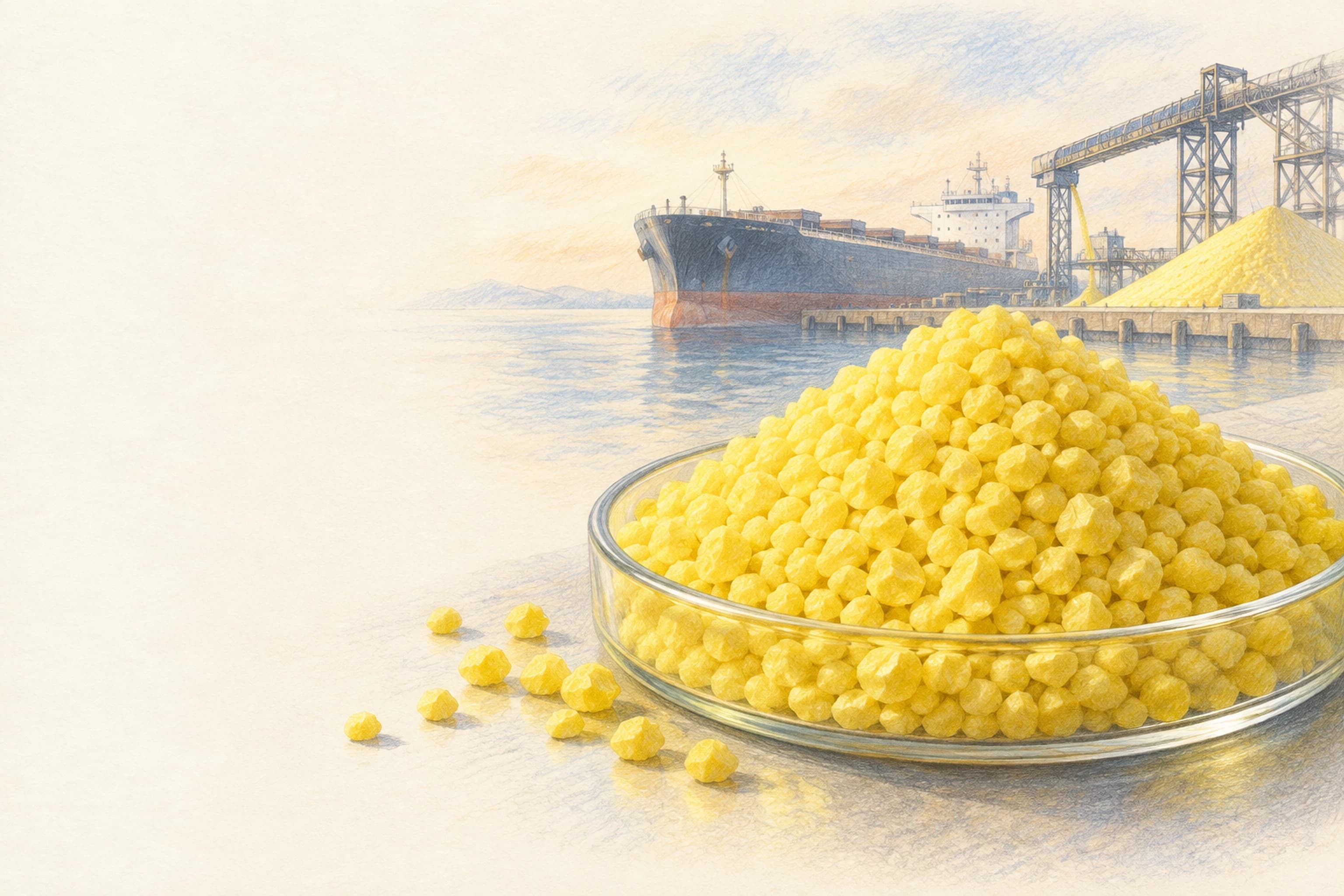
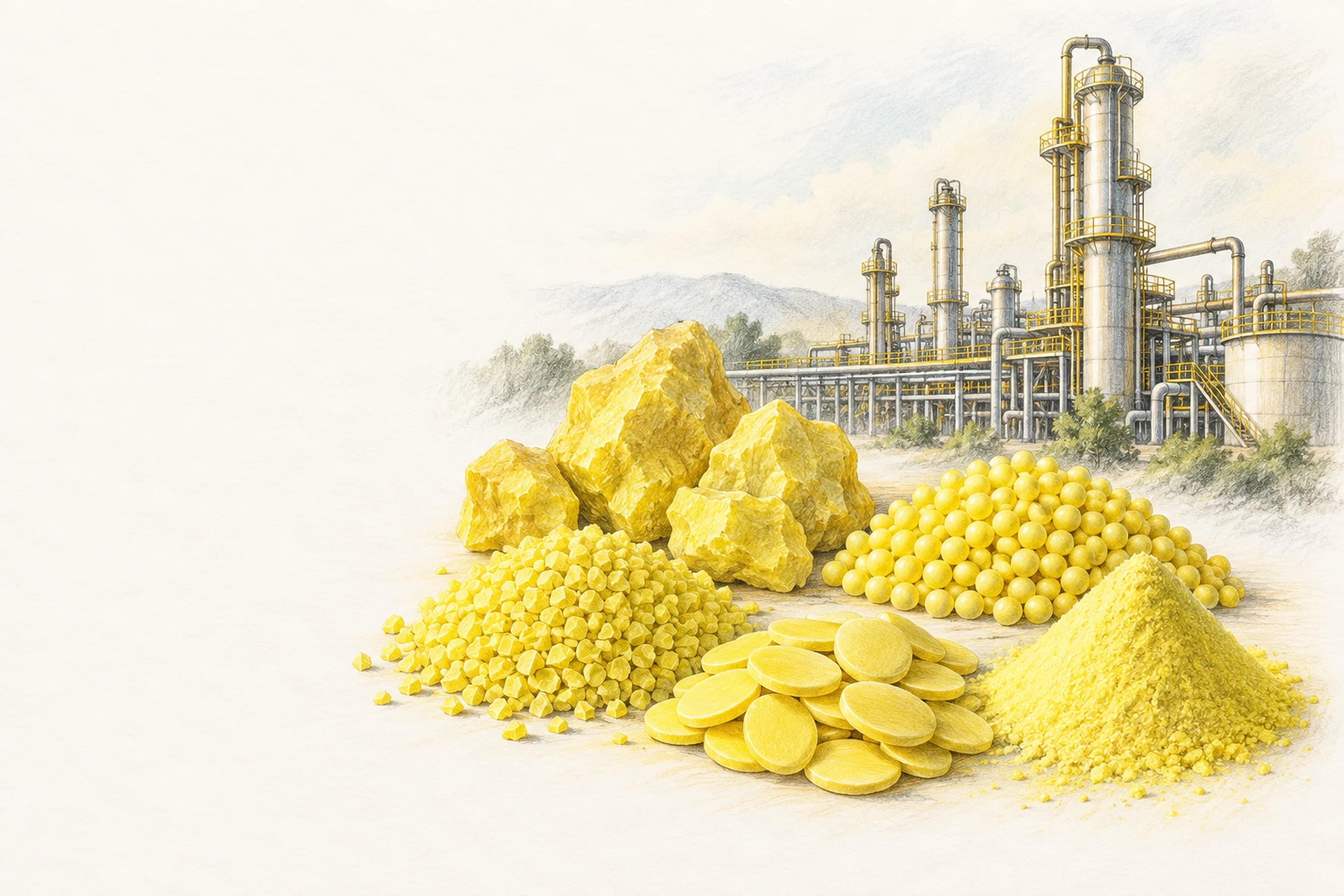
Granular sulphur is valued because it arrives as hard, roughly round particles that flow easily and give off little dust. That advantage is not permanent. Every drop from a conveyor, grab or truck body breaks some granules, and a cargo can arrive with far more fines than it had when it left the producer. Fines matter for quality, for housekeeping and above all for safety.
Why fines are a problem
- Fire and explosion. Sulphur dust ignites easily in air. Static discharge, friction, hot surfaces and sparks can all set it off, and dust clouds in enclosed spaces can explode.
- Health and housekeeping. Dust irritates eyes and the respiratory tract and settles on equipment.
- Corrosion. Fine sulphur combined with moisture and air can produce acidity that attacks steel structures and conveyors.
- Quality claims. Contracts based on a premium granule specification often set limits on fines; a cargo with excessive breakdown may not meet them.
What makes granules break
Industry grading of formed sulphur, developed under the SUDIC framework, looks at four properties: shape, size distribution, moisture and friability. Friability is a measure of how easily granules break or abrade under stress. A well-made granule is close to spherical and grows in layers during drum granulation, which tends to give a strong, rounded product. Irregular or flaky particles, or granules with weak outer layers, break more readily.
The main stresses come from handling:
- High free-fall drops into holds, silos and hoppers.
- Repeated transfer points on conveyors.
- Grab discharge and bulldozers working inside ships' holds.
- Vehicle movement over stockpiles.
- Thermal cycling and long storage, which can weaken granules.
Practical ways to limit breakdown
| Stage | Measure |
|---|---|
| Loading | Use telescopic chutes or cascade chutes to reduce free fall; avoid running vehicles over the cargo |
| Conveying | Minimise transfer points; use soft-loading chutes and keep belt speeds moderate |
| Storage | Build stockpiles with low drop heights; keep them covered to limit weathering |
| Discharge | Choose grabs and hoppers sized to avoid spillage and repeated handling |
| Bagging | Fill bags gently; bulk bags cut the number of handling steps |
Controlling dust where it does form
- Enclose transfer points and fit dust extraction with suitable explosion protection, such as relief vents or suppression.
- Bond and earth conveyors, chutes and metal equipment to prevent static build-up.
- Clean up spills promptly using methods that do not raise dust clouds; do not blow dust off surfaces with compressed air.
- Control ignition sources: hot work permits, suitable electrical equipment and no smoking near sulphur.
- Keep sulphur away from oxidising agents such as chlorates and nitrates.
Water sprays are sometimes used to suppress dust in bulk handling. If you use them, take the extra moisture into account against your specification and remember that wet sulphur can be more corrosive to steel.
Granular sulphur starts as a low-dust product; whether it stays that way depends on how gently it is handled at every transfer.
Checking fines on receipt
A simple receiving check helps settle questions early. Take samples from several points as the cargo is discharged, not just from the top of a stockpile, and run a sieve analysis on a combined sample. Compare the fines figure with the loading certificate. A moderate increase is normal after a sea voyage and several transfers; a sharp rise points to rough handling, weak granules or both, and is worth discussing with the supplier while samples are still available.
Protecting your quality at purchase
If fines matter to your process or your safety case, specify a maximum fines content and agree where it will be measured: at loading or at discharge. Ask for a size distribution on the CoA and, for large cargoes, independent sampling. Nuroil supplies granular sulphur with a CoA on every delivery and can arrange third-party inspection at loading on request. Always refer to the product SDS for full precautions.