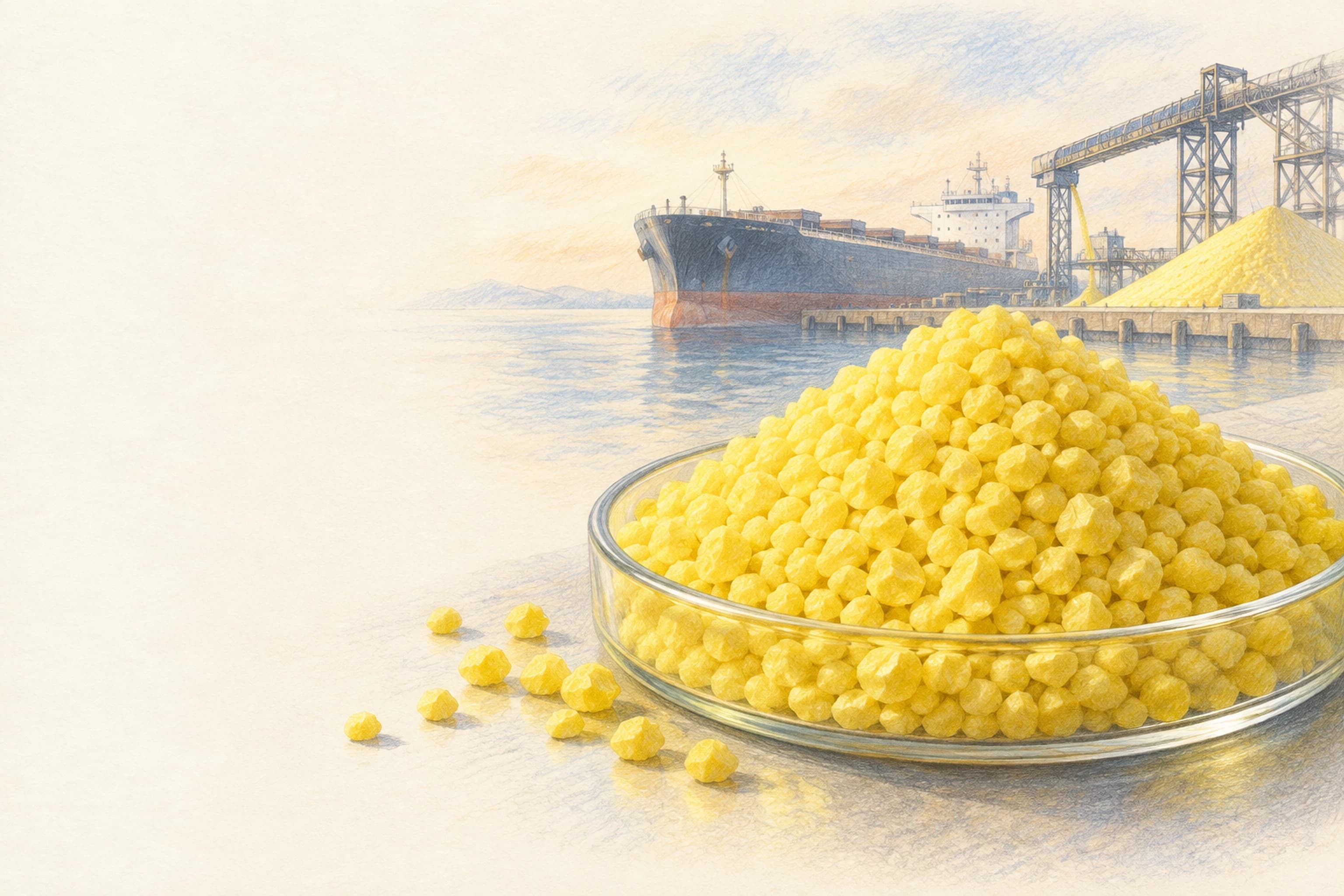
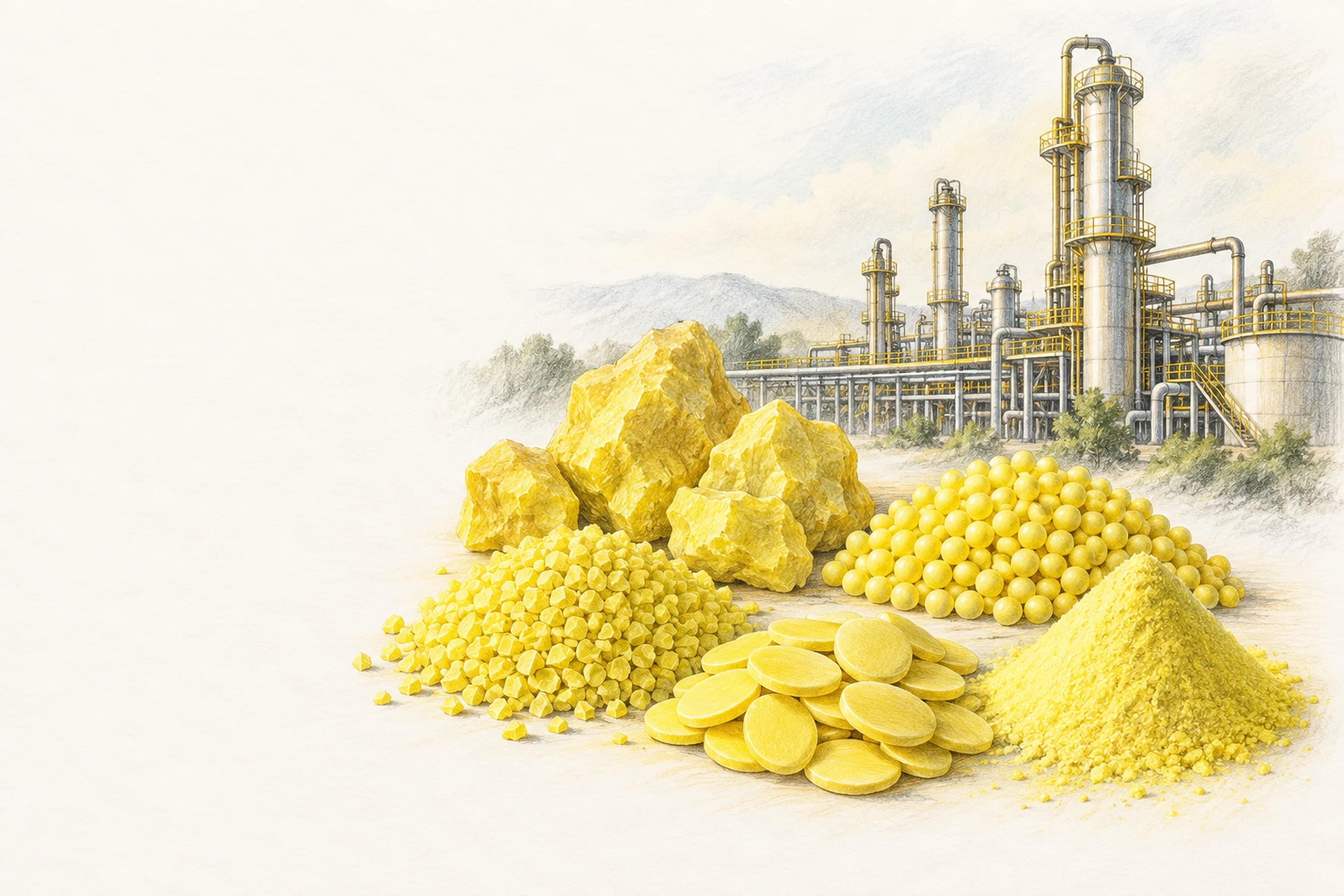
Specifications for sulphur usually start with purity, ash, carbon and acidity. For granular sulphur, a second set of physical properties is just as important, because they decide how the product handles, how much dust it makes and whether it meets a premium grade. This guide covers those physical properties. Our general sulphur pieces deal with purity and chemical parameters in more detail.
Premium and standard formed sulphur
Formed sulphur products, including granules, pastilles and prills, are commonly graded against a framework developed by the Sulphur Development Institute of Canada, known as SUDIC. It classes products as premium or standard on four properties: shape, size distribution, moisture and friability. The ideal product it describes is close to spherical and roughly 2 to 6 mm in diameter. Well-made granules and pastilles typically meet the premium requirements, while products such as wet-process prills can fall to standard because of their moisture.
The physical parameters
| Parameter | What it describes | Why it matters |
|---|---|---|
| Size distribution | Share of material in each sieve fraction | Flow, packing density, melting rate, fines content |
| Fines | Material passing a small sieve | Dust, fire risk, handling losses |
| Shape | Sphericity and regularity of particles | Flow, strength, resistance to breakage |
| Moisture | Free water, as a percentage | Weight paid for, corrosion, melting behaviour |
| Friability | Fines produced under a defined stress | How the product survives handling and shipping |
| Bulk density | Mass per unit volume as stacked | Storage and hold capacity |
How the tests work
- Sieve analysis. A representative sample is shaken through a stack of sieves and each fraction weighed. Results are reported as percentage retained or passing at each opening. Ask for the sieve sizes to be stated.
- Moisture. Usually determined by weight loss on gentle drying, below the melting point.
- Friability. A sample is subjected to a set stress, such as tumbling or impact, and sieved before and after. The increase in fines measures how fragile the product is. Different methods give different numbers, so compare results only when the method is the same. The SUDIC framework uses defined stress levels for this purpose.
- Shape. Often assessed visually or by image analysis; formal limits are less common in trade contracts.
How production method affects the numbers
Drum granulation builds granules in layers from small seeds, cooling them by evaporating sprayed water. It tends to give near-spherical granules, and seed control lets operators adjust the size distribution. Belt-formed pastilles are hemispherical, and since the cooling water does not touch the product, they are typically very dry. Both can meet premium criteria; the specification is what you should hold the supplier to, rather than the process name.
Two cargoes of 99.5% sulphur can handle very differently; size distribution, fines and friability explain why.
Sampling makes or breaks the result
Granular sulphur segregates as it is handled: fines tend to collect in the centre of a pile or at the bottom of a hold, while larger granules roll to the edges. A single scoop from the surface can therefore give a misleading size distribution. Representative samples are taken in increments across the whole lot, usually from a moving stream during loading, combined and then reduced with a sample divider before testing. Ask the inspector to state how the sample was drawn.
Where to measure
Granules break down during handling, so fines at discharge are almost always higher than at loading. Contracts should say where the physical properties are measured. Many buyers accept loading-port results from an independent inspector and add a separate allowance or test at discharge if fines are critical.
Building your specification
Alongside the chemical limits, state the size range you need, a maximum fines figure, a maximum moisture and, where relevant, the friability method and limit. Ask for these on the CoA. Nuroil supplies granular sulphur with a CoA on every delivery, and third-party inspection with sampling at loading can be arranged on request. Send your specification through the quote request form.