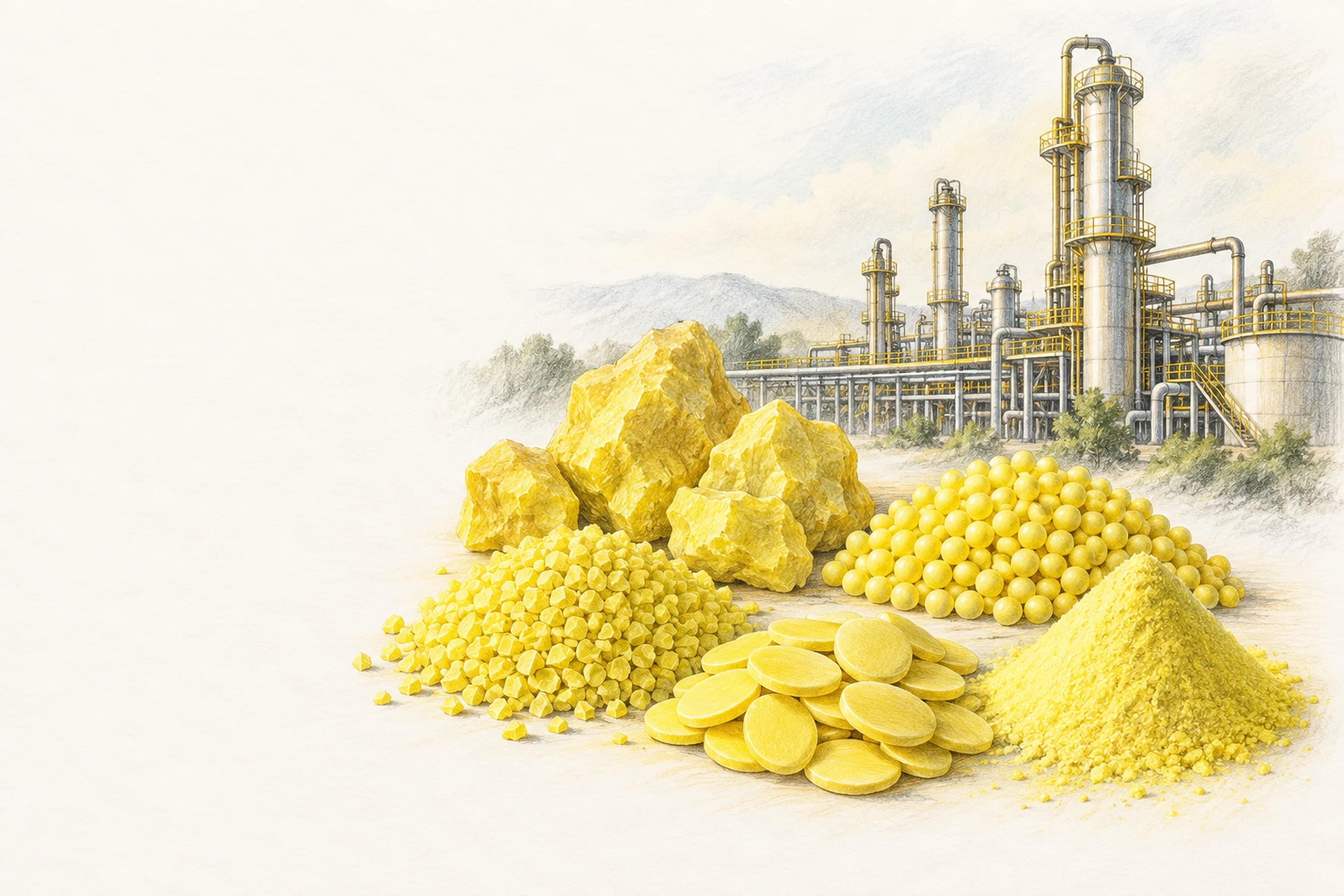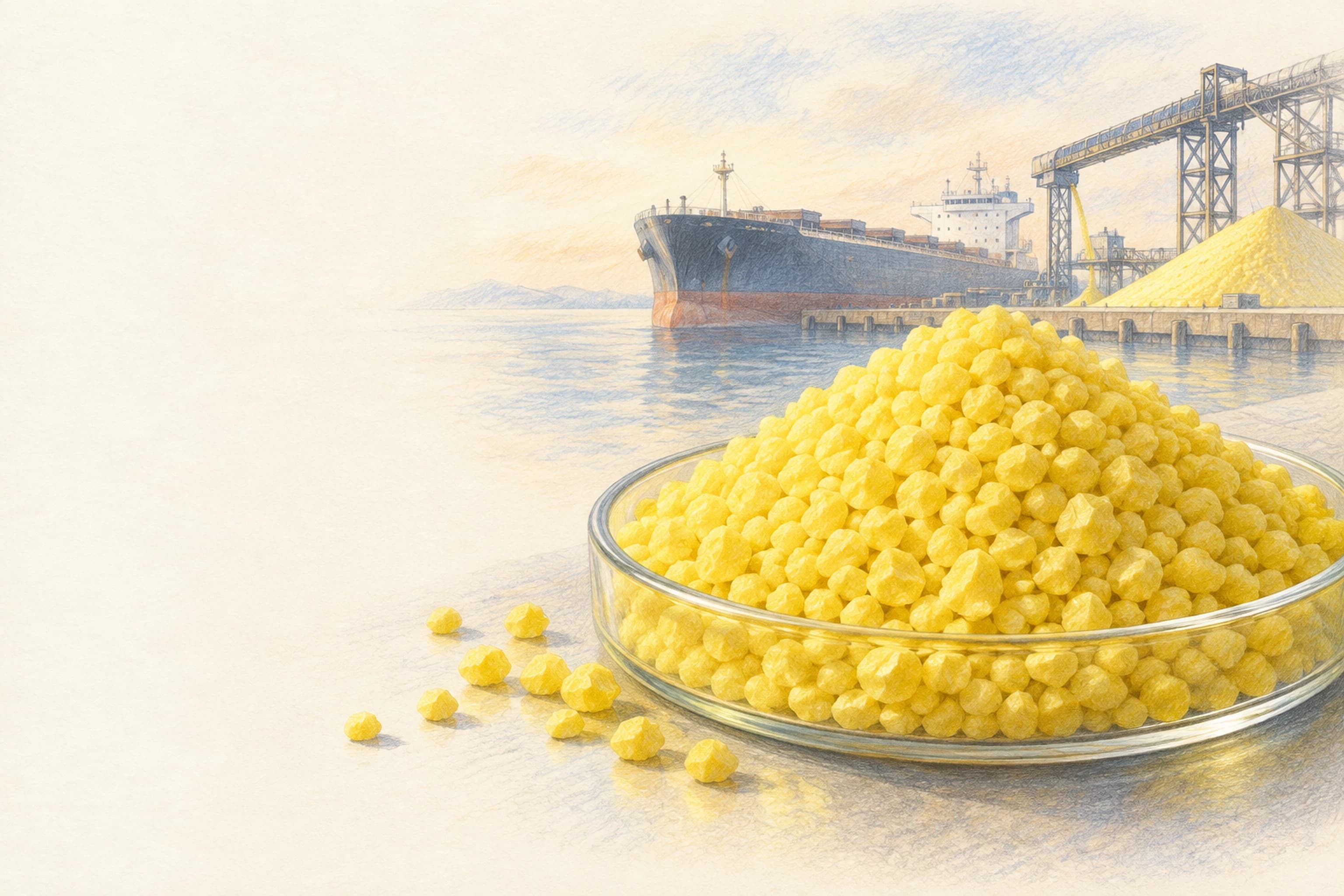
Buyers who ask for granular sulphur are sometimes offered pastilles instead, and vice versa. Both are premium formed products made from molten sulphur, both are free-flowing and both are far less dusty than crushed lump sulphur. They are made in different ways, though, and the differences can matter for some users. This guide compares the two directly.
How drum granulation works
In a drum granulator, small sulphur seeds, usually less than 2 mm across, tumble inside a rotating drum. Molten sulphur is sprayed onto the moving bed, coating the seeds in thin layers. Heat is removed by spraying water into the drum, which evaporates. The granules grow layer by layer, like an onion, until they reach the target size and are screened. Oversize is crushed and returned as seed, along with undersize.
Seed generation and screening let operators adjust the size distribution during production. The layered growth tends to give strong, near-spherical granules.
How pastillation works
In a belt pastillator, molten sulphur is dropped as individual droplets onto a moving stainless steel belt. Water is sprayed onto the underside of the belt to cool it, and the droplets solidify as hemispheres with a flat base. Because the water does not touch the product, pastilles come off the belt dry. The process is often described as producing very little dust.
Side-by-side comparison
| Feature | Drum-granulated sulphur | Sulphur pastilles |
|---|---|---|
| Shape | Near-spherical | Hemispherical, flat base |
| Formation | Built up in layers on seeds | Single droplet solidified on a belt |
| Contact with cooling water | Yes, evaporative cooling in the drum | No, belt cooled from below |
| Size control | Adjustable through seeds and screening | Set by droplet size; very uniform |
| Typical scale | Large single units suited to high throughput | Multiple belts; scales in modules |
| Grading | Can meet premium criteria | Can meet premium criteria |
Does the difference matter to you?
For most melting users, such as sulphuric acid plants and sulphur burners, both forms work well. What matters more is purity, ash, carbon, moisture and fines, which are set by the specification rather than the process. A few points can still tip the choice:
- Flow in bins and chutes. Spherical granules roll freely. Pastilles flow well too, but their flat base can make them settle differently in some hoppers.
- Moisture. Pastilles are usually very dry. Granules are also low in moisture when made, but the process involves water, so check the CoA.
- Bulk density. Shape affects how particles pack. If storage or hold volume is tight, ask for bulk density on both offers.
- Breakage. Both are designed to resist breakage. Compare friability results only when the same test method has been used.
- Fertilizer blending. Where sulphur is blended with other granular fertilizers, a spherical granule in a matched size range may blend more evenly.
Write the specification around the properties you need and let both forms compete; the process name alone does not guarantee quality.
Other formed and unformed sulphur
Prills, made by dropping sulphur through air or into water, can carry more moisture and fall into the standard rather than premium grade. Crushed lump and slate sulphur are cheaper to produce but much dustier and more irregular. Our general guide on the sulphur page covers these forms more broadly.
Chemistry is the same
Granules and pastilles are both solidified from molten sulphur, so their purity reflects the sulphur fed to the forming unit rather than the forming method. A refinery or gas plant producing high-purity liquid sulphur will normally deliver similar chemical results in either form.
Choosing and ordering
If your process has no strong preference, say so in your enquiry; it widens the choice of supply. If it does, state the form and the physical limits you need. Nuroil supplies granular sulphur from established producers with a CoA for every delivery, and can arrange third-party inspection on request. Use the quote request form to send your requirements.