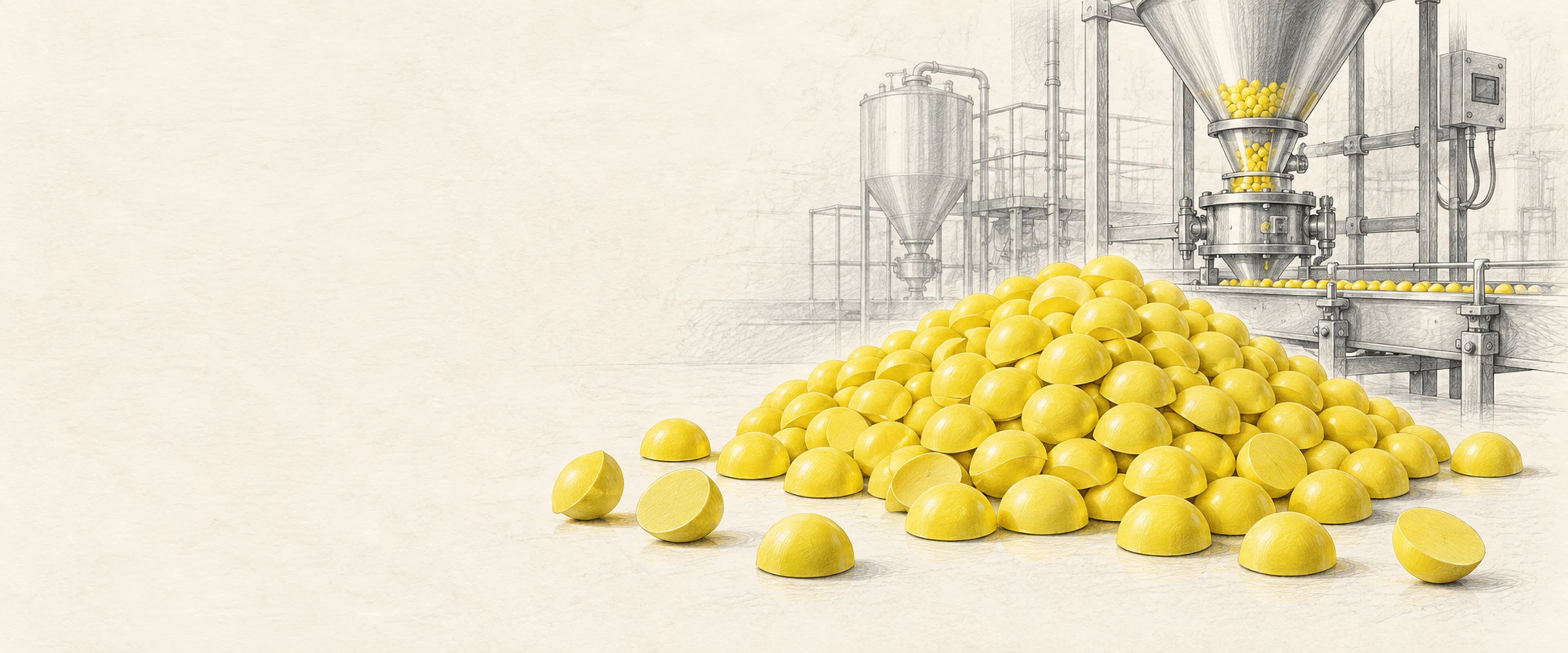
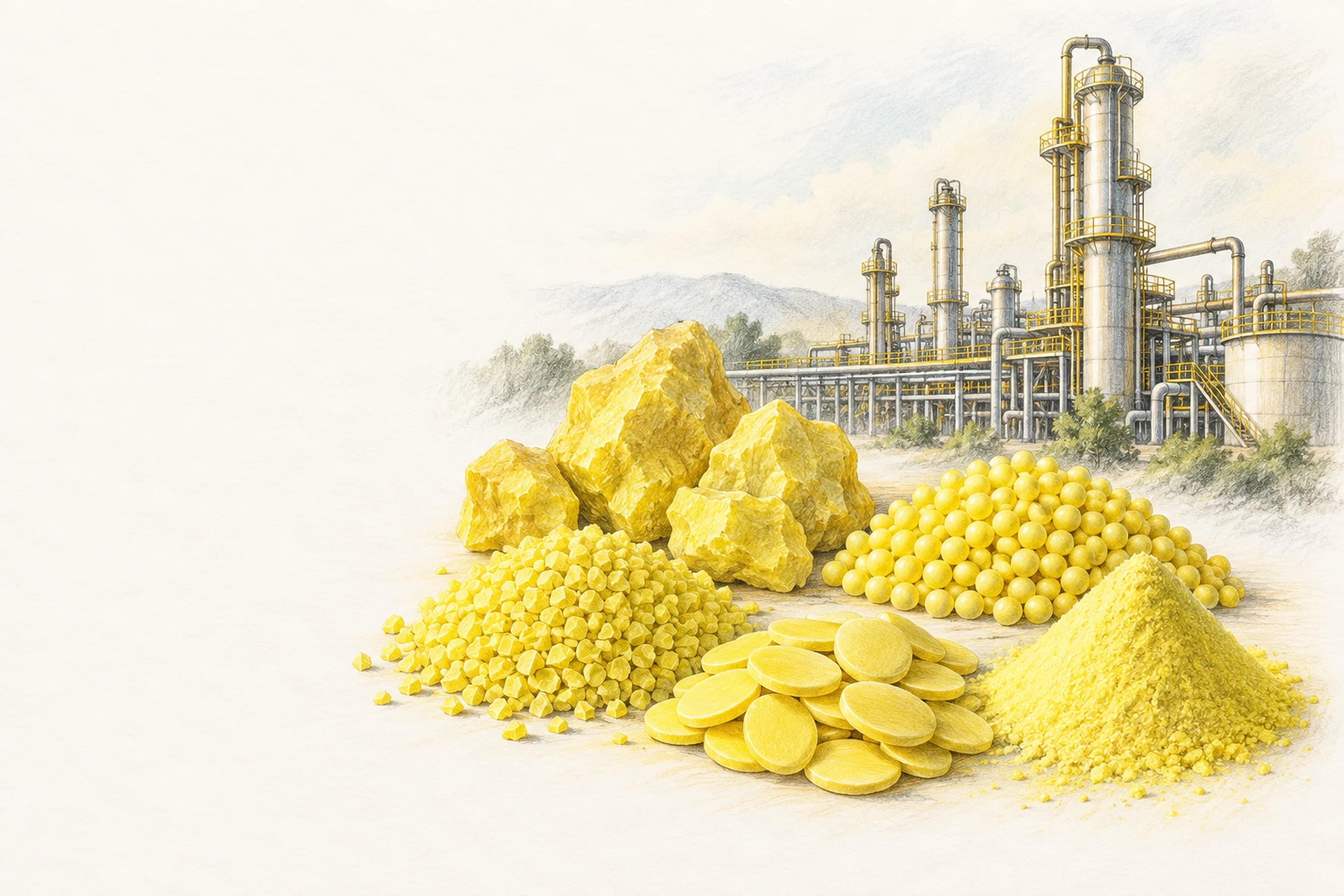
Pastillation turns molten sulphur into uniform, dome-shaped solids that handle with little dust. Knowing how the process works makes it easier to judge a CoA, troubleshoot a dusty cargo and talk to producers in their own terms.
The steel-belt process
Liquid sulphur arrives from the recovery unit or a melter and is held just above its melting point. It is fed into a heated drop former, a stationary inner tube (the stator) surrounded by a perforated rotating shell. As the shell turns, liquid passes through its holes and is deposited as individual drops on a steel belt moving underneath at a matched speed.
Cooling water is sprayed onto the underside of the belt. It never touches the sulphur, which is why pastilles leave the line dry. The drops set into hemispherical pastilles with a flat base and are scraped off at the discharge end, then conveyed to storage, bagging or bulk loading.
For bentonite grades, finely powdered dry bentonite is blended into the molten sulphur before forming, so the clay is suspended evenly in every pastille. The clay must be dry when added, because moisture would start the swelling reaction too early.
Why the process gives a consistent product
- Uniform size. Internal baffles and nozzles equalise the pressure across the full belt width, so every hole delivers the same flow and pastilles are alike from edge to edge.
- Low moisture. Indirect cooling means no water contact.
- Low friability. Each pastille solidifies as a single drop, giving a dense, robust particle with few fines.
- Easy remelting. Uniform, dry pastilles melt evenly without agglomerating.
Process control still matters. Engineers have reported cases where pastilles looked solid at discharge but had not fully stabilised inside, leading to breakage and build-up later in handling. Belt speed, cooling and the temperature of the feed all affect the final structure.
The quality tests
| Property | Why it matters | How it is assessed |
|---|---|---|
| Size distribution | Flow, spreading, blending, dust | Sieve analysis |
| Friability | Dust created during repeated handling | Tumbling or impact test, such as SUDIC stress levels I and II |
| Fines content | Dust and explosion risk, product loss | Fraction passing a fine sieve |
| Moisture | Acid formation, caking, weight | Loss on drying |
| Bulk density | Bag and hold capacity | Weighing a known volume |
| Crushing strength | Survival in bags and spreaders | Force to crush single pastilles |
| Dispersion (bentonite grades) | Breakdown in soil | Behaviour in water over a set time |
SUDIC refers to a set of formed-sulphur quality criteria developed by an industry committee in the 1970s. It covers size consistency, moisture, friability and fines, and bulk density, and its "premium" category is still widely used as a benchmark for formed products.
Why friability deserves attention
Formed sulphur may be handled many times between the producing plant and the end user: conveyors, stockpiles, ship holds, grabs, hoppers and trucks. Each transfer abrades a little product. A low-friability pastille keeps fines low, which means less dust in the working area, less material lost and a lower risk of dust fires or explosions.
For bentonite grades there is a balance to strike. The pastille must be hard enough to survive bagging, shipping and the spinning discs of a spreader, yet still break down readily once it is wet in the soil. Producers tune clay content, clay quality and forming conditions to meet both needs, which is why hardness and dispersion results are best read together rather than separately.
Using this when you buy
Ask producers or traders for the sieve analysis, moisture and, where available, friability or crushing-strength data alongside purity. For bentonite pastilles, ask for sulphur content and a dispersion result as well. Nuroil provides a CoA with every delivery of pastillated sulphur and can arrange independent inspection on request through our contact page.