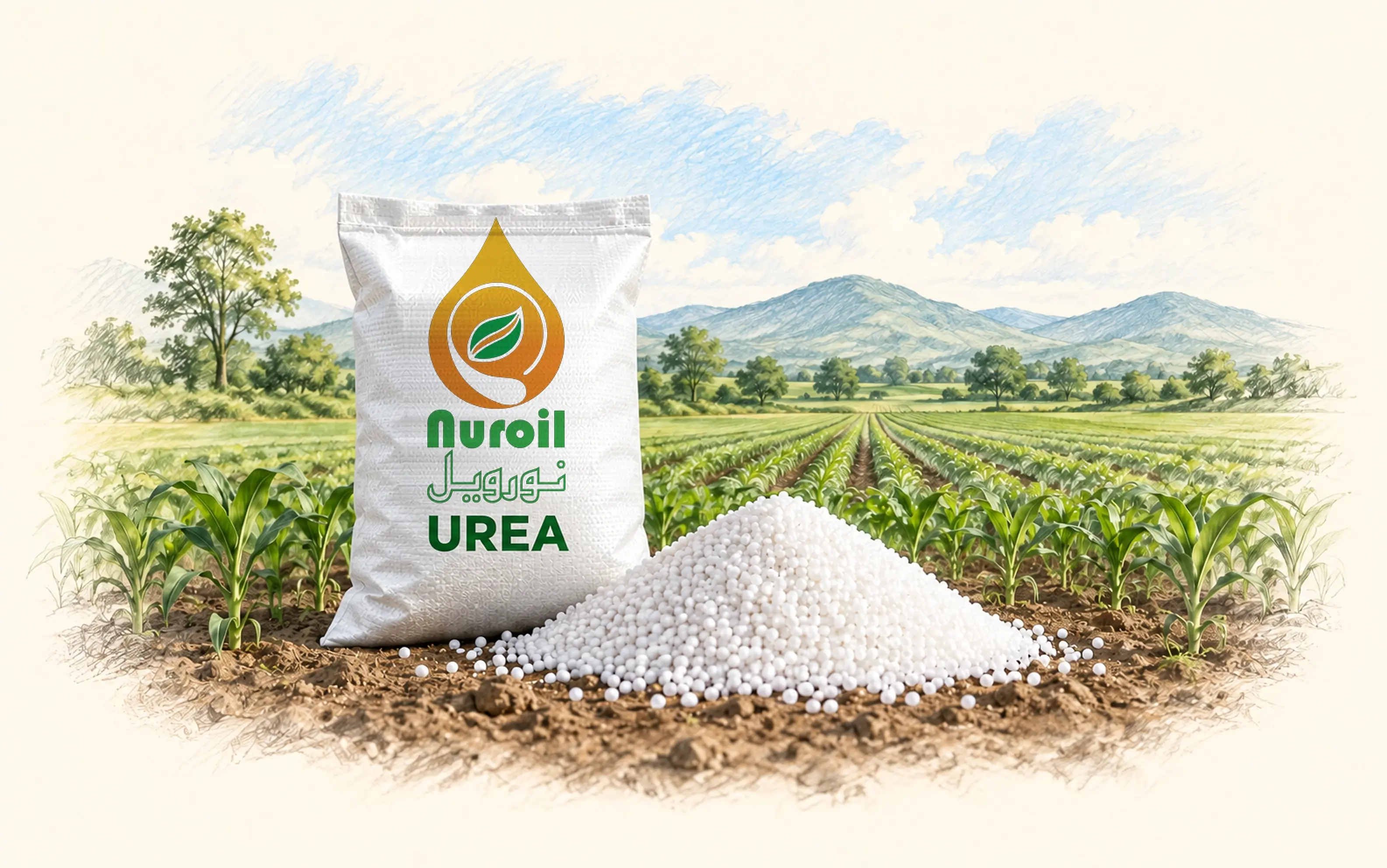
Urea leaves the plant as dry, free-flowing particles. Whether it stays that way depends largely on what happens in warehouses, ship holds and depots afterwards. Caked urea is harder to bag, blend and spread, and lumps can cause problems in spreaders and feed mixers. This guide explains why urea cakes and how to store it well, in bulk and in bags. Always follow the product SDS and any national storage rules.
Why urea cakes
Urea is hygroscopic. It starts to absorb water from the air once the relative humidity rises above a threshold known as its critical relative humidity (CRH). Published figures for prilled urea put the CRH at about 70% at 30 °C, falling to around 66% at 42 °C, so hot, humid climates are particularly demanding.
When particles take up moisture, a thin film of urea solution forms on their surfaces. When the air dries or temperatures fall, that solution recrystallises and forms bridges between particles. Repeated cycles of temperature and humidity strengthen these bridges, and pressure from the weight of a pile or stack presses particles together. Dust and broken particles add contact points and make caking worse.
Factors that increase caking
- Humid air entering through open doors, hatches or damaged sheeting.
- Day-night temperature swings that drive moisture migration within a pile.
- High moisture content at loading.
- Weak particles that break into fines during handling.
- Tall piles or high stacks that put heavy pressure on the lower layers.
- Long storage periods, especially through a humid season.
Bulk storage
- Use a closed, weather-tight building with a sound roof and floor. Keep doors closed except when moving product.
- Insulation and limited ventilation during humid weather help reduce humidity and temperature swings.
- Cover piles with plastic sheeting when not being worked, particularly in humid periods.
- Clean the floor and walls of old product, other fertilizers and debris before receiving a new cargo.
- Work the pile from one face and rotate stock on a first-in, first-out basis.
Bagged storage
- Store bags on clean pallets or a dry, raised surface, never directly on damp ground.
- Limit stack height; several fertilizer producers advise no more than about three big bags or pallets high.
- Keep bags out of direct sunlight, which degrades woven polypropylene and heats the contents.
- Outdoors, cover stacks with secured sheeting and place empty pallets on top so sheets do not rub on bags.
- Set aside and repack damaged bags promptly.
| Risk | Control |
|---|---|
| Humid air | Closed building, covered piles, lined bags |
| Temperature cycling | Insulated store, avoid sun on stacks |
| Pressure | Limit pile and stack height |
| Fines and dust | Gentle handling, screening where needed |
| Contamination | Clean store, segregate incompatible products |
Segregation and safety
Store urea apart from ammonium nitrate. A mixture of the two is far more hygroscopic than either product and can turn wet quickly. Keep urea away from strong oxidisers, and in particular from calcium hypochlorite and other chlorine-releasing products, which can react with it to form explosive nitrogen trichloride. Follow the SDS for incompatible materials, fire precautions and spill clean-up. Feed-grade urea should be stored separately from fertilizer grades and secured from livestock.
Dry air, stable temperatures and limited pressure are the three things that keep urea free-flowing.
Dealing with caked product
Light, soft caking can often be broken by careful handling or screening. Hard caking usually needs mechanical lump breaking, which creates fines, so it is better to prevent it. Granular and conditioned urea resist caking better than unconditioned or technical grades, which should be stored with extra care.
Supply points to agree
Specify moisture limits, conditioner requirements and packing suited to your storage period, for example woven bags with inner liners for humid climates. Agree on loading dates that avoid long storage before your season. Ask for a CoA per lot and the SDS. Nuroil supplies urea in bulk, 50 kg bags or jumbo bags on FOB, CFR or CIF terms.