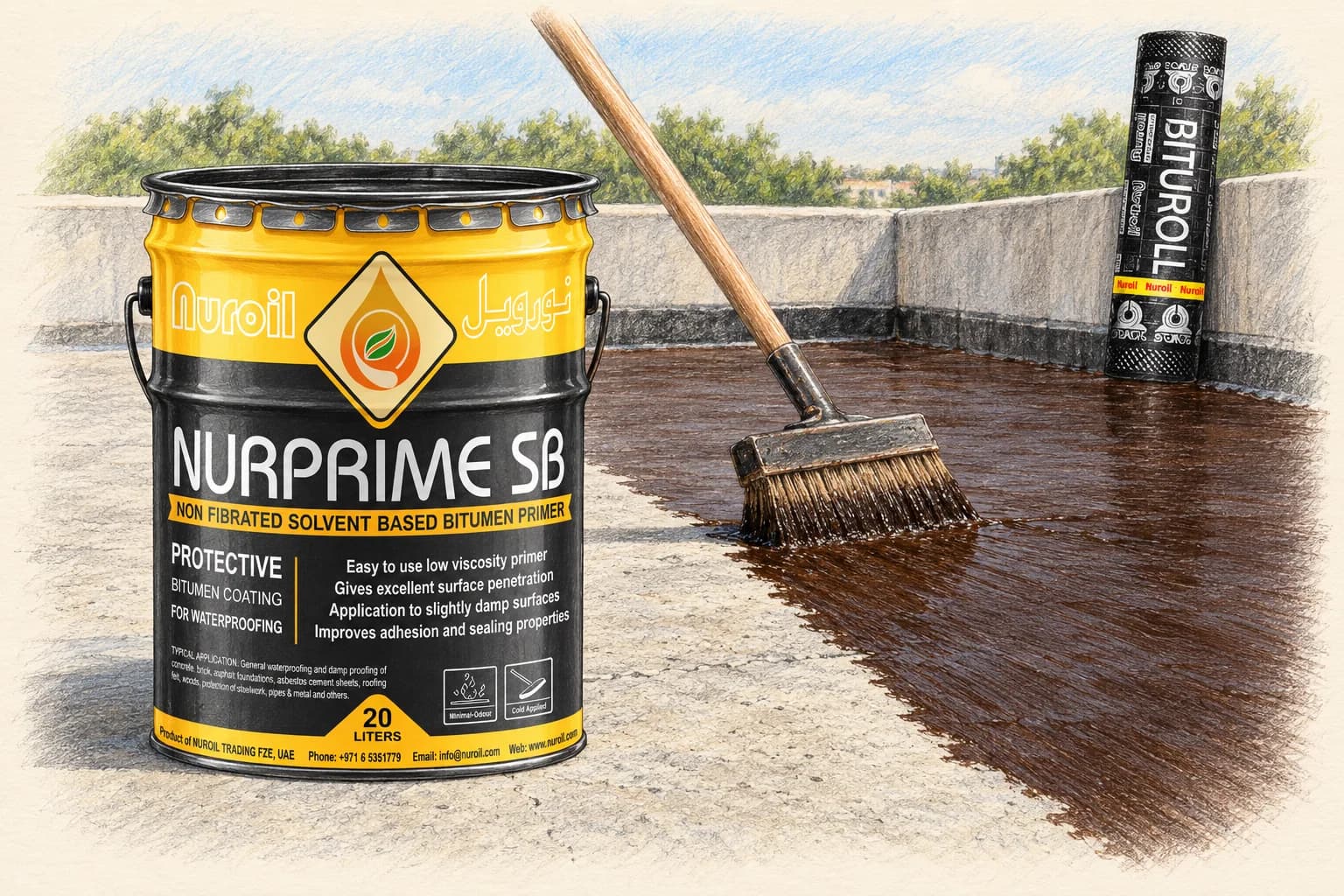
Solvent-based bitumen primers are thin liquids made by dissolving bitumen, sometimes rubber-modified, in volatile hydrocarbon solvents. The solvent is what lets the primer soak into concrete pores and dry quickly. It is also the reason these primers need careful ventilation: almost all of it evaporates into the air around the worker within hours of application.
How much solvent is involved
Data sheets typically give a non-volatile or solids content of roughly 35 to 45 percent by weight. The remainder, more than half of every litre, is solvent that leaves the film as it dries. Manufacturers also report this as VOC content in grams per litre. One North American mod-bit primer lists a VOC content below 350 g/L. A water-based rubberized emulsion from a Gulf producer, by comparison, lists below 50 g/L.
Some air quality authorities set VOC limits for coatings. A widely referenced Californian rule, for instance, sets a separate category for bituminous roof primers at 350 g/L. Limits differ by country and region, so check whether your project or market has its own requirement before choosing a product.
Why ventilation matters
Solvent vapour creates two hazards at once.
- Health: breathing hydrocarbon solvent vapour can cause headache, dizziness and drowsiness, and long or repeated exposure brings further risks. The safety data sheet gives the exposure limits and symptoms for the specific solvent blend.
- Fire and explosion: the vapour is flammable. Data sheets list flash points from below 0 °C to around 40 °C depending on the solvent, which means vapour can ignite at normal site temperatures.
Most flammable solvent vapours are heavier than air. They flow downhill and collect in low points such as basements, lift pits, trenches, tanks and sumps, where they can build up even when the air at head height seems clear.
Practical controls
| Situation | Main concern | Typical controls |
|---|---|---|
| Open roof or exposed wall | Short-term inhalation | Work upwind, keep pails closed when not in use |
| Basement or podium slab | Vapour build-up at low level | Forced ventilation, extract from low points, no ignition sources |
| Pits, tanks, sumps | Confined space, flammable atmosphere | Confined space permit, gas monitoring, mechanical ventilation, standby person |
| Occupied building | Odour and vapour reaching occupants | Isolate area, seal air intakes, consider a water-based primer |
Other common measures:
- Remove ignition sources from the area: no smoking, hot work, naked flames or non-rated electrical tools nearby.
- Never use a torch to speed up drying. One manufacturer explicitly warns against heating primer with a torch.
- Wear the gloves, eye protection and respiratory protection listed in the safety data sheet. In poorly ventilated areas, respirators with organic vapour filters are commonly specified.
- Keep only the quantity needed for the shift at the work face.
- Collect used rags and rollers in a closed metal container.
Ventilation must reach the low points of the space, because that is where solvent vapour collects.
When to consider a water-based primer
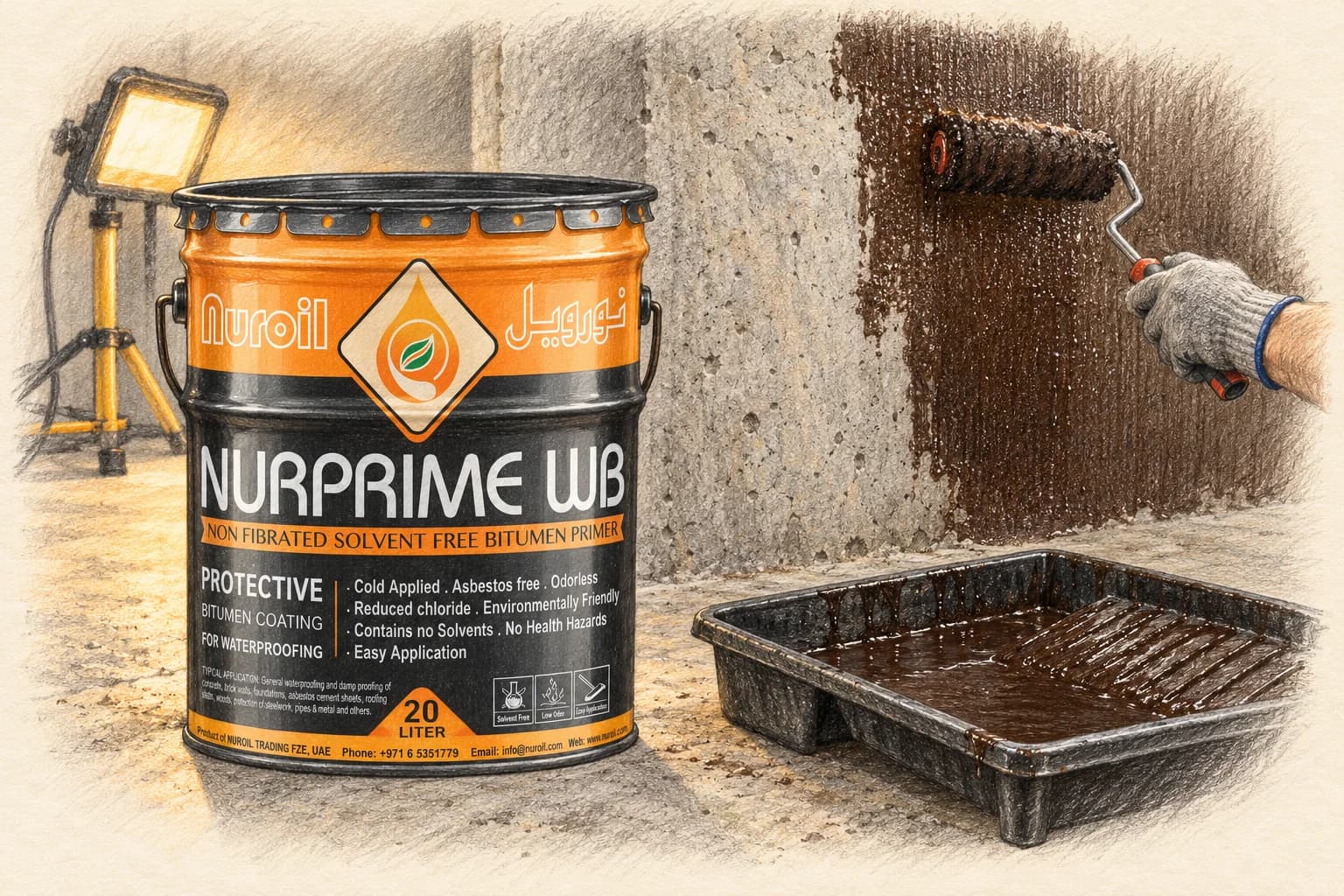
Where ventilation is difficult, such as occupied buildings, hospitals, schools and deep confined areas, a water-based bitumen primer may be the better choice, provided it is approved for the membrane or coating that follows. Solvent-based primers still have a place where fast drying and deep penetration on dense concrete are the priority, especially for torch-applied membranes outdoors.
What to ask your supplier
Ask for the safety data sheet and technical data sheet, and check the VOC content, flash point and solvent type against your site rules and any regional limits. If your project has a VOC requirement, include it in your enquiry. Nuroil supplies solvent-based bitumen primers with a certificate of analysis on every delivery and MSDS on request; use request a quote to send your specification.