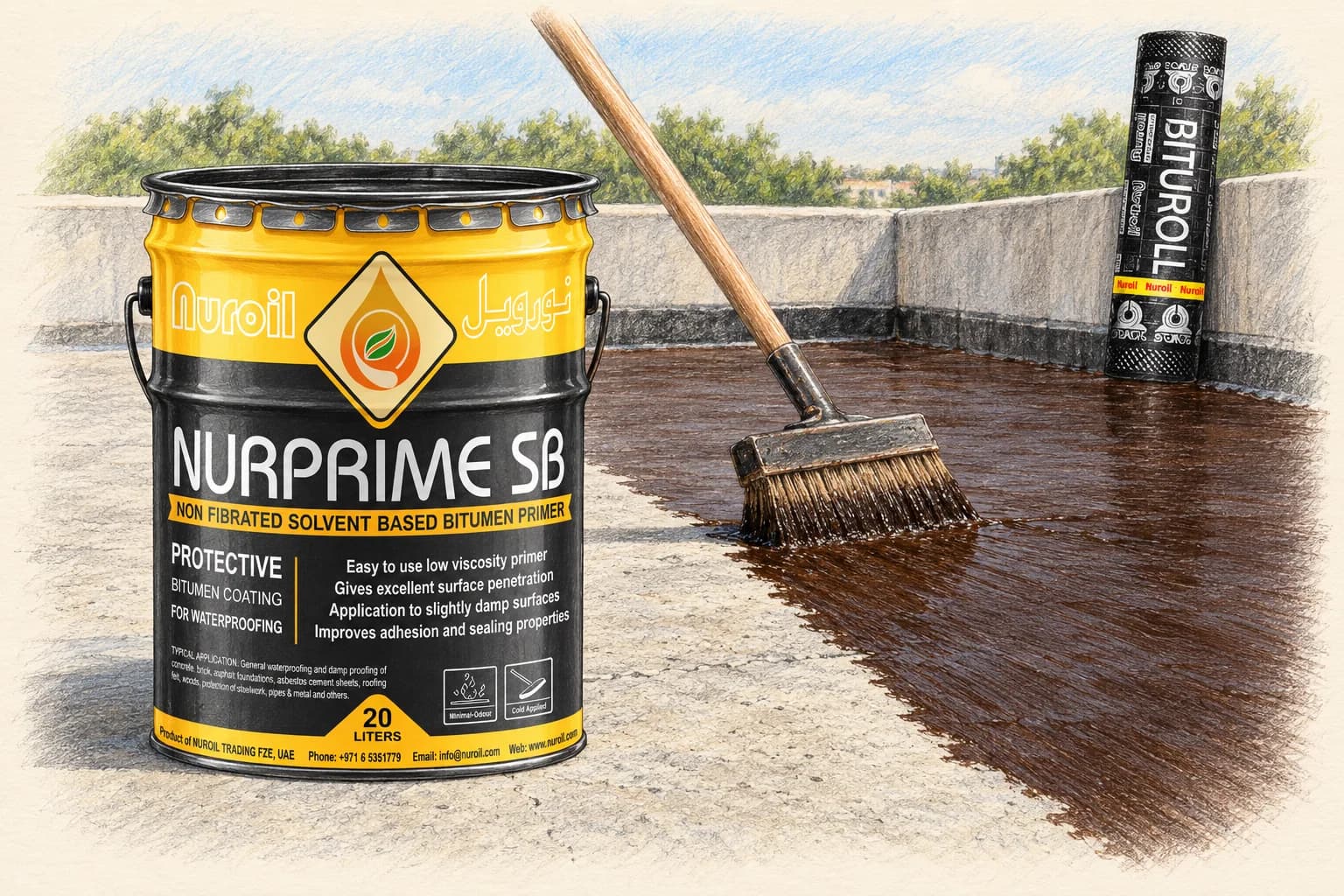
Solvent-based bitumen primers look much the same from one producer to the next: a thin black liquid in a pail or drum. Their data sheets, however, tell you a lot about how a primer will flow, dry and bond. Many primers state compliance with ASTM D41, the standard specification for asphalt primer used in roofing, dampproofing and waterproofing. This guide explains the tests behind that claim and other values commonly listed.
About ASTM D41
ASTM D41 covers asphalt primers for use on concrete, masonry, metal and asphalt surfaces, above and below grade, to improve the bond of later bituminous layers. The current edition classifies primers into Type I and Type II. Its requirements are based on furol viscosity, distillation, penetration of the distillation residue, and solubility of that residue in trichloroethylene. Earlier editions also listed water content. The numerical limits are in the purchased standard, so a buyer should ask the supplier to show test results against the specified type.
Common parameters on a data sheet
| Parameter | Test method often cited | Example published value | What it tells you |
|---|---|---|---|
| Saybolt Furol viscosity at 25 °C | ASTM D88 | 25 to 125 seconds | How easily the primer flows and penetrates |
| Distillation, volume off to 225 °C | ASTM D402 | 35% minimum | Share of fast-evaporating solvent |
| Distillation, volume off to 360 °C | ASTM D402 | 65% maximum | Total solvent; the rest is bitumen residue |
| Penetration of residue at 25 °C | ASTM D5 | 20 to 50 dmm | Hardness of the bitumen left behind |
| Solubility of residue | ASTM D2042 | About 99% | Purity of the bitumen; low values suggest fillers or contamination |
| Water content | ASTM D95 | 0.5% maximum | Water can affect stability and adhesion |
| Density | ASTM D70 or D1475 | About 0.85 to 0.95 g/cm³ | Converts litres to kilograms |
| Solids or non-volatile content | ASTM D1644 and others | About 35 to over 40% by weight | Bitumen left on the surface per litre |
| Flash point | Various closed-cup methods | From below 0 °C to about 40 °C | Fire hazard and transport classification |
| VOC | Calculated or measured | Below 350 g/L on one product | Solvent emissions; regional limits may apply |
Example values come from published data sheets of different producers and are not a specification.
Reading viscosity and distillation together
A low viscosity primer flows into pores but may give a thinner residue per coat. The distillation test splits the primer into the solvent that boils off and the bitumen residue. The share that evaporates below 225 °C indicates the fast solvent fraction, which affects drying speed. The share to 360 °C shows the total volatile content. Together these explain how quickly the primer dries and how much bitumen it leaves behind.
The residue tests
After distillation, the remaining bitumen is tested like a paving or industrial grade. Penetration shows whether it is hard or soft; a fairly hard residue resists softening on hot roofs. Solubility confirms that the residue is mostly bitumen rather than fillers or insoluble matter. These tests are useful when comparing primers that claim identical solids content.
Flash point and solids
Flash point varies widely with the solvent blend. One North American primer lists a closed-cup flash point below -18 °C, while several Gulf-region primers list around 38 °C. This difference affects storage and transport rules, so check it even when the rest of the sheet looks similar. Solids content tells you how much bitumen stays on the surface; along with coverage it is the best guide to value per square metre.
Two primers can both claim ASTM D41; ask which type, and for the actual test results on the batch you will receive.
Other claims
Some primers also cite other standards, for example a national primer specification or a test showing suitability for contact with potable water. Such claims are product specific and should be backed by a test report.
Putting it into an enquiry
Specify the standard and type required, any VOC or flash point limits, pack size and quantity. Ask for the technical data sheet, safety data sheet and a certificate of analysis showing viscosity, distillation and residue results for the batch. Nuroil provides a CoA with every delivery and third-party inspection on request; send your specification through request a quote.