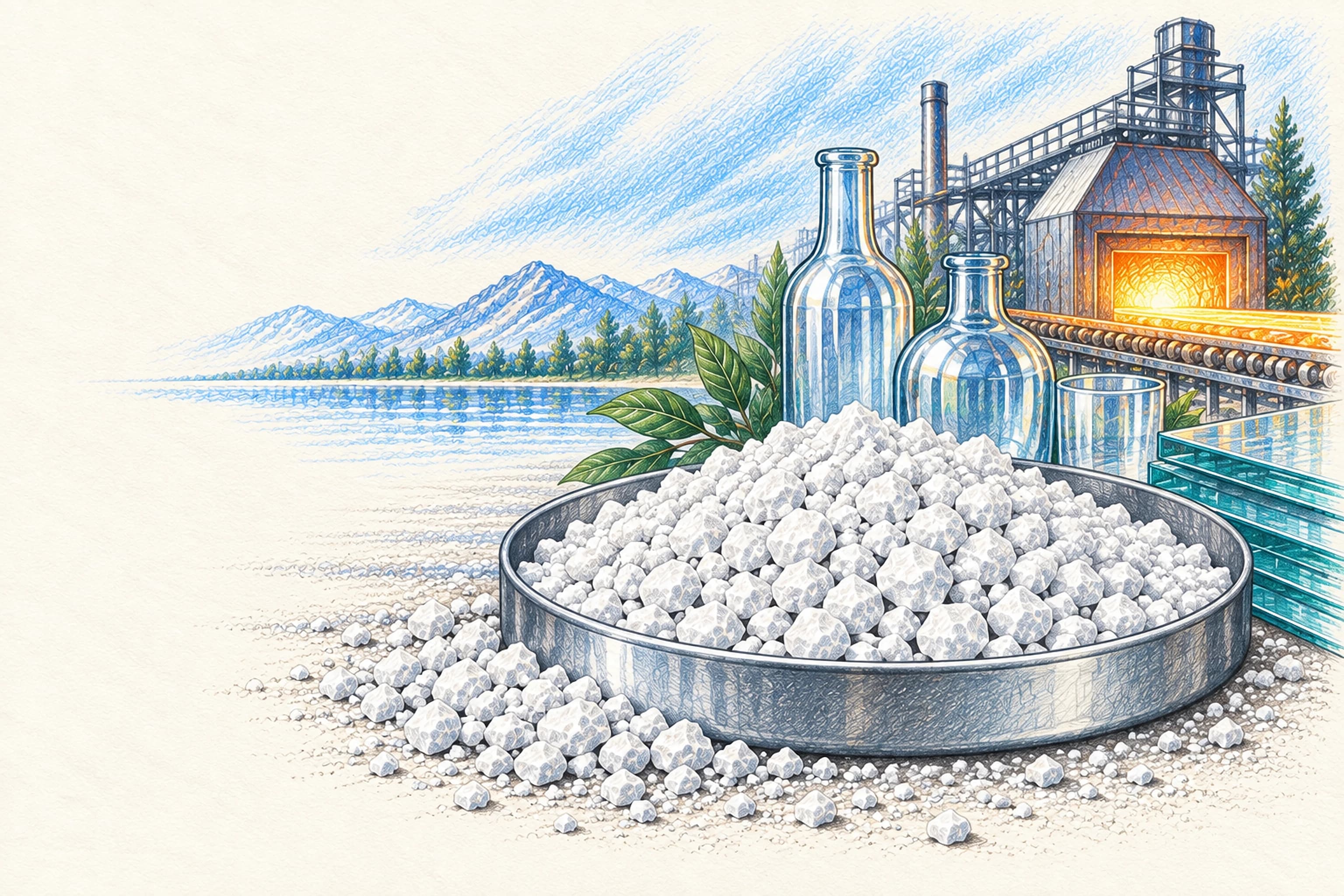
Most of the glass around us, including windows, bottles and jars, is soda-lime glass. Sand gives it its body, but soda ash is what makes it practical to melt. Glass is the largest single use of soda ash worldwide. In some major producing markets it accounts for close to half of all consumption.
What soda ash does in the furnace
Pure silica (SiO2) melts at about 1,713 °C, which is too hot for economical glass production. Soda ash acts as a flux. When heated with sand, it gives off carbon dioxide and supplies sodium oxide, which breaks up the silica network and lowers the temperature at which the batch melts and becomes workable.
Glass made from sand and soda alone would dissolve slowly in water. Limestone or dolomite is therefore added to supply calcium and magnesium oxides, which make the glass chemically durable. That combination of sand, soda and lime gives soda-lime glass its name. Small amounts of other materials, such as feldspar for alumina, are added according to the product.
Its share of the batch
Soda ash is a modest part of the batch by weight but an important part of its cost. Figures from the flat glass industry show sand making up around 62% of batch weight, with soda ash at roughly 16% by weight but about 60% of raw material cost. That is why glassmakers watch soda ash consumption closely and why recycled glass (cullet) is so valuable. Cullet already contains its sodium, so every tonne used reduces both the fresh soda ash needed and the energy required for melting.
Why glassmakers specify dense grade
Glass plants almost always buy dense soda ash, for three practical reasons:
- Batch uniformity. Batch ingredients with different particle sizes and densities tend to separate during conveying and charging. Dense ash grains are closer in size to glass sand, so the mixed batch stays more uniform on its way to the furnace.
- Less carry-over. Fine particles can be swept out of the furnace by combustion gases. Alkali-rich dust attacks refractory linings and can build up in regenerators and flues. Limiting fines reduces this.
- Handling. Dense ash flows freely through silos and weighers in automated batch houses and makes less dust at transfer points.
Quality points that matter to a glass plant
| Parameter | Why it matters in glass |
|---|---|
| Na2CO3 content | Batch calculations assume a fixed sodium input. Lot-to-lot consistency matters as much as the headline purity. |
| Iron (as Fe2O3) | Iron colours glass green or blue-green. Clear (flint) glass and low-iron flat glass need very low iron in all raw materials. |
| Chloride and sulphate | These affect fining and gas release in the melt and are watched as part of the overall batch chemistry. |
| Particle size distribution | Too many fines increase dust and carry-over. Too much coarse material can slow melting and affect mixing. |
| Moisture | Changes the true weight of soda ash added and can cause lumps in the batch house. |
Some national soda ash standards set an iron limit specifically because of discoloration in glass. Glassmakers usually add their own internal limits for particle size and fines.
Other points for glass buyers
Soda ash absorbs moisture from humid air. Product that has been stored badly can form soft lumps, which disturb weighing and mixing. Bulk deliveries and jumbo bags should be kept dry and used first in, first out. Dense grains can also break down if they are conveyed too aggressively, especially in pneumatic systems, which increases the fines content.
For a glass plant, consistency between deliveries matters as much as purity. A steady particle size and iron level keep the batch and the furnace stable.
What to include in a glass-grade enquiry
Specify dense soda ash with your minimum Na2CO3, maximum iron, chloride and sulphate, bulk density, and screen limits for oversize and fines. Give your monthly volume, preferred packing (jumbo bags or bulk) and discharge port. Ask for a certificate of analysis for each lot and, for a new source, a sample or a run of past analyses to check consistency. Nuroil provides a CoA with every delivery and can arrange third-party inspection at loading on request. Details are on the soda ash page.