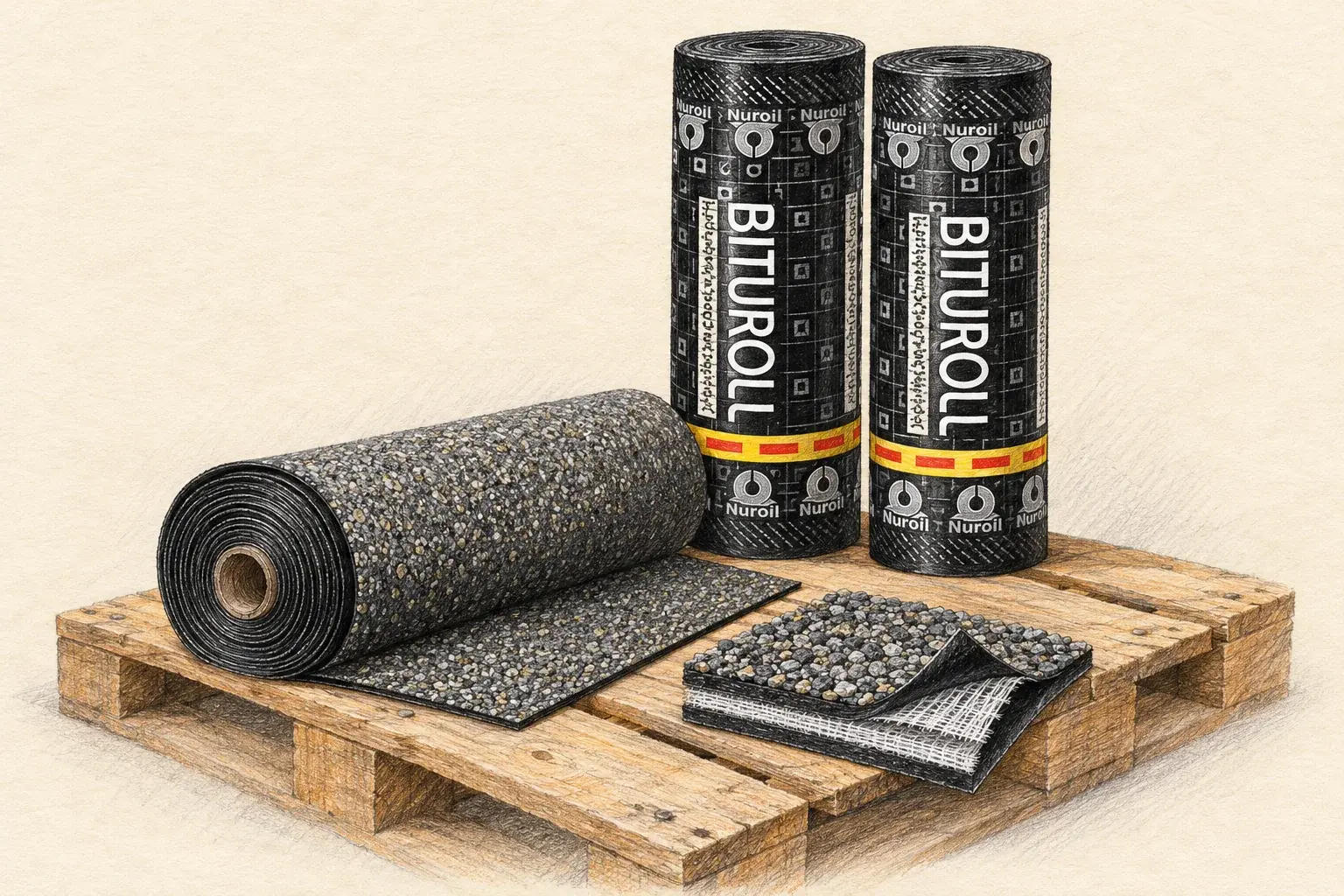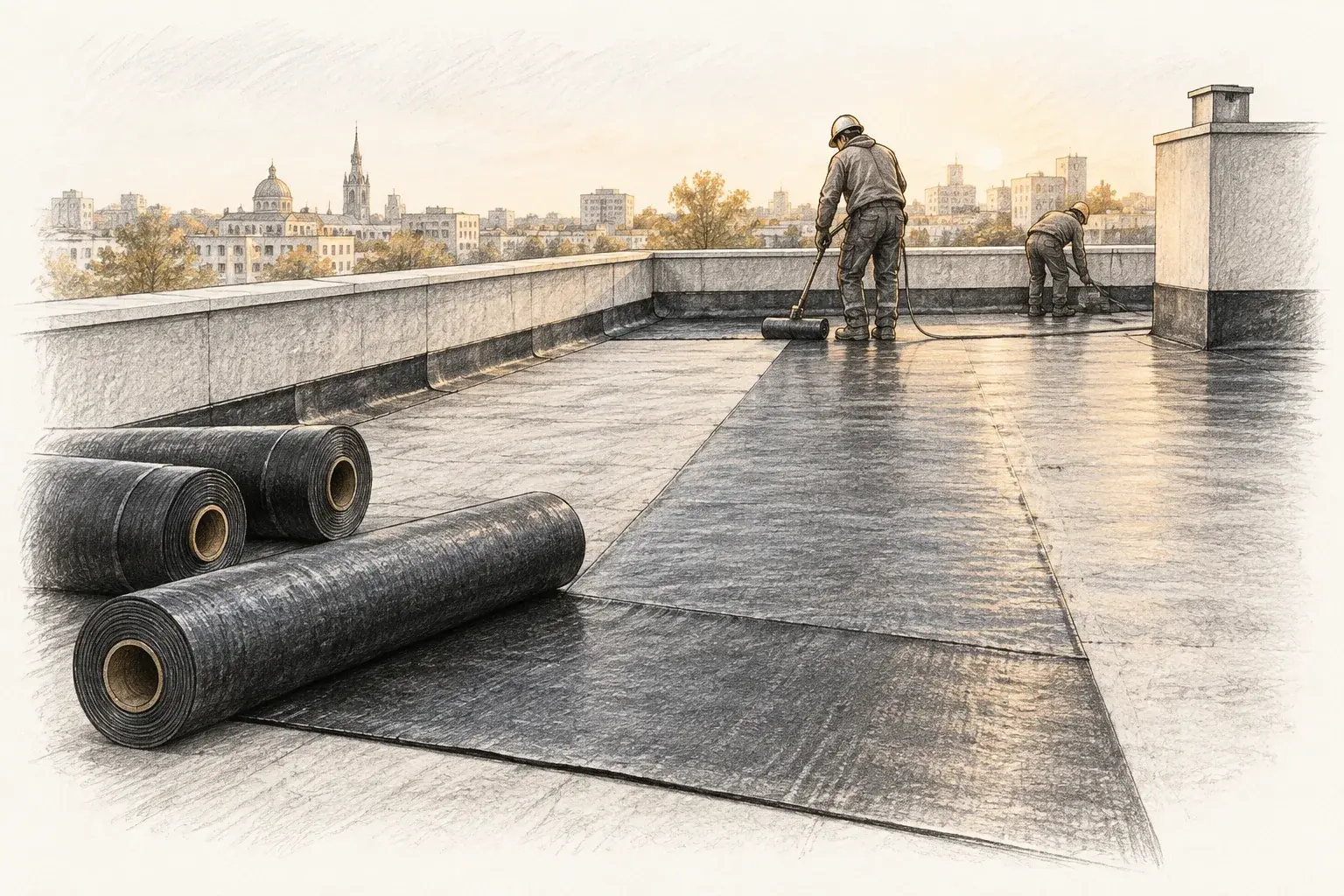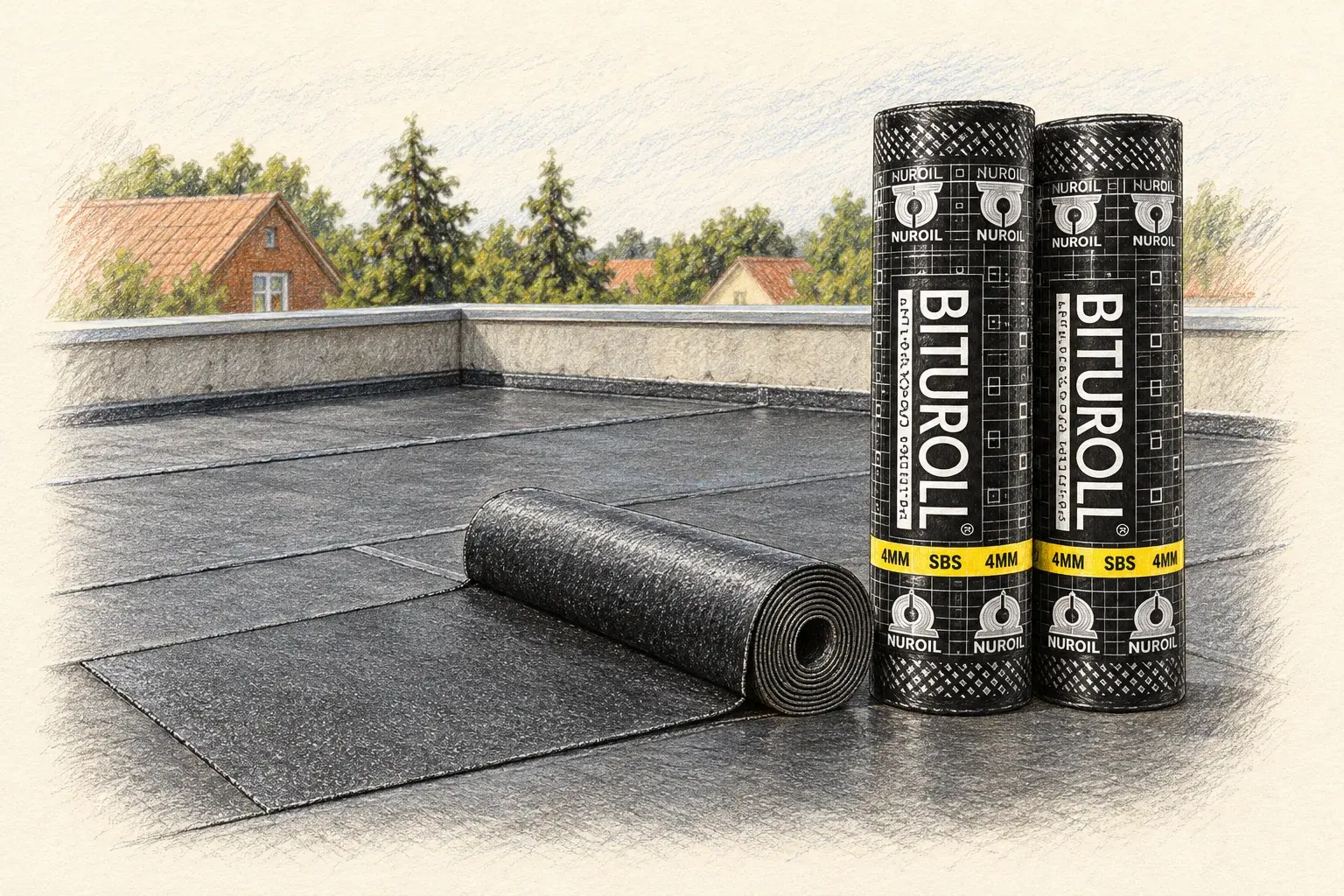
Two SBS membranes with the same compound can behave very differently depending on the reinforcement inside them and how thick they are. These two choices set tensile strength, elongation, puncture resistance and dimensional stability. This guide explains the options and how to match them to a job.
What the reinforcement does
The reinforcement, or carrier, is a mat at the core of the sheet that the bitumen compound coats on both sides. It gives the membrane its strength and controls how it behaves under load and heat. The ASTM specifications for SBS sheets are divided by reinforcement type, which shows how central it is: D6164 for polyester, D6163 for glass fibre, and D6162 for combinations of polyester and glass.
Reinforcement options compared
| Carrier | Strengths | Limitations | Typical uses |
|---|---|---|---|
| Non-woven polyester | High elongation, good tear and puncture resistance, tolerates substrate movement | Can shrink or stretch when heated during laying if not stabilised | Cap and base sheets on roofs with movement, foot traffic, mechanically fixed systems |
| Glass fleece (glass fibre mat) | Excellent dimensional stability, low cost | Low elongation, lower tear and puncture resistance; can crack over moving joints | Underlayers, vapour control layers, stable concrete decks |
| Polyester with glass yarns or composite | Combines elongation of polyester with improved stability during manufacture and laying | Properties depend on proportion of each fibre | General-purpose roofing where both strength and stability are wanted |
The ASTM specifications note that many polyester mats include a small share of glass yarns to aid processing and reduce distortion; these yarns do not change the classification unless they materially affect the finished properties. A dedicated fibre glass reinforced membrane is a different product aimed at stability rather than stretch.
Reinforcement weight
Polyester carriers are described by mass per square metre. Heavier mats generally give higher tensile and tear strength. Data sheets for polyester-reinforced SBS sheets commonly quote carriers in the region of 150 to 250 g/m², but the declared tensile and tear results are a better basis for comparison than the mat weight alone.
Thickness choices
SBS sheets are commonly made in nominal thicknesses of around 2 mm to 5 mm, with 3 mm and 4 mm being the most common for roofing. Granule-surfaced caps are often described by mass per square metre instead.
- Thinner sheets (around 2 to 3 mm) are typical as base sheets in two-layer systems, or where weight and ease of handling matter.
- 4 mm sheets are a common choice for single-layer applications, cap sheets and below-grade tanking where a single robust layer is required.
- 5 mm and heavier sheets are used where extra compound is wanted for long life, heavy traffic, or protection against root penetration and ballast.
More thickness means more compound above and below the carrier, which improves resistance to ageing, puncture and minor installation damage. It also makes rolls heavier and slower to torch. Thickness on its own does not replace a second layer: two layers provide redundancy at laps, which a single thick sheet cannot.
Matching the build-up to the job
- Exposed roof, two layers: polyester or composite base sheet plus mineral-surfaced polyester cap.
- Exposed roof, single layer: heavy polyester sheet with factory surfacing and generous laps; follow the manufacturer's system approval.
- Basement or foundation tanking: polyester-reinforced sheet of adequate thickness, protected by boards before backfilling.
- Under paving or green roofs: polyester sheets, with a root-resistant top layer where planting is planned.
Choose reinforcement for movement and stability, and thickness for durability. Use a second layer for redundancy, not just a thicker sheet.
What to state when ordering
Specify the reinforcement type and, if required, minimum mat weight; nominal thickness or mass per square metre; surface finish on each face; roll dimensions; and the applicable standard. Ask for the data sheet showing tensile, elongation, tear and cold flexibility values. Nuroil can quote different reinforcement and thickness combinations side by side; send your build-up through the quote request form.