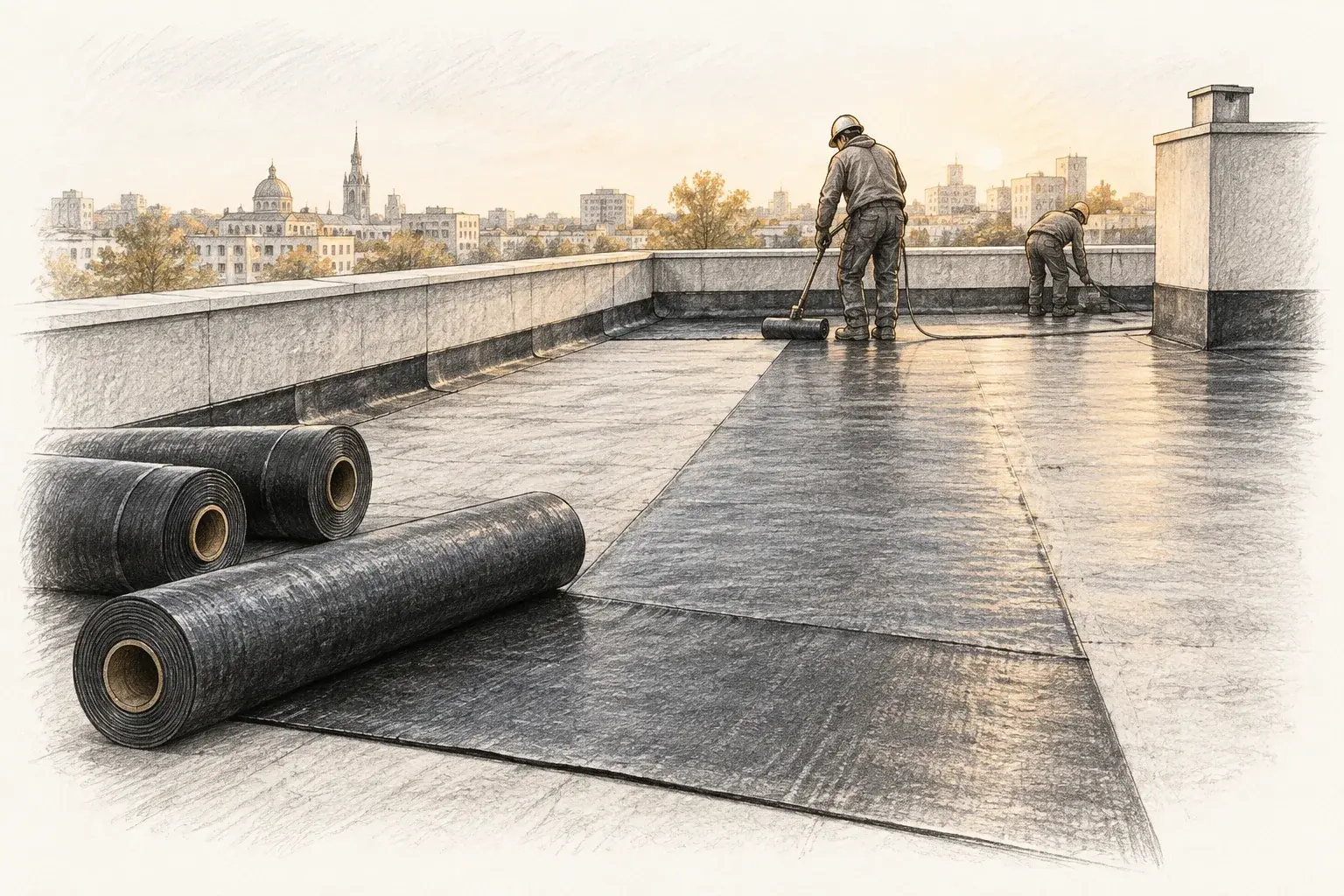
Blisters are among the most common defects reported on SBS modified bitumen roofs. They appear as raised, often rounded areas where the membrane has separated from the layer below. Some are harmless for years; others split open and let water in. Understanding why they form helps both in preventing them and in deciding when to act.
What a blister is
A blister is a void between layers, either between the cap sheet and base sheet, between the base sheet and substrate, or within a lap. Gas inside the void, usually air and water vapour, expands when the roof heats up in the sun, lifting the membrane. As the roof cools the pressure falls, but the bond rarely recovers, so the blister tends to grow with each daily cycle.
Research carried out jointly by the National Research Council of Canada and the US roofing contractors' association into blistering of hot-applied SBS roofs found that blisters form for the same basic reason as in older built-up roofs: voids in the system. The same work noted that blistering has been reported more often on SBS than on APP membranes.
Common causes
- Moisture trapped during installation. Damp decks, wet insulation, dew on base sheets or rain during laying all leave water that later turns to vapour.
- Incomplete bonding. Skips in hot bitumen or adhesive, cold spots in torching, or insufficient pressure when rolling the sheet into place.
- Debris and uneven substrate. Dust, grit and ridges prevent full contact.
- Unrelaxed sheets. Rolls laid without being allowed to relax can shrink back and pull away from the substrate.
- Lap-line blisters. Where laps in successive layers are staggered, a linear blister can form along the edge of a lap.
Deciding whether to repair
Not every blister needs cutting open. A closed, intact blister keeps water out, and disturbing it creates an opening that must then be sealed perfectly. Industry guidance summarised in trade publications suggests repair when a blister:
- has opened, cracked or shows fatigue cracking around its edge;
- has lost its surfacing or exposed the reinforcement;
- sits in a foot-traffic area where it will be stepped on;
- has pulled a seam apart by a significant part of its width.
Small, stable blisters can be marked, photographed and monitored at each inspection.
The usual repair approach
Repair methods vary by system and the membrane manufacturer's instructions take priority, but the general sequence is:
- Cut the blister open, typically with cross cuts or by removing the lifted section back to well-bonded membrane.
- Check for moisture in the layers below. If the insulation or deck is wet, the source must be found and the wet material dealt with, or the blister will return.
- Allow the area to dry fully and clean away loose granules, dust and debris.
- Re-bond the flaps where possible, then apply a patch of compatible SBS membrane extending well beyond the cut on all sides, with properly sealed edges.
- Restore the surface finish (granules or coating) over the patch so the repair is UV protected.
Preventing blisters in the first place
Most prevention happens before the first roll is opened. Store rolls dry and on end, keep insulation boards covered, check that decks are dry before laying, and follow the manufacturer's bonding method for full adhesion. Avoid laying in rain, fog or heavy dew, and allow cold rolls to warm and relax before use. Our construction products range lists the membranes and primers that make up a complete system.
Blisters almost always trace back to trapped moisture or incomplete bonding. Fixing the source matters more than patching the symptom.
Supply points for repair materials
When ordering membrane for repairs, match the original product's modifier (SBS with SBS), reinforcement and surface finish where possible, and order a small quantity of compatible primer. Ask for the product data sheet so the contractor can check bonding method and compatibility. Nuroil supplies SBS membranes with a certificate of analysis on every delivery; contact our team through the contact page with roll sizes and quantities.