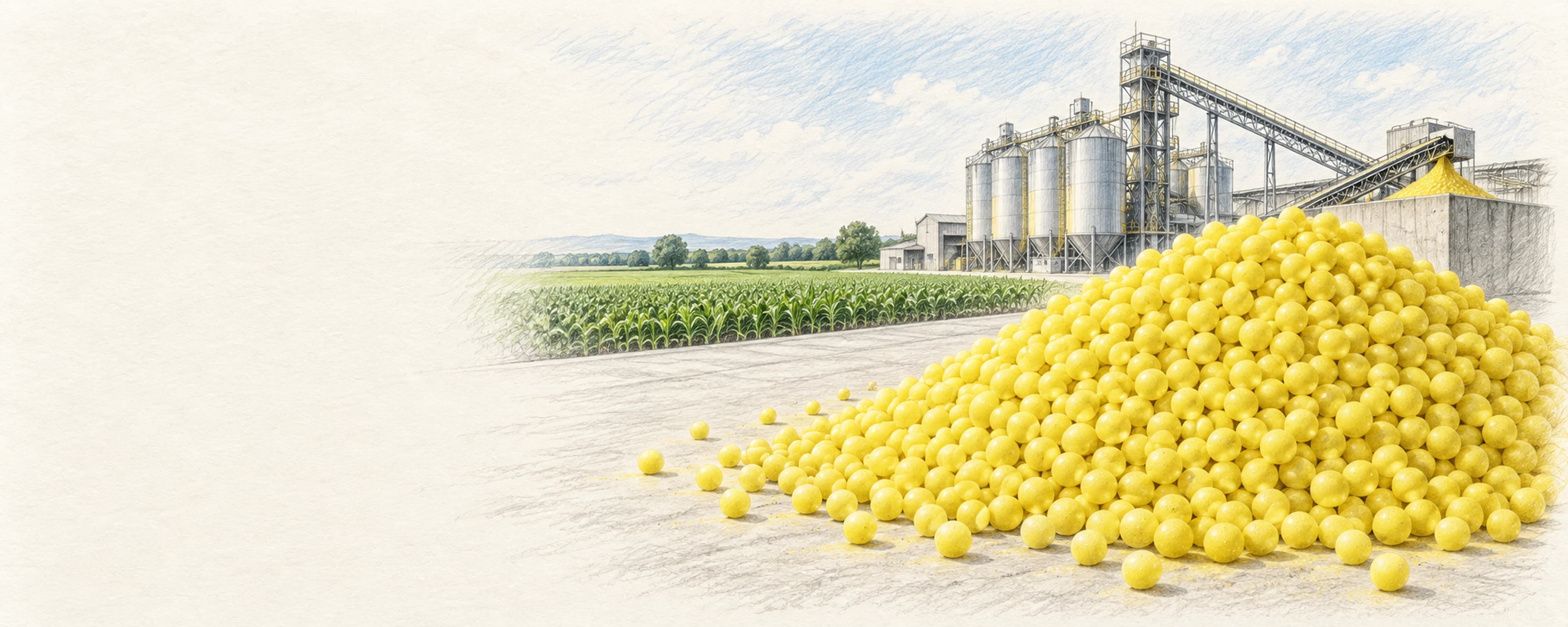
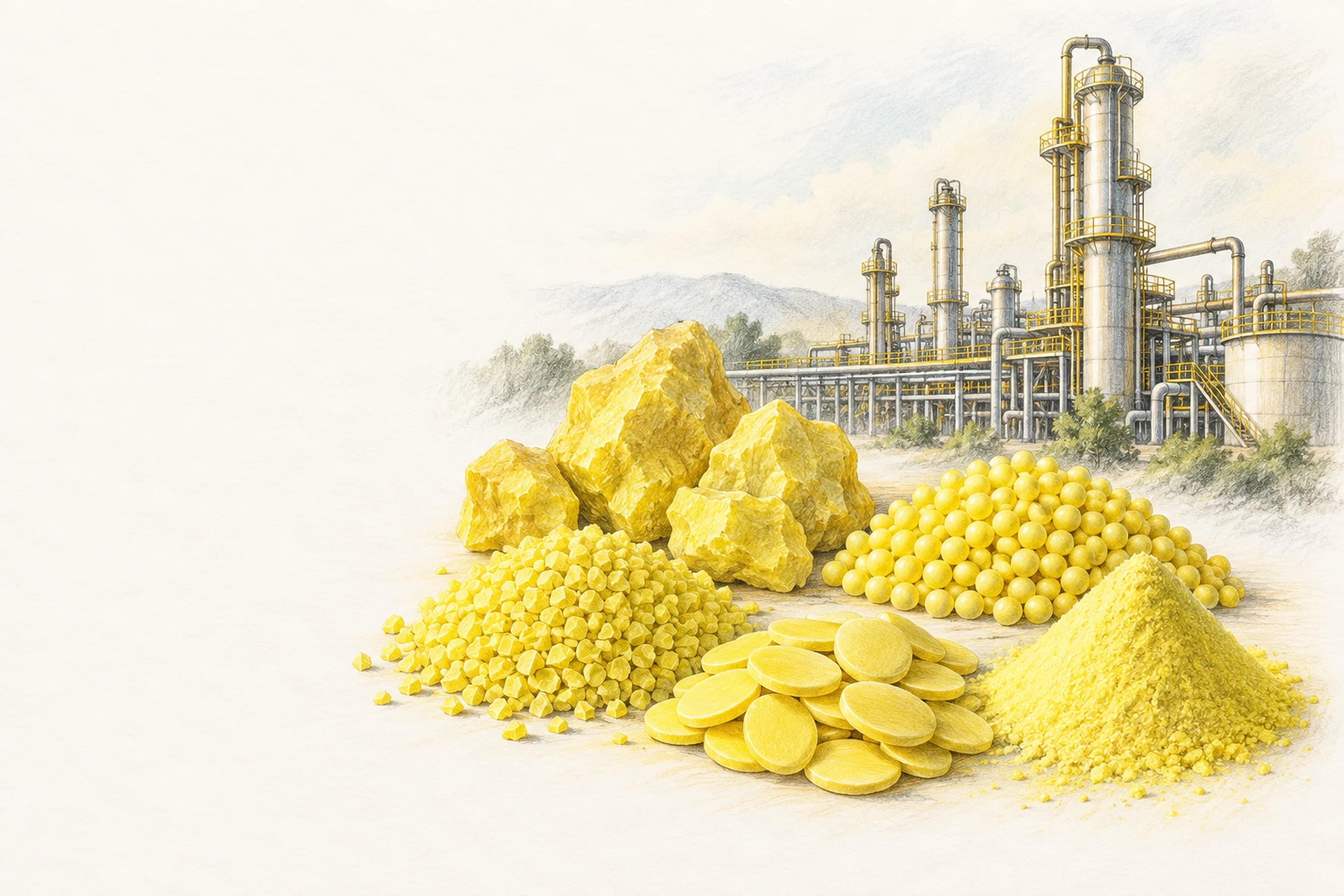
Elemental sulphur is a popular fertilizer source because it is concentrated and cheap to transport, but plants cannot take it up directly. Soil microbes must first oxidise it to sulphate. How quickly they can do that depends mostly on how much sulphur surface they can reach, and that is where the physical form of the product matters. A sulphur prill a few millimetres across behaves very differently from a fine powder.
Oxidation is a surface process
Sulphur-oxidising bacteria work on the outside of sulphur particles. Halving the diameter of a particle roughly doubles the surface area per kilogram, so fine particles oxidise far faster than coarse ones. Research models of elemental sulphur oxidation treat the rate as proportional to exposed surface area and predict release from a product's sieve analysis.
Laboratory work illustrates the scale of the difference. In one column study at 25 °C, very fine sulphur particles (below about 0.1 mm) mixed into soil oxidised at roughly 2% per day, while sulphur concentrated in bentonite pastilles oxidised at well under 0.1% per day. The pastilles only released sulphur quickly once they had broken apart and their particles had spread into the soil.
Plain prills versus bentonite-bound prills
| Product | What it is | Behaviour in soil |
|---|---|---|
| Plain sulphur prills | Solid beads of pure sulphur, typically a few millimetres across | Very low surface area; oxidise slowly over a long period unless broken up |
| Bentonite-bound prills or pastilles | Sulphur mixed with bentonite clay, formed into beads | Clay swells in moist soil and the bead disperses into fine particles, but release can still be slow |
| Micronised or fine sulphur | Finely ground powder, often in a fertilizer granule | Fastest oxidation; suited to meeting in-season needs |
Plain sulphur prills made for industrial use are not designed as fertilizers. Their main agricultural role is as a raw material: they are melted or ground and then made into fertilizer products such as sulphur-bentonite or sulphur-enhanced phosphates.
Temperature and soil conditions
Soil microbes are much more active in warm, moist soils. A recent incubation study comparing micronised sulphur, sulphur co-granulated with phosphate and bentonite-bound prills found that cool autumn and winter soils sharply delayed sulphate formation, and that bentonite-bound prills released the least sulphur under all conditions tested. The authors described them as a longer-term sulphur source rather than a supply of immediate sulphate. Oxidation in that study was also faster in an alkaline, coarse-textured soil than in a slightly acidic silt loam.
What this means for fertilizer programmes
- Where a crop needs sulphur early in the season, a sulphate source or a product with finely divided sulphur is more reliable than prills.
- Prilled or bentonite products suit building soil sulphur over several seasons, or applications made well ahead of crop demand in warm conditions.
- Combining sulphate with elemental sulphur gives both immediate and longer-term supply.
Agronomic advice for a specific crop and soil should come from a local agronomist; the background on why crops need sulphur is covered elsewhere in our Knowledge Centre.
For plants, the useful measure of an elemental sulphur product is its exposed surface area, not just its sulphur content.
Why prills are still useful to fertilizer makers
For a fertilizer plant, slow oxidation of whole prills is not a drawback, because the prills are a feedstock. Their value lies in being easy to handle, store and meter. Low moisture helps when they are melted for sulphur-bentonite production, and low fines reduce dust on the way to the melter or mill. Purity matters because whatever is in the sulphur ends up in the field.
Buying prilled sulphur for fertilizer production
If you buy prills to make fertilizers, specify purity, moisture, fines and size range, and any limits on contaminants that could end up in soil. Ask for a CoA per lot. Nuroil supplies prilled sulphur with a CoA on every delivery; request a quote with your process and volumes.