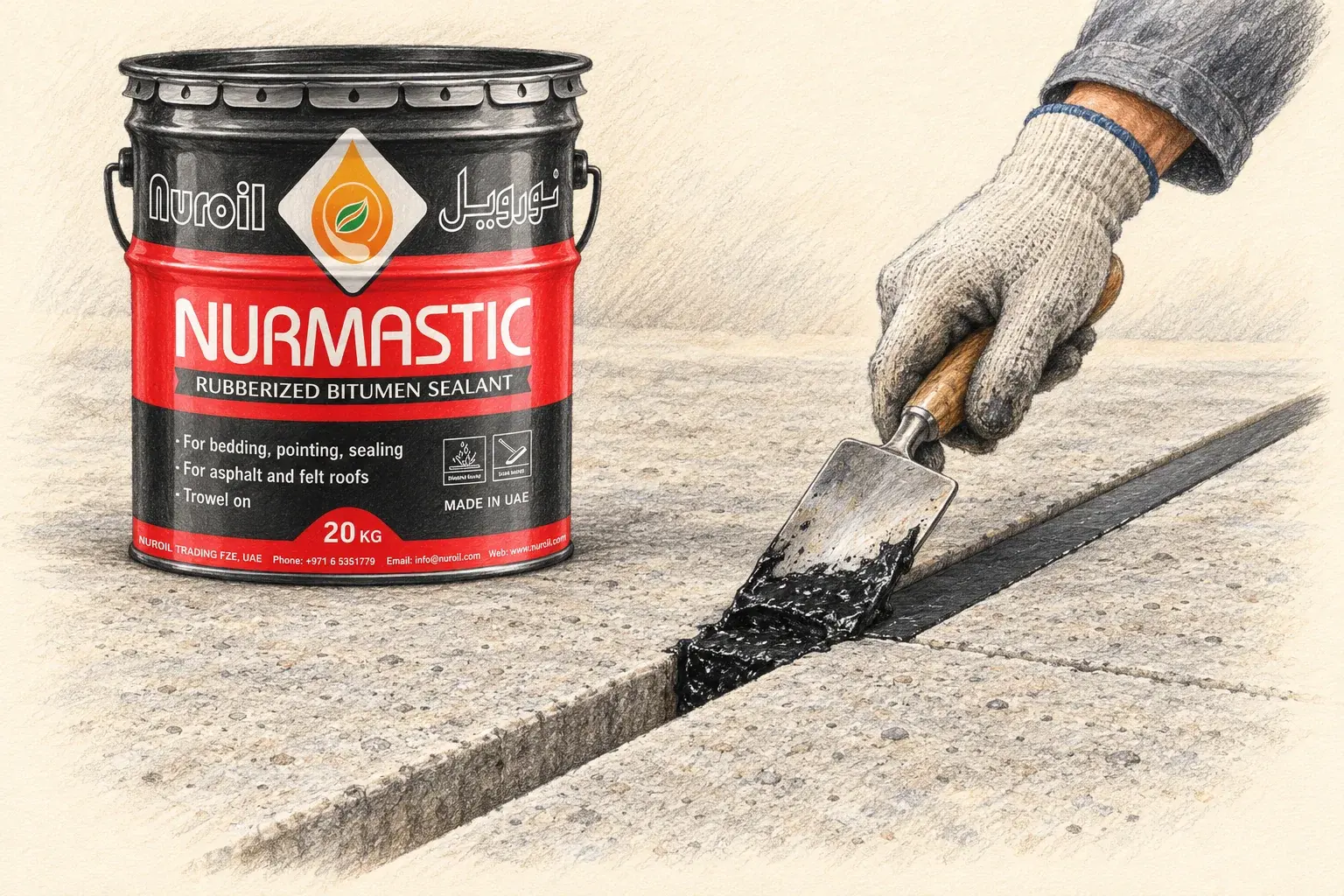
Most of the life of a bitumen joint sealant is decided before the melter is lit. Highway agencies and producers agree that a clean, dry, correctly shaped reservoir is the single biggest factor in how long a seal lasts. This article walks through the preparation steps for cracks in asphalt and joints in concrete pavements.
Decide whether to rout or saw
Routing or sawing cuts a uniform reservoir along the crack. It removes weathered, loose material from the crack edges and gives the sealant a known volume and vertical walls to bond to. Guidance linked to the US Federal Highway Administration suggests routing working cracks wider than about 3 mm that are reasonably widely spaced; heavily cracked areas may be better treated with other preservation methods.
- Cut to remove at least a few millimetres from each side so the walls are fresh, intact and free of loosely bonded aggregate.
- Keep reservoir dimensions within the specification. One state agency calls for a minimum reservoir of about 10 mm wide by 13 mm deep for narrow cracks; producers publish reservoir tables that vary with climate and binder grade.
- For concrete pavements, existing joints are usually resawn or refaced to remove old sealant and expose clean concrete on both faces.
Clean the reservoir
Cleaning removes cutting dust, old sealant, dirt and vegetation. The usual sequence is:
- Remove old sealant and debris mechanically (plough, saw or wire brush).
- For concrete joints, sandblasting each face is commonly specified to remove laitance and residue.
- Blow out the joint with high-pressure compressed air immediately before sealing. Specifications commonly require a minimum around 620 kPa (90 psi), and the air must be dry and oil-free; an oil film from a poorly maintained compressor is enough to stop the sealant bonding.
- Where a hot-air lance is used, it helps dry and warm the walls, but it must not scorch or burn the asphalt.
Make sure it is dry
Moisture is the enemy of adhesion. A hot sealant poured onto a damp surface can trap steam and form bubbles, and a cold sealant will not wet a wet surface. Inspection checklists typically require that no moisture is present on the surface or in the crack, and that ambient and surface temperatures meet the manufacturer's and agency's limits, often about 4 °C and rising. Avoid sealing in the early morning when dew may still be present, and allow time after rain.
Install backer rod in concrete joints
In sawn concrete joints a backer rod is pushed into the reservoir to the correct depth. ASTM D5249 describes three functions: it limits the depth and quantity of sealant, prevents the sealant bonding to the bottom of the joint, and gives a form for the sealant to develop its shape. For hot-poured sealants the rod must be heat resistant so it does not melt or shrink when the hot compound is poured onto it. Rods should be slightly larger than the joint width so they stay in place.
Seal promptly
Seal soon after cleaning, before wind, traffic or moisture can recontaminate the joint. Fill from the bottom up to avoid trapping air, and finish to the profile the specification calls for: flush, slightly recessed, or with a narrow overband. Keep overbands thin and narrow, as wide films on the surface are prone to tracking in hot weather. Open to traffic only once the sealant has cooled or cured enough not to pick up on tyres.
| Step | Asphalt cracks | Concrete joints |
|---|---|---|
| Shaping | Rout working cracks to a uniform reservoir | Resaw or reface joint walls |
| Cleaning | Compressed air, optional hot-air lance | Sandblast faces, then compressed air |
| Bond control | Usually not required | Heat-resistant backer rod |
| Finish | Flush or narrow overband | Flush or slightly recessed |
Supply considerations
Preparation methods should match the product chosen, so obtain the producer's data sheet before planning the work. In an enquiry, give the pavement type, crack or joint widths, total linear length to be sealed, climate range and the standard required. Ask for application instructions, recommended pouring temperature and the SDS. Nuroil can supply bitumen sealant alongside other construction products for road maintenance programmes.