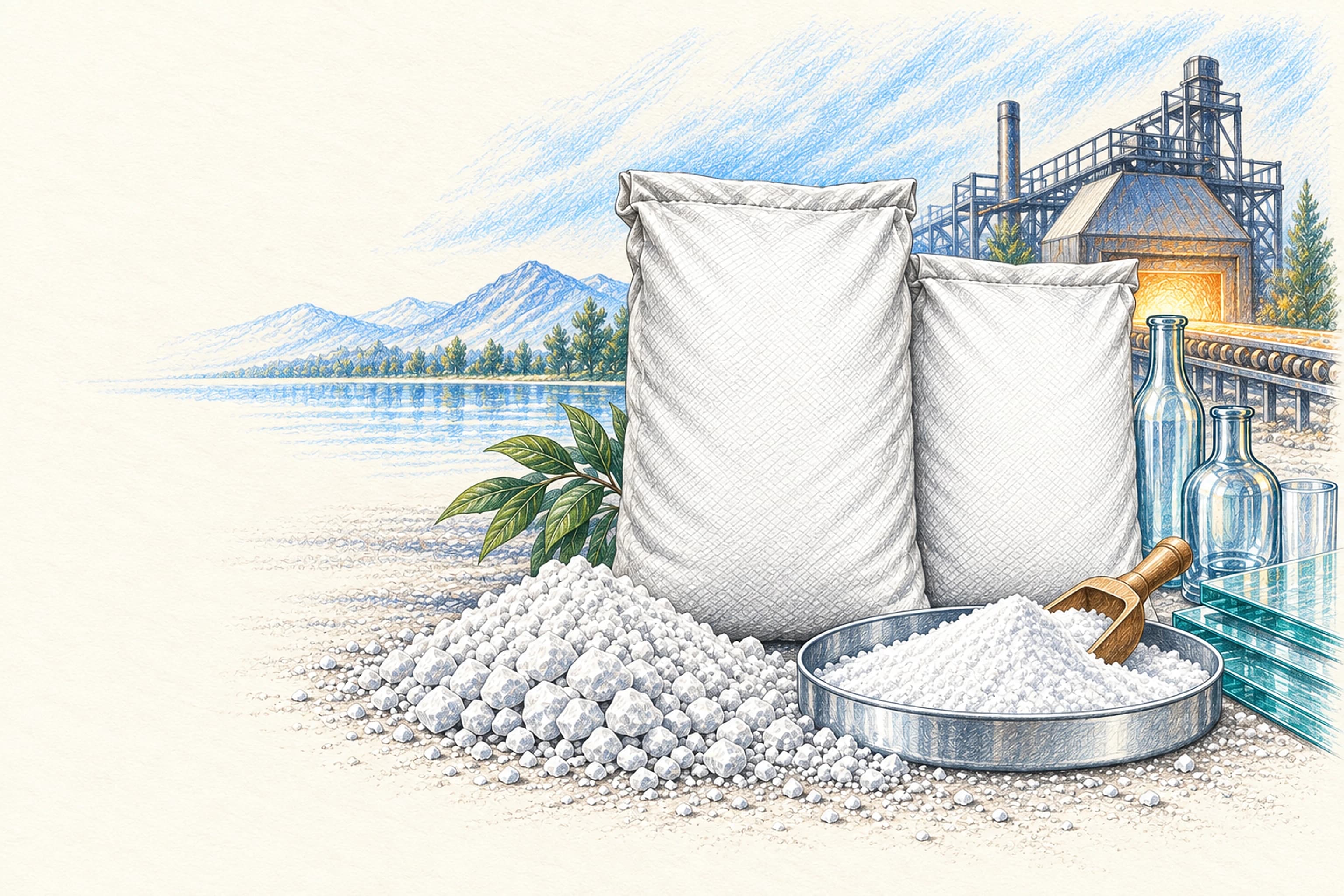
Glass making takes the largest share of the world's soda ash, and most glass plants use the dense grade. The light grade has its own set of users, generally those who dissolve the carbonate, react it in solution or blend it as a fine powder. This guide runs through the main applications, the role soda ash plays in each and the specification points that buyers in each sector tend to focus on.
Why some industries prefer the light grade
Light ash is anhydrous sodium carbonate with a fine, porous particle structure. It dissolves quickly, absorbs liquids and mixes evenly with other fine powders. Its drawbacks are dust, lower tonnage per container and a stronger tendency to cake if it gets damp. Industries that value fast dissolution or liquid carrying capacity accept those drawbacks; others pick dense ash.
Applications at a glance
| Industry | What soda ash does | Points buyers watch |
|---|---|---|
| Powder detergents and cleaners | Alkali, water softener, carrier for liquid surfactants | Absorptivity, iron, insolubles, particle size |
| Soap making | Alkali for neutralising fatty acids | Carbonate content, chloride |
| Sodium silicate and other sodium salts | Sodium source reacted with silica or acids | Iron, insolubles, consistent carbonate content |
| Textile processing | Alkali for scouring and for fixing reactive dyes | Purity, fast dissolution, low insolubles |
| Water treatment | Raises pH and alkalinity; precipitates hardness | Compliance with a water-treatment standard |
| Food processing | Acidity regulator and raising agent (E500) | Food-grade certification, heavy metal limits |
| Metallurgy and mineral processing | Flux and pH control | Carbonate content, sulphate |
Detergents and cleaners
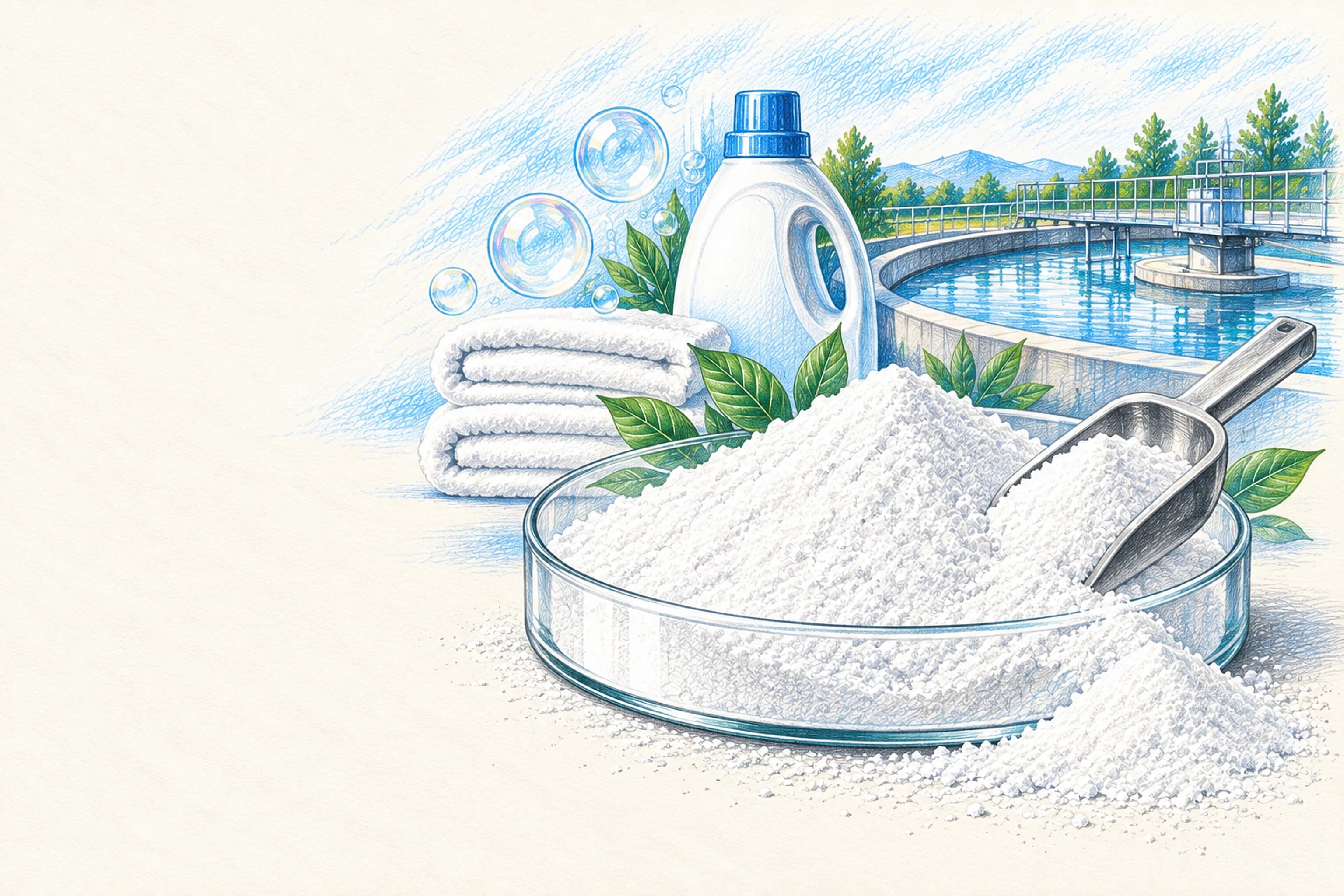
Powder detergents are the classic light ash market. Sodium carbonate supplies alkalinity that helps break down fatty soils, and its carbonate ions remove calcium and magnesium from hard water as insoluble carbonates. In dry-blended powders the porous light grade also absorbs nonionic surfactants and perfume so the finished powder stays free-flowing.
Chemicals made from soda ash
Soda ash is a basic raw material for many sodium compounds, including silicates, phosphates, bicarbonate and various sodium salts. Chemical plants that dissolve the ash before reaction often choose the light grade for its fast dissolving. Iron and insolubles are the usual concerns, since they carry through into the product or the filter cake.
Textiles
Dye houses use soda ash in scouring baths and, in reactive dyeing, as the alkali that makes the dye bond with cotton fibres. Consistency matters: a change in strength alters the bath pH and can affect shade. Light ash dissolves readily in the make-up tanks used in dye houses.
Water treatment
Treatment plants use soda ash to raise pH and alkalinity, to reduce the corrosiveness of soft water and to remove hardness by precipitation. Drinking water plants usually require compliance with a recognised standard, such as AWWA B201 or a national equivalent. Light ash suits plants that make up solutions in batches; dense ash suits plants with dry feeders designed for it.
Food uses
As food additive E500, sodium carbonate acts as an acidity regulator, raising agent and anticaking agent. It is used in alkaline noodle solutions and pretzel-style dips. Only food-grade material with the appropriate certification should be used, never technical grade.
Choose the light grade when your process benefits from fast dissolving or liquid absorption; otherwise dense ash is usually easier to ship and handle.
Matching supply to use
When you enquire, tell the supplier the end use as well as the grade. That allows the right certificates to be prepared: a standard CoA for technical uses, or compliance statements for water treatment and food. Nuroil supplies light soda ash for industrial users and provides a CoA with every delivery, with MSDS, certificate of origin and third-party inspection available on request. Send details through the quote request form, or see our soda ash page for the other grades.