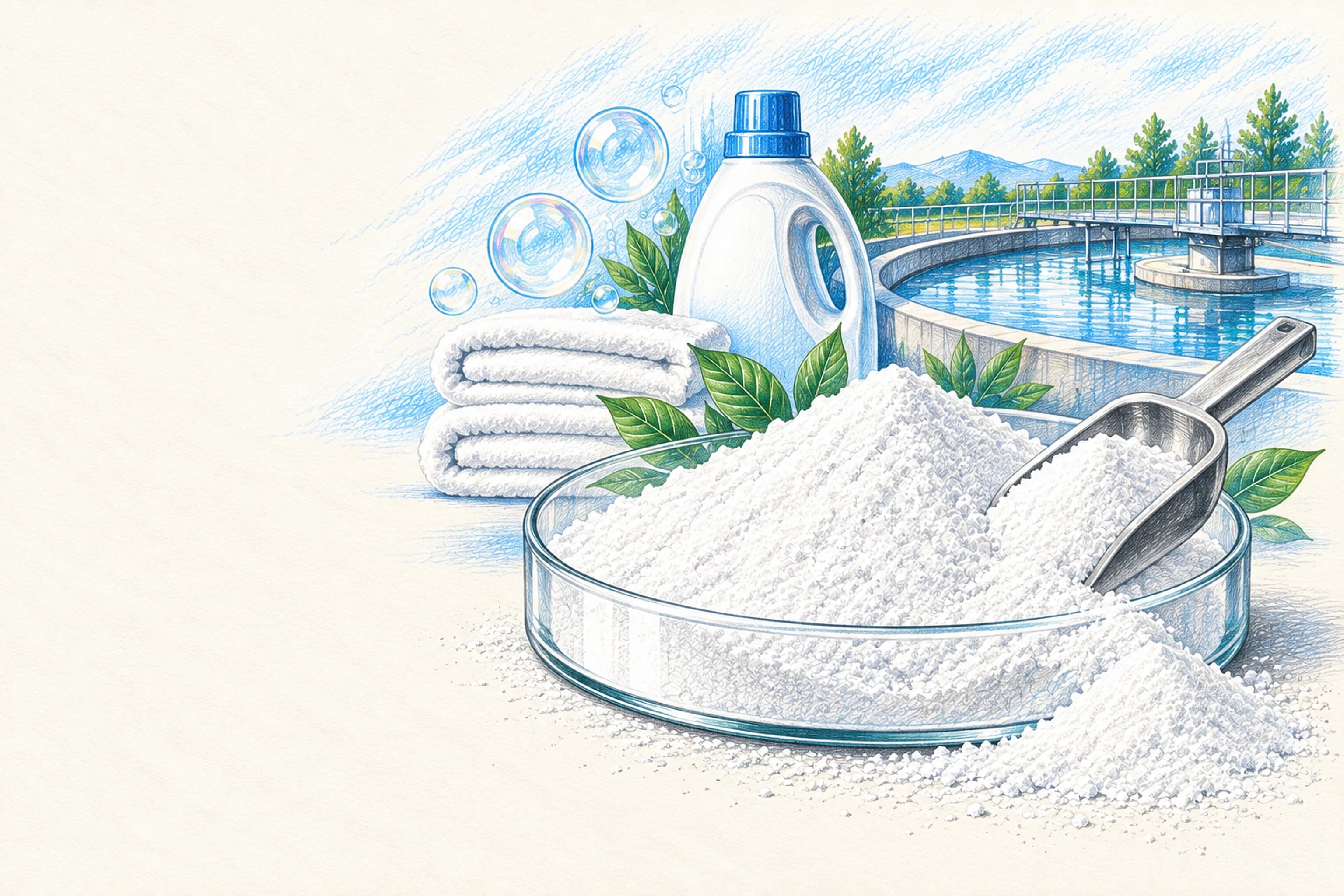
Most washing powders contain a large share of sodium carbonate. It supplies alkalinity, softens hard water and helps lift fatty soils. Chemically, light and dense soda ash are the same compound, so a formulator could in principle use either. In practice many powder plants, especially those that dry-blend rather than spray-dry, prefer the light grade. The reason lies in the shape and structure of the particles rather than in their chemistry.
Where light soda ash comes from
Light soda ash is the anhydrous carbonate made when sodium bicarbonate is heated, which is the final step of the synthetic ammonia-soda route. As the bicarbonate decomposes, carbon dioxide and water vapour escape from inside each crystal. What is left behind is a fine, porous particle with a low bulk density. Producers' data sheets typically put light ash at roughly 0.5 to 0.7 tonnes per cubic metre, while dense ash, made by converting light ash to the monohydrate and calcining again, sits at about 1 tonne per cubic metre or more.
That internal porosity is the useful part. Patent literature on dry detergent manufacture attributes the absorptive quality of low-density soda ash to the pore structure left by the escaping gas.
Why absorptivity matters in a powder plant
A dry-blending line mixes solid builders and fillers and then sprays liquid ingredients onto them. The liquids are usually nonionic surfactants, perfume and sometimes liquid optical brightener or acid-form surfactant that is neutralised in place. The solid carrier has to soak up these liquids and still flow freely out of the mixer, through the filling machine and out of the pack.
- Liquid loading. A porous carrier holds more liquid before the blend becomes sticky or lumpy.
- Heat-sensitive ingredients. Spray towers are poor at handling nonionics and perfumes, which can degrade or smoke at tower temperatures. Plants that spray-dry a base powder often post-dose these liquids onto light ash afterwards.
- Dissolving speed. The small, porous particles dissolve quickly in the wash, which helps hand-wash and cold-water products.
Producers express this property as absorptivity: the weight of a standard test liquid the ash can hold while staying free-flowing. If your formulation depends on it, ask for the figure and the test method on the specification, because it is not part of every standard certificate.
The trade-offs
Light ash is not perfect for every powder. Its fine particles are dusty, which matters for operator exposure and housekeeping. In a blend with coarser ingredients such as granulated sulphate or enzyme prills, fine light ash can separate during conveying and filling, so that the top and bottom of a carton differ in composition. Some manufacturers deal with this by using a medium-density ash or by agglomerating the blend. Others simply control mixing time and drop heights.
| Property | Light soda ash | Dense soda ash |
|---|---|---|
| Typical bulk density | About 0.5 to 0.7 t/m³ | About 1.0 t/m³ or more |
| Particle structure | Fine and porous | Coarser, more compact |
| Liquid absorption | High | Low |
| Dissolving speed | Fast | Slower |
| Dusting and segregation risk | Higher | Lower |
In a dry-blended powder, light soda ash works as both the alkali and the sponge that carries the liquid ingredients.
Quality points detergent buyers watch
Beyond sodium carbonate content, detergent plants usually look at iron, because it can tint white powders, and at water-insoluble matter, which can leave residue on fabric. Sodium chloride and sulphate are usually low in good-quality ash and rarely cause problems in detergents. Moisture pick-up matters too: light ash that has absorbed water in storage will have partly converted to hydrate, lost some of its absorptivity and started to cake.
What to put in an enquiry
When requesting light soda ash for detergent use, state that you need the light grade, your required sodium carbonate minimum, and any limits on iron and insolubles. If absorptivity or particle size matters to your line, ask for these on the specification and the Certificate of Analysis. Nuroil supplies light soda ash with a CoA for every delivery, with MSDS and certificate of origin on request. Send your requirements through the quote request form.