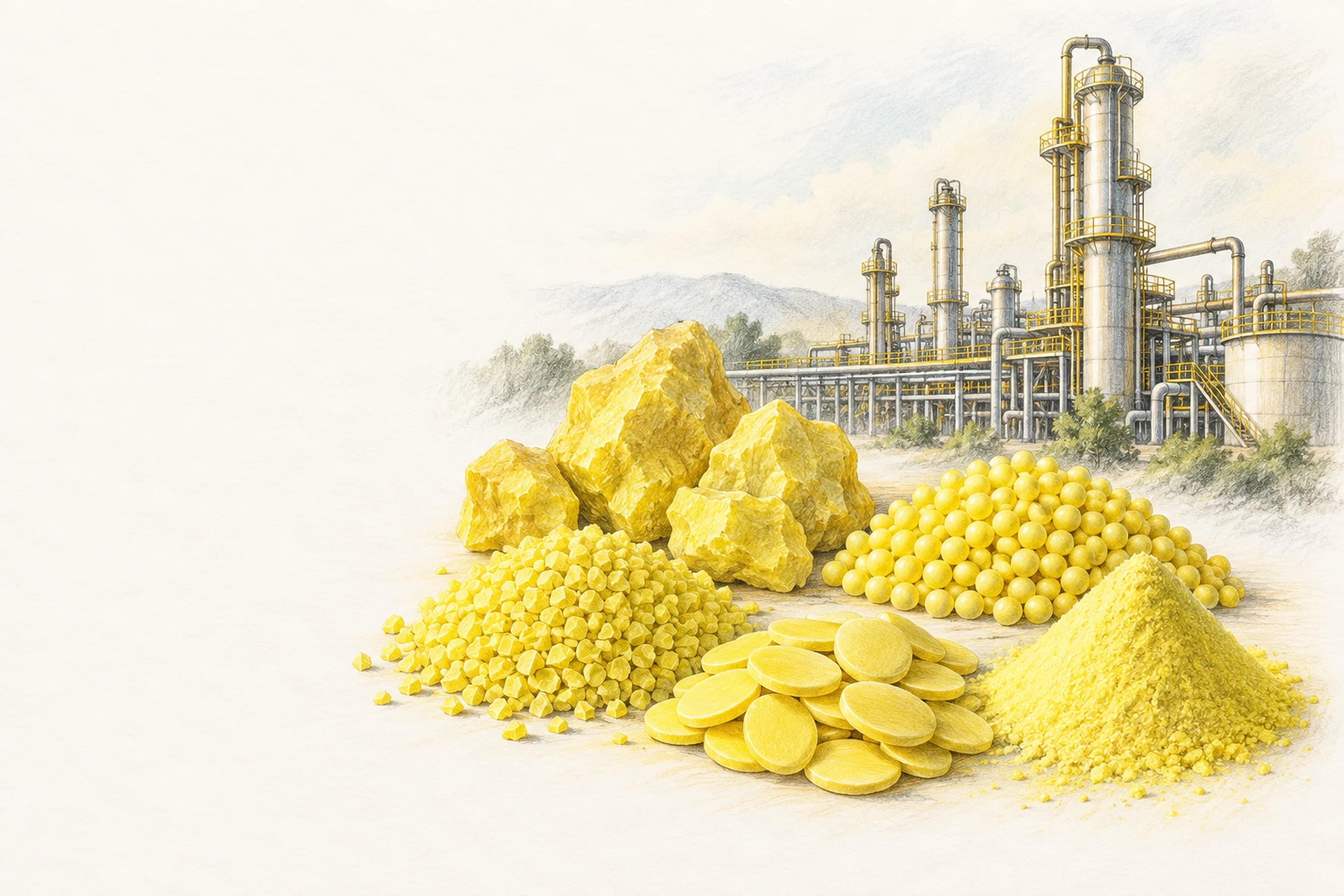
Prilled sulphur is made by turning molten sulphur into droplets and letting them freeze into small, roughly round beads. The idea was borrowed from fertilizer prilling, and it gives a product that flows, stacks and loads far more easily than broken lumps. How the droplets are cooled, by water or by air, shapes almost everything about the final prill.
The basic principle
Liquid sulphur, held just above its melting point of about 115 to 119 °C, is pushed through a perforated plate, nozzle or spinning bucket. The stream breaks into droplets, which fall through a cooling medium. As they cool, they solidify from the outside in, forming a shell around a still-liquid core that then freezes. The size of the holes, the flow rate and the liquid temperature control the droplet size.
Water prilling
In water prilling, droplets fall a short distance into a tank or channel of water, which quenches them almost instantly. The prills are then drained, often on screens or by dewatering conveyors, and sent to stockpile.
- Advantages: low capital cost, compact equipment and simple operation. It is the most common way sulphur has been prilled.
- Drawbacks: the product carries water. Rapid quenching can also trap moisture in pores and create less uniform shapes, and in some cases hollow or irregular prills. Wet prills can contain several per cent water.
Moisture matters because water on sulphur slowly forms acid, which corrodes steel conveyors, rail wagons and ship holds, and can lead to iron sulphide deposits that may self-heat. Under the SUDIC quality criteria, wet prills fall short of the premium specification on moisture and are generally classed as a standard-quality product.
Air prilling
In air prilling, molten sulphur is sprayed at the top of a tall tower, often around 60 metres high, and the droplets fall against rising cool air. The drop height is calculated so that each prill is solid enough to survive landing at the bottom.
- Advantages: a dry, free-flowing prill with a smooth surface and a fairly narrow size range.
- Drawbacks: very high capital cost and, historically, serious fire risk. In the 1980s several air prilling towers suffered fires when static electricity ignited sulphur dust inside them, and the process was largely abandoned in favour of granulation and pastillation. Newer designs use closed nitrogen loops and dust scrubbing to address this.
Comparing the routes
| Feature | Water prilling | Air prilling |
|---|---|---|
| Cooling medium | Water bath | Rising air in a tall tower |
| Plant cost and size | Lower, compact | High, tall structure |
| Product moisture | Wet unless dried | Dry |
| Shape and surface | Less uniform, may be porous | Smooth and round |
| Main operating concern | Water treatment, acidic run-off | Dust and static ignition |
Prills compared with other formed sulphur
Granulation, where layers of sulphur build up on seed particles in a rotating drum, and pastillation, where drops are deposited on a cooled steel belt, now account for much formed sulphur. Both can meet premium criteria for moisture and dust. Improved wet prilling processes also exist that aim for more uniform, denser prills with fewer fines. When a supplier offers prilled sulphur, it helps to know which process made it.
Two products both called prilled sulphur can behave very differently. Ask how they were made and what their moisture and fines content is.
For a melter, the forming route matters mainly through moisture and fines. For a fertilizer plant or a site that handles the prills several times, shape and strength matter more, because weak prills turn to dust on the way to the process.
What to ask your supplier
Ask about the forming process, typical size range, moisture, fines and friability, and request a CoA for each lot. Nuroil supplies prilled sulphur from established producers, with a CoA on every delivery; you can request a quote or contact us for details.