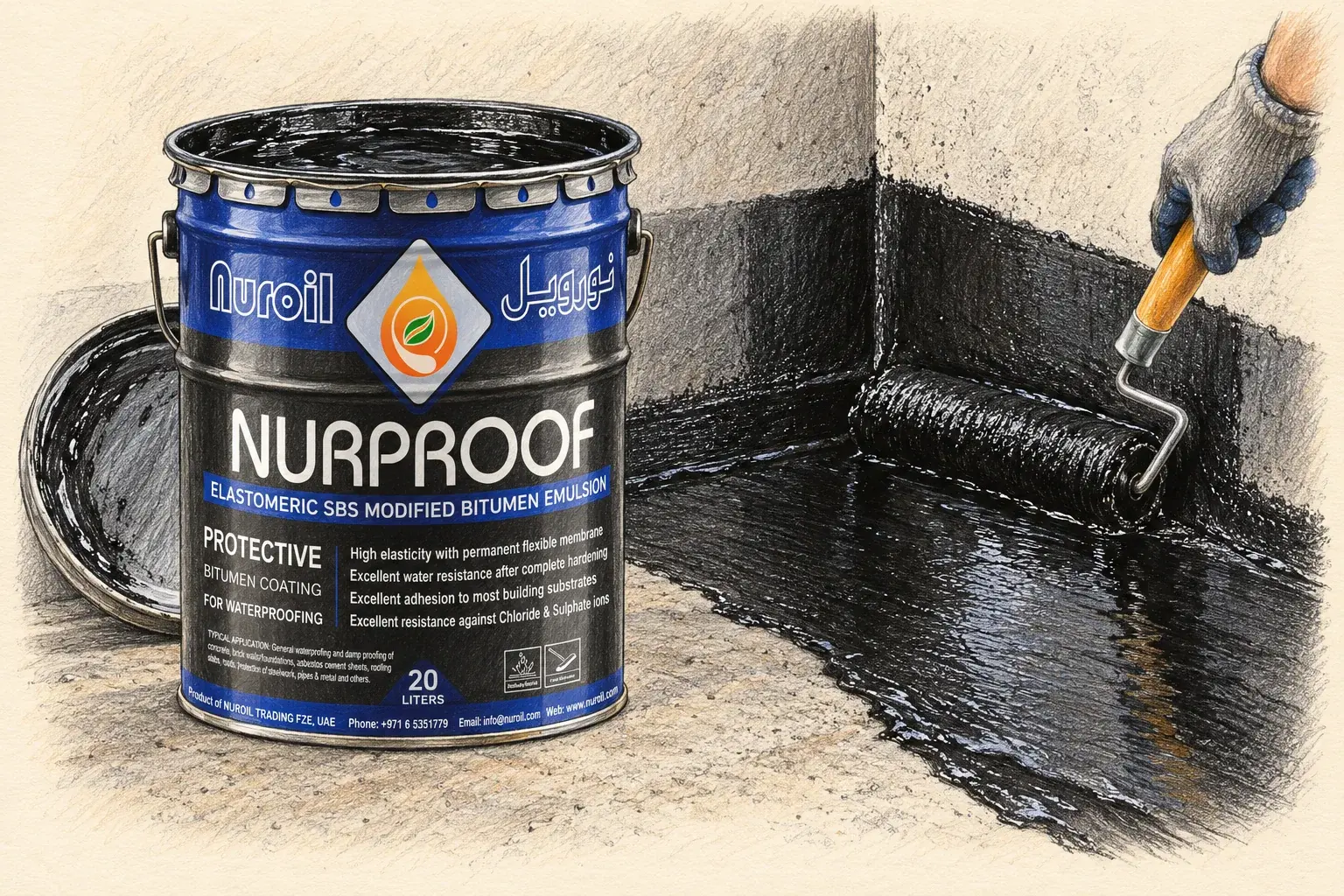
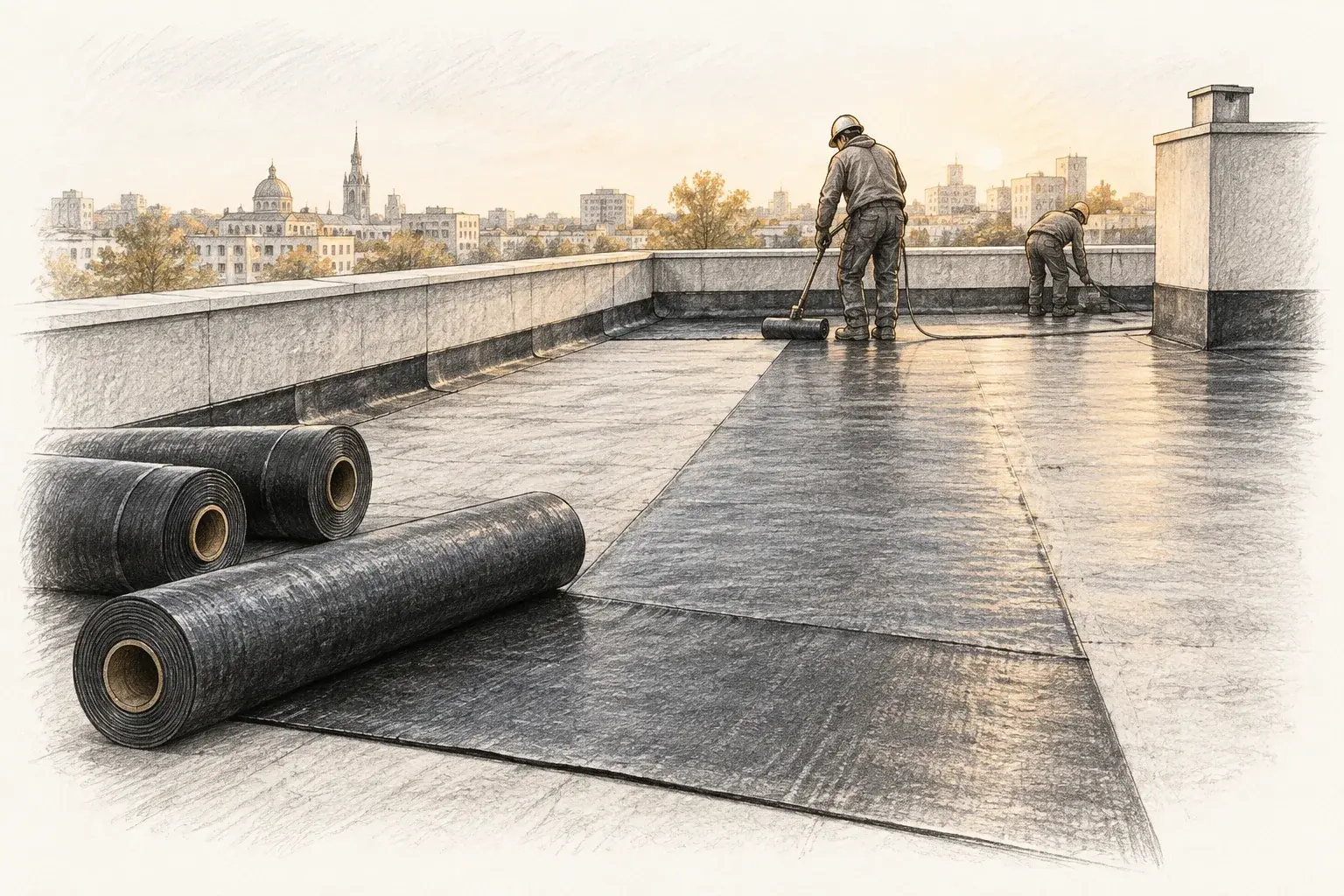
Plain bitumen is a good waterproofer but a poor elastic material. It is brittle when cold, soft when hot, and a thin film of it cracks when the surface underneath moves. Elastomeric bitumen coatings solve this by blending in a rubber, most often SBS (styrene-butadiene-styrene). Understanding what the rubber does helps buyers judge which product suits which job.
What SBS is
SBS is a thermoplastic elastomer. Its molecules are chains with hard polystyrene blocks at each end and a soft, rubbery polybutadiene block in the middle. At normal temperatures the polystyrene ends cluster together into tiny hard domains, which act like anchor points tying the chains into a network. The rubbery middle sections between those anchors can stretch and spring back. When heated well above service temperatures, the hard domains soften, which is why SBS can be blended into hot bitumen in the first place.
What happens when it is added to bitumen
At the right dosage, the SBS swells with the lighter oils in the bitumen and forms a continuous rubbery network through the binder. The result behaves less like a thick liquid and more like a rubber:
- Better cold flexibility. The film can bend at lower temperatures without cracking.
- Higher softening point. The film resists flowing on vertical surfaces in heat.
- Elastic recovery. When stretched over a moving crack, the film pulls back rather than staying thinned.
- Crack bridging. The film can span hairline and small shrinkage cracks that open after application.
How it gets into a liquid coating
Liquid-applied SBS bitumen coatings come in two main forms. Water-based products are bitumen emulsions in which SBS (or another rubber latex) is either pre-blended into the bitumen or added as a latex; they dry as the water evaporates and the droplets join into a continuous rubberised film. Solvent-based products dissolve SBS-modified bitumen in a solvent; they dry as the solvent evaporates. Water-based types are easier to handle indoors and in confined spaces; solvent-based types dry faster in cool or damp conditions but need fire and ventilation precautions.
What the rubber cannot do
SBS improves the film but does not make it a substitute for good design. Elastic coatings bridge small cracks, not structural joints that move many millimetres; those need a joint detail or a reinforced membrane. The coating is only as good as its thickness, so a thin coat of a high-rubber product can underperform a correctly built thick coat of a simpler one. Most SBS bitumen coatings are also not intended for permanent UV exposure, since sunlight slowly ages the butadiene part of the rubber; they work best when covered by soil, screed, tiles or a reflective topcoat.
| Property | Unmodified bitumen coating | SBS-modified coating |
|---|---|---|
| Cold flexibility | Becomes brittle | Stays flexible to lower temperatures |
| Hot-weather sag | More prone | Better resistance |
| Crack bridging | Limited | Bridges small cracks |
| Elastic recovery | Little | Recovers after stretching |
How performance is measured
For polymer modified bituminous thick coatings used below ground, the European standard EN 15814 sets requirements, with crack bridging tested to EN 15812 and other properties to companion standards. Product data sheets may also give elongation at break, solids content and drying times. Ask for those numbers rather than relying on words such as elastic or flexible. Check also the dry film thickness at which each result was obtained, because a crack bridging or elongation figure measured on a thick film says little about a thin one applied on site.
Buying an SBS coating
When enquiring, state whether you need a water-based or solvent-based product, the intended use (foundations, wet areas, roofs under covering) and the target dry film thickness. Ask for the data sheet, safety data sheet and a certificate of analysis for the batch. Nuroil supplies elastomeric SBS bitumen coating with those documents; send your requirements via request a quote.