A technical data sheet for a fibre glass reinforced bitumen membrane can list a dozen test results with standard numbers attached. They are not all equally important for every job, and the way values are declared varies between producers. This guide explains the common entries, mostly referring to the European test methods that most data sheets use, and what to look for in each.
Identity and build-up
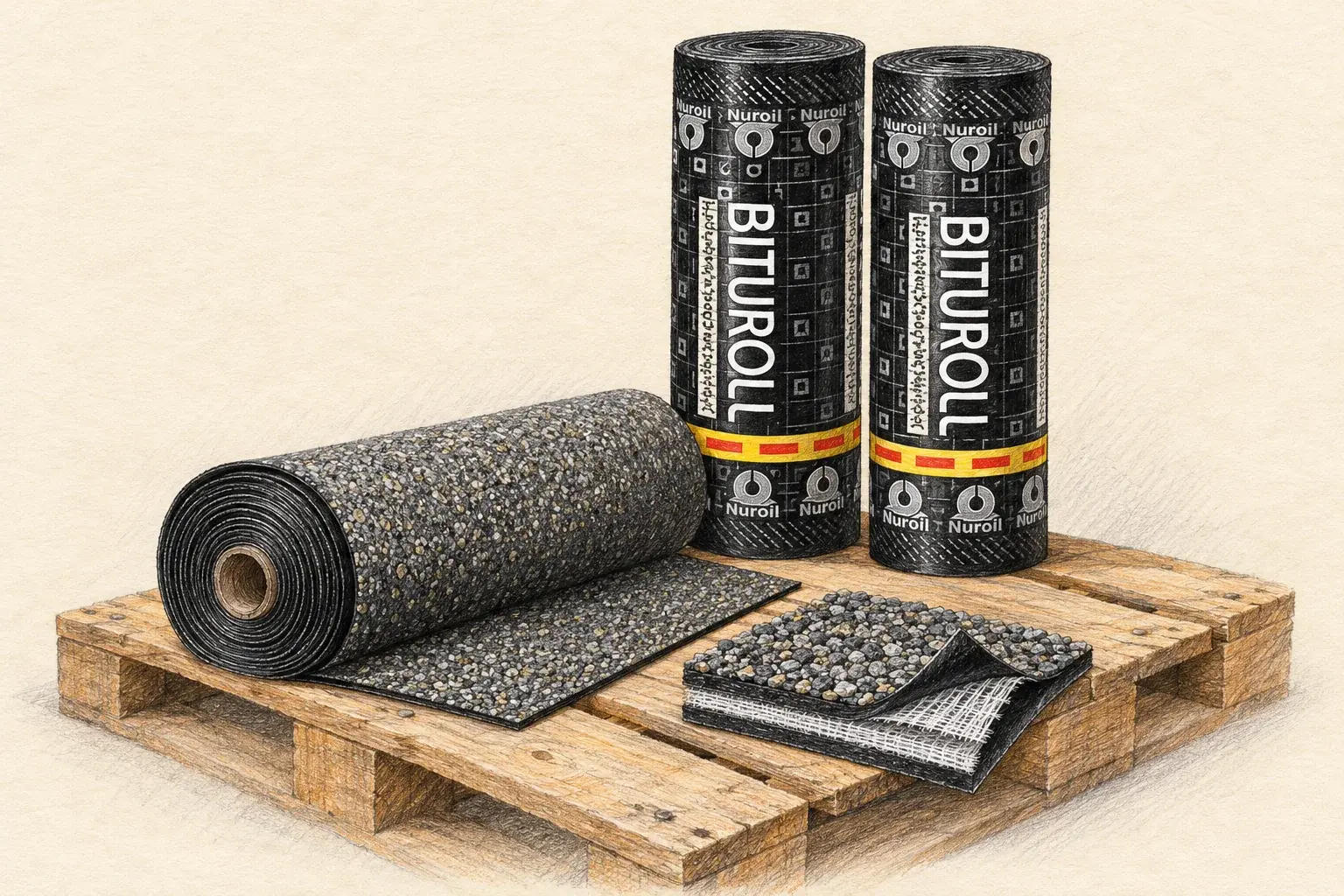
The first lines describe what the sheet is: the compound (oxidised bitumen, SBS or APP modified), the carrier (glass fleece, glass mat with threads, or glass scrim), the top and bottom finishes (sand, polyethylene film, slate or mineral granules) and the nominal thickness or mass per unit area. Thickness and mass are measured to EN 1849-1. For torch-applied sheets, thickness is the usual basis of comparison; for some base sheets, mass per square metre is quoted instead. In North America, glass-reinforced SBS sheets are described under ASTM D6163, which sets minimum properties for smooth and granule-surfaced grades.
Main performance values
| Value | Common test method | What it tells you |
|---|---|---|
| Thickness / mass per area | EN 1849-1 | How much compound you are buying; link to durability |
| Tensile strength (length and cross) | EN 12311-1 | Force the sheet carries before breaking, in N/50 mm |
| Elongation at maximum force | EN 12311-1 | Stretch before failure; low for glass carriers |
| Tear resistance (nail shank) | EN 12310-1 | Resistance to tearing at fixings |
| Low-temperature flexibility | EN 1109 | Coldest temperature at which the sheet bends without cracking |
| Flow resistance at elevated temperature | EN 1110 | Highest temperature before compound slides on a slope |
| Dimensional stability | EN 1107-1 | Shrinkage or growth after heating; a strength of glass carriers |
| Watertightness | EN 1928 | Pass or fail under set water pressure |
Reading tensile and elongation figures
Tensile strength is quoted separately for the length (machine) and cross direction because carriers are often stronger along the roll. Glass-reinforced vapour control and base sheets commonly declare a few hundred newtons per 50 mm with elongation of only around 2%. Polyester-reinforced cap sheets, by comparison, often declare 500 N/50 mm or more and elongation of 30–50%. A glass sheet will never match polyester on elongation; compare glass sheets with other glass sheets.
Watch how values are declared. Some producers give a nominal value with a tolerance (for example 400 ± 100), others a minimum, others a minimum and maximum band. Convert them to the same basis before comparing.
Low and high temperature limits
Low-temperature flexibility and flow resistance together show the working temperature window of the compound. Oxidised compounds have a narrower window than SBS compounds, which stay flexible at lower temperatures. In hot climates the flow resistance figure is important: a roof surface in summer sun runs far hotter than the air, so a compound with a low flow temperature can creep at upstands. These values depend on the compound, not the glass carrier, so a glass sheet with an SBS compound can perform well at both ends.
Dimensional stability
This is where glass-reinforced sheets stand out. EN 1107-1 heats a sample and measures the change in length. Studies comparing reinforcements found glass-reinforced sheets far more stable than polyester ones. A low figure here means the sheet stays flat when torched and under sun, which is why glass is preferred for base layers and underlays.
Watertightness and other entries
Watertightness is usually a simple pass at a stated pressure. Other entries you may see include peel and shear resistance of joints, resistance to impact and static load, fire classification for external roof exposure, and root resistance for green roofs. Ask which apply to your project rather than assuming they are covered.
Using the data sheet in purchasing
In an enquiry, give your required values (or the project specification) and ask the supplier to confirm the product meets each one. Ask for the data sheet, a certificate of analysis or test certificate for the batch, and the declaration of performance where the product is CE marked. Nuroil supplies fibre glass reinforced membrane with a certificate of analysis on every delivery and third-party inspection on request through request a quote.